
News Centre
News Type
Send your inquiry
PPS Hydrolysis Resistance: Hot Water Pump Materials
PPS Hydrolysis Resistance Defeats Hot Water Attack
Hot water destroys many engineering plastics slowly but surely. The chemical process, called hydrolysis, breaks polymer chains when heat and moisture act together. Nylon gears swell, polyester parts lose strength, and even some high-performance resins degrade over time. PPS hydrolysis resistance comes from its rigid aromatic structure, which gives water molecules few points of attack. That stability makes polyphenylene sulfide the default material for parts that live in hot water.
In addition, the crystallinity of PPS blocks water penetration effectively. Highly crystalline regions leave little free volume for moisture to enter. Therefore, the polymer resists the swelling that weakens other resins. This structure explains the long service life in wet parts.
Consider a circulation pump impeller running at 80 degrees Celsius for years. A PA66 impeller can lose a large share of its tensile strength through hydrolysis and soften in service. A PPS impeller, in contrast, holds its dimensions and strength because the polymer chain simply does not react with water. For the same reason, PPS appears in water heaters, coffee machines, and industrial valves where reliability matters.
How PPS Resists Steam and Boiling Water
The chemical structure explains the performance. PPS consists of para-substituted benzene rings linked by sulfur atoms. This arrangement is highly crystalline and hydrophobic, so water uptake stays below 0.05 percent. Furthermore, the bonds resist nucleophilic attack by water even at elevated temperature. As a result, PPS parts survive boiling water and pressurized steam far longer than aliphatic polymers such as nylon or PET.
Moreover, surface quality influences hydrolysis resistance in service. A smooth machined surface offers fewer initiation sites for attack. In contrast, rough or cracked surfaces let water reach deeper layers. Finishing the part properly is therefore part of the design.
Testing confirms the behavior. Glass-filled PPS retains most of its mechanical strength after thousands of hours in water at 90 to 100 degrees Celsius. Even superheated water and steam at 130 to 150 degrees cause limited degradation compared with other thermoplastics. Therefore, engineers use PPS hydrolysis resistance as the benchmark when comparing materials for hot water meter housings, pump volutes, and dishwasher internals.
Choosing the Right PPS Grade for Wet Service
Most hot water components use glass-reinforced PPS. A 40 percent glass-filled grade offers flexural modulus around 14,000 MPa and continuous service temperature near 220 degrees Celsius. However, the glass fiber surface must be properly coupled to the resin, otherwise water attacks the interface. Therefore, buyers should specify grades designed for hydrolysis resistance, not general-purpose molding compounds.
For example, hot water meters often run for twenty years without maintenance. A PPS measuring chamber keeps its geometry throughout that period. Meanwhile, alternative materials may warp and cause measurement drift. Utilities specify PPS for exactly this reason.
Unfilled and mineral-filled PPS also appear in wet applications where lower warpage or better weld strength is needed. Meanwhile, impact-modified PPS trades some stiffness for toughness in snap-fit housings. In addition, lubricated PPS grades suit pump bushings that run submerged. Each grade choice changes the balance of strength, creep, and wear, so the duty cycle should be defined before material selection.
Moreover, water hammer and pressure spikes add dynamic load to wet-service parts. For example, a pump that starts and stops often needs thicker sections than steady flow suggests.
Machining PPS Components for Pumps and Valves
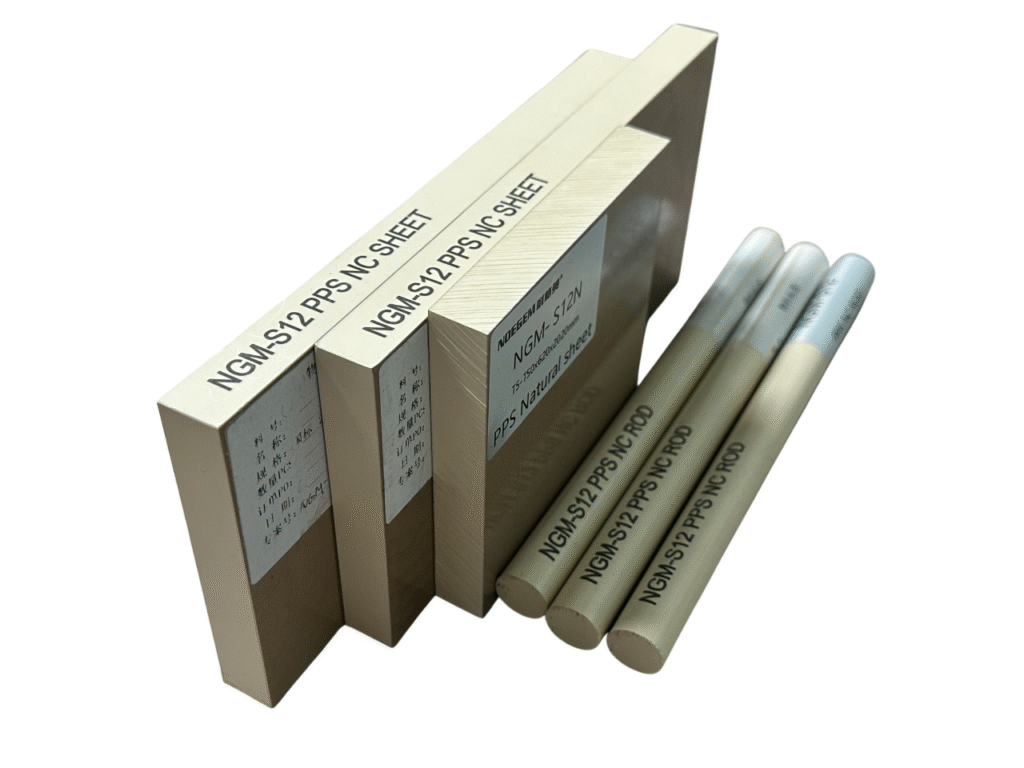
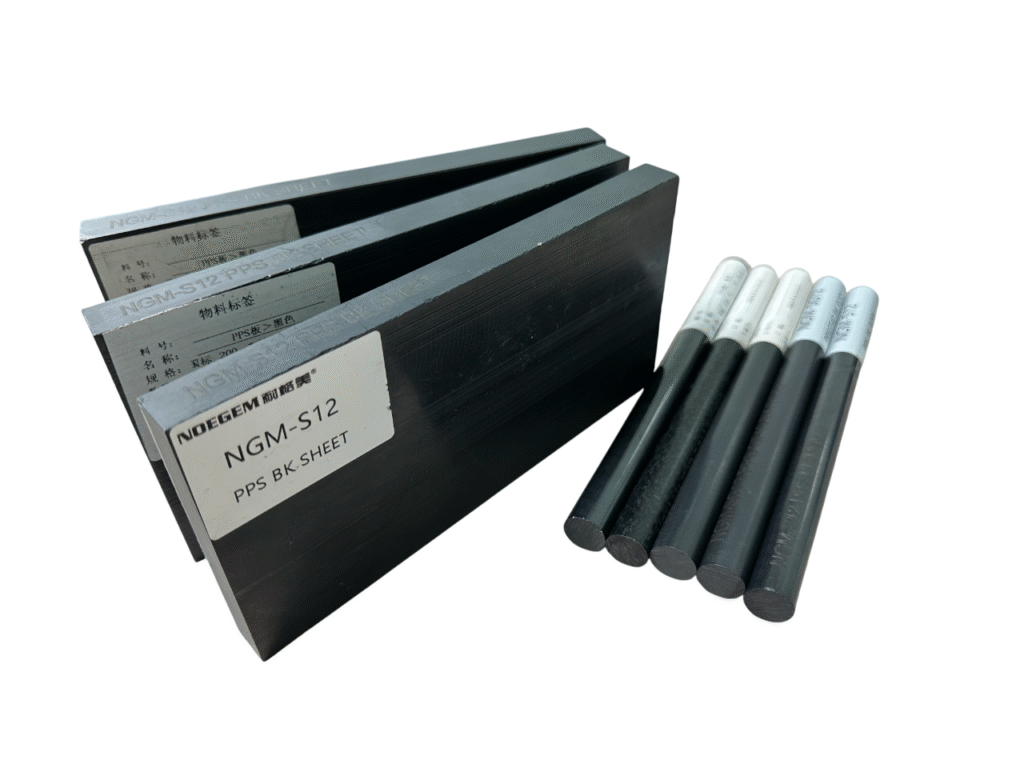
Prototype and replacement parts often come from PPS stock rather than injection molding. PPS sheet and rod machine into impellers, seats, sleeves, and housings with tight tolerances. Because PPS is stiff and slightly abrasive, machinists use carbide tooling and rigid setups. Furthermore, parts should be annealed after machining to relieve surface stress that could later interact with hot water.
Furthermore, NAGOMER stocks PPS in several glass loadings. This lets designers match stiffness to the actual pressure rating. As a result, a prototype can be machined and tested before molding tooling exists. Engineering support is available during selection.
Sealing faces need special care. A valve seat machined from PPS must be flat and smooth to close leak-free over many cycles. In addition, the material’s low moisture uptake keeps critical clearances stable, which prevents a pump shaft seal from binding or leaking. NAGOMER supplies PPS sheet and rod in glass-filled and unfilled grades, with dimensional data for engineers designing wet-service components.
Real-World Applications of PPS in Water Systems
Central heating pumps use PPS impellers and housings because the whole assembly runs hot for decades. Domestic water meters employ PPS gears and measuring chambers that resist scaling and hydrolysis. Furthermore, commercial coffee machines heat water to 90 degrees daily; their brew groups and valves use PPS for the same reason. Industrial ball valves and butterfly valve seats also rely on PPS hydrolysis resistance in hot process lines.
When an application demands both heat and chemical resistance, PPS often outranks PA, POM, and even some more expensive resins. NAGOMER Engineering Plastics, nagomer.com, advises customers on PPS grade selection and supplies certified sheet and rod for pump and valve manufacturers across the world.
Designing a part that lives in hot water? NAGOMER supplies PPS sheet and rod engineered for hydrolysis resistance. Contact info@nagomer.com for grade data.