
News Centre
News Type
Send your inquiry

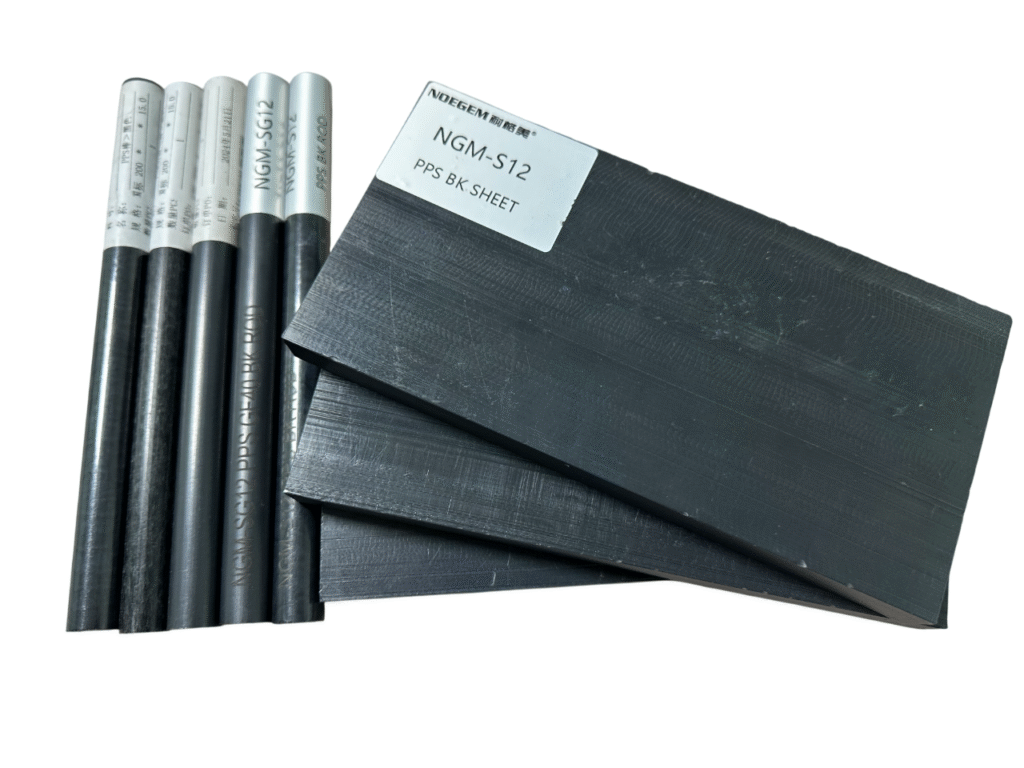
PPS GF40 Sheet: Glass-Filled PPS Properties & Industrial Applications
Technical Properties
Mechanical Properties
Property | Value | Standard |
Tensile strength | 150 MPa | ISO 527 |
Tensile modulus | 12 GPa | ISO 527 |
Flexural strength | 210 MPa | ISO 178 |
Flexural modulus | 14 GPa | ISO 178 |
Impact strength (Charpy, notched) | 10 kJ/m² | ISO 179 |
Compressive strength | 180 MPa | ISO 604 |
Hardness (Rockwell) | R121 | ASTM D785 |
Thermal Properties
Property | Value |
Continuous service temperature | 200°C |
Short-term max temperature | 240°C |
HDT (1.8 MPa) | 260°C |
Thermal conductivity | 0.29 W/m·K |
CLTE (linear expansion) | 2.5 × 10⁻⁵ /°C |
Physical Properties
Property | Value |
Density | 1.66 g/cm³ |
Water absorption 24h | 0.02% |
Mould shrinkage | 0.2–0.5% |
Advantages of PPS GF40
Dimensional Stability
The combination of PPS’s inherent low moisture absorption (0.02% at 24h) and glass fibre reinforcement gives PPS GF40 exceptional dimensional stability — better than PA66, POM, and even unfilled PEEK. This makes it ideal for precision components that must maintain tight tolerances in varying environmental conditions.
Chemical Resistance
PPS is chemically inert to virtually all common solvents, acids, and bases below 200°C. Glass-filled grades retain this chemical resistance while adding structural performance. Only concentrated nitric acid and some strong oxidisers attack PPS at elevated temperatures.
High Temperature Performance
With a continuous service temperature of 200°C and HDT of 260°C, PPS GF40 operates in temperature zones where POM and PA66 cannot survive. This covers automotive under-hood, industrial heating, and chemical processing applications.
Cost vs PEEK
PPS GF40 costs approximately 60–70% less than PEEK while delivering comparable temperature and chemical resistance. For structural applications under 200°C, PPS GF40 is often the better economic choice.
Industrial Applications
Automotive Under-Hood
· Throttle body housings — resistance to hot fuel vapours
· Water pump impellers — coolant temperature resistance
· Sensor housings — electronic protection at engine temperatures
· Exhaust gas recirculation components — high-temperature stability
Electronics & Electrical
· Connector bodies — high-temperature SMT processing
· Coil bobbins — electrical insulation at elevated temperatures
· Relay housings — arc resistance and dimensional stability
· LED reflector cups — thermal stability and surface finish
Chemical Processing
· Pump housings — chemical resistance
· Valve bodies — corrosion-free alternative to metal
· Heat exchanger plates — thermal and chemical performance
· Filter housings — chemical compatibility
Industrial Equipment
· Compressor components — hot gas and oil resistance
· Boiler parts — continuous high temperature
· Drying equipment — hot air exposure
· Conveyor components — wear and heat resistance
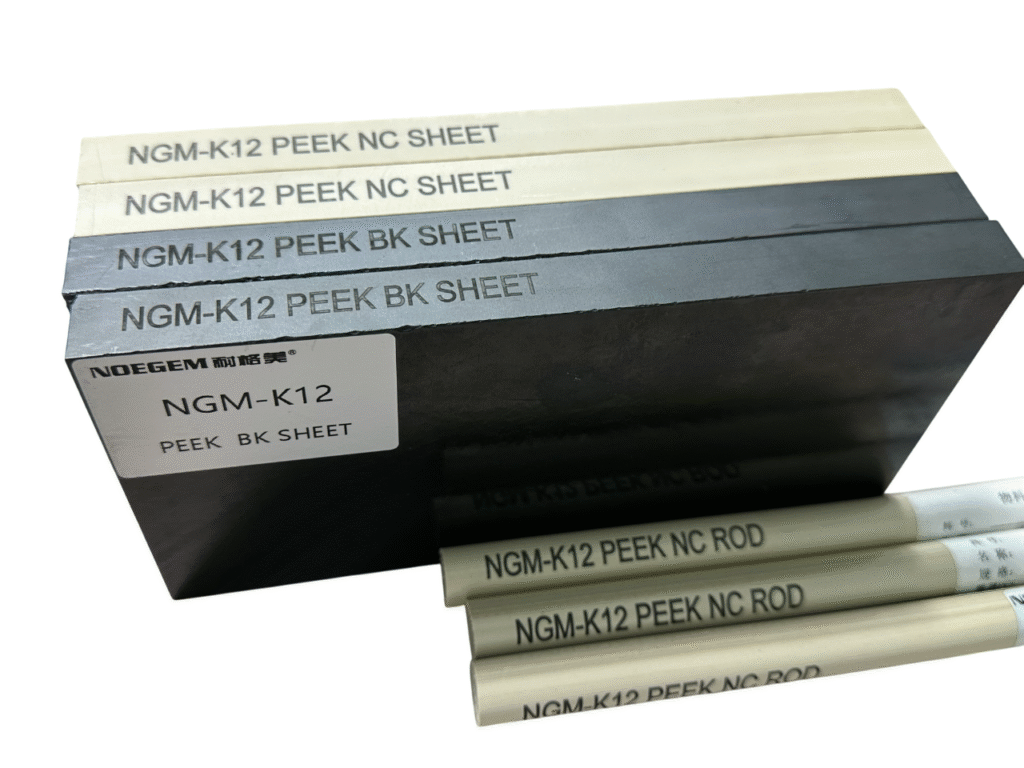
For comparison with PEEK, see our PPS GF40 vs PEEK guide. For material overview, read our Engineering Plastics Overview.
FAQ
Q1: What is the maximum operating temperature of PPS GF40?
PPS GF40 has a continuous service temperature of 200°C and can withstand short-term exposure up to 240°C. Its heat deflection temperature (HDT) at 1.8 MPa is 260°C, making it suitable for high-temperature structural applications.
Q2: Is PPS GF40 chemically resistant?
Yes, PPS GF40 has excellent chemical resistance. It is inert to virtually all common solvents, acids, and bases below 200°C. Only concentrated nitric acid, strong oxidizers, and some amines at high temperatures can attack PPS.
Q3: How does PPS GF40 compare to PEEK in cost?
PPS GF40 typically costs 60–70% less than PEEK while offering comparable temperature and chemical resistance. However, PEEK has higher mechanical strength, better wear resistance, and FDA compliance that PPS lacks. PPS GF40 is the better choice for cost-sensitive structural applications under 200°C.
Q4: Can PPS GF40 sheets be machined?
Yes, PPS GF40 can be CNC machined, but the glass fibre reinforcement causes rapid tool wear. Use carbide or polycrystalline diamond (PCD) tools with moderate cutting speeds and good dust extraction. Achievable tolerances are ±0.1mm.
Need PPS GF40 sheets for your application? Contact NAGOMER for technical data and pricing, or explore our PPS products and PEEK alternatives.
NAGOMER — Professional Engineering Plastics Solutions
www.nagomer.com | info@nagomer.com