
News Centre
News Type
Send your inquiry

PPS Automotive Applications: Under-Hood Component Guide
The Under-Hood Heat Challenge
The space beneath a vehicle hood ranks among the harshest environments for any engineering material. Continuous operating temperatures reach 120 to 150 degrees Celsius, with transient peaks near exhaust manifolds hitting 180 degrees or higher. Engine oil, transmission fluid, coolant, brake fluid, and road salt create a chemical cocktail that degrades most plastics within months. Vibration, thermal cycling, and mechanical stress add further demands. PPS automotive applications address all of these challenges in a single material.
Furthermore, polyphenylene sulfide offers continuous service temperatures up to 220 degrees Celsius with minimal property loss. The semicrystalline structure provides chemical resistance to automotive fluids that would dissolve or swell amorphous plastics. In addition, PPS absorbs less than 0.02 percent moisture, meaning dimensional stability remains excellent even in humid environments. Moreover, the material meets flame retardancy standards without additives, satisfying fire safety requirements for engine compartment components. Consequently, automotive engineers can consolidate multiple metal components into a single PPS part, reducing assembly complexity and weight simultaneously.
PPS Automotive Applications in Fuel Systems
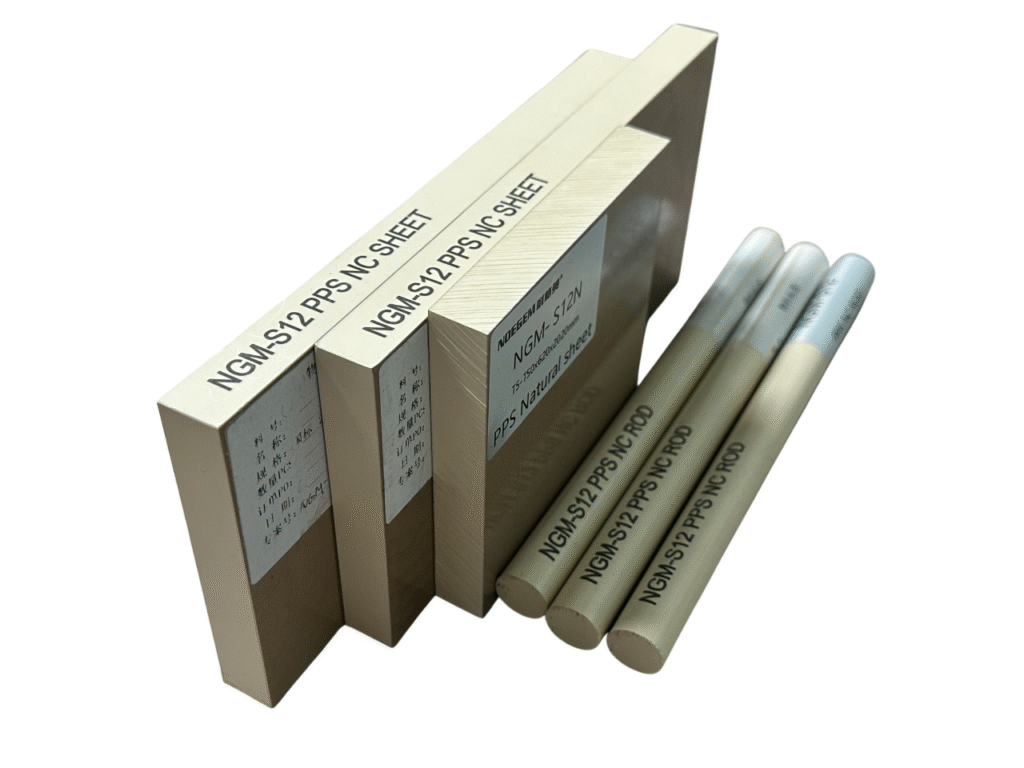
Fuel system components represent one of the largest PPS automotive applications. Fuel pump housings, fuel rail insulators, fuel sender modules, and throttle body components all rely on PPS for its resistance to gasoline, ethanol blends, and diesel fuel. Glass-filled PPS grades provide the structural stiffness needed for pressure-containing parts, with flexural modulus exceeding 12,000 MPa. NAGOMER supplies glass-filled PPS (NAGOMER SG12B) in sheets and rods for machining prototype and low-volume fuel system components.
The transition to ethanol-blended fuels has actually increased PPS adoption. However, standard nylons absorb ethanol and swell, causing dimensional changes that affect sealing performance. Moreover, PPS shows no measurable swelling in E85 fuel after 1,000 hours of immersion at 60 degrees Celsius. Furthermore, PPS fuel system components meet SAE J30 and SAE J2044 standards for fuel contact and pressure cycling. Therefore, this combination of chemical stability and regulatory compliance makes PPS the preferred material for next-generation fuel system design across the automotive industry.
Sensor Housings for Thermal Cycling
Modern engines pack an increasing number of sensors into the under-hood environment. Temperature sensors, pressure sensors, oxygen sensors, and knock sensors all need housings that survive thermal cycling and chemical exposure. PPS provides the dimensional stability these precision components require. Its low coefficient of thermal expansion of 20 to 30 ppm per degree Celsius ensures that sensor mounting features maintain alignment across the full operating temperature range.
For instance, coolant temperature sensor housings machined from PPS maintain tight tolerances after thousands of thermal cycles from minus 40 to 130 degrees Celsius. The material also provides excellent electrical insulation, with dielectric strength above 18 kV per millimeter. Additionally, PPS inherently meets UL94 V-0 flame retardancy without additives, satisfying fire safety requirements for engine compartment electronics. Furthermore, thermostat housings, EGR valve bodies, and intake manifold runners also use glass-filled PPS for structural and thermal performance in production vehicles.
PPS in EV Battery Systems
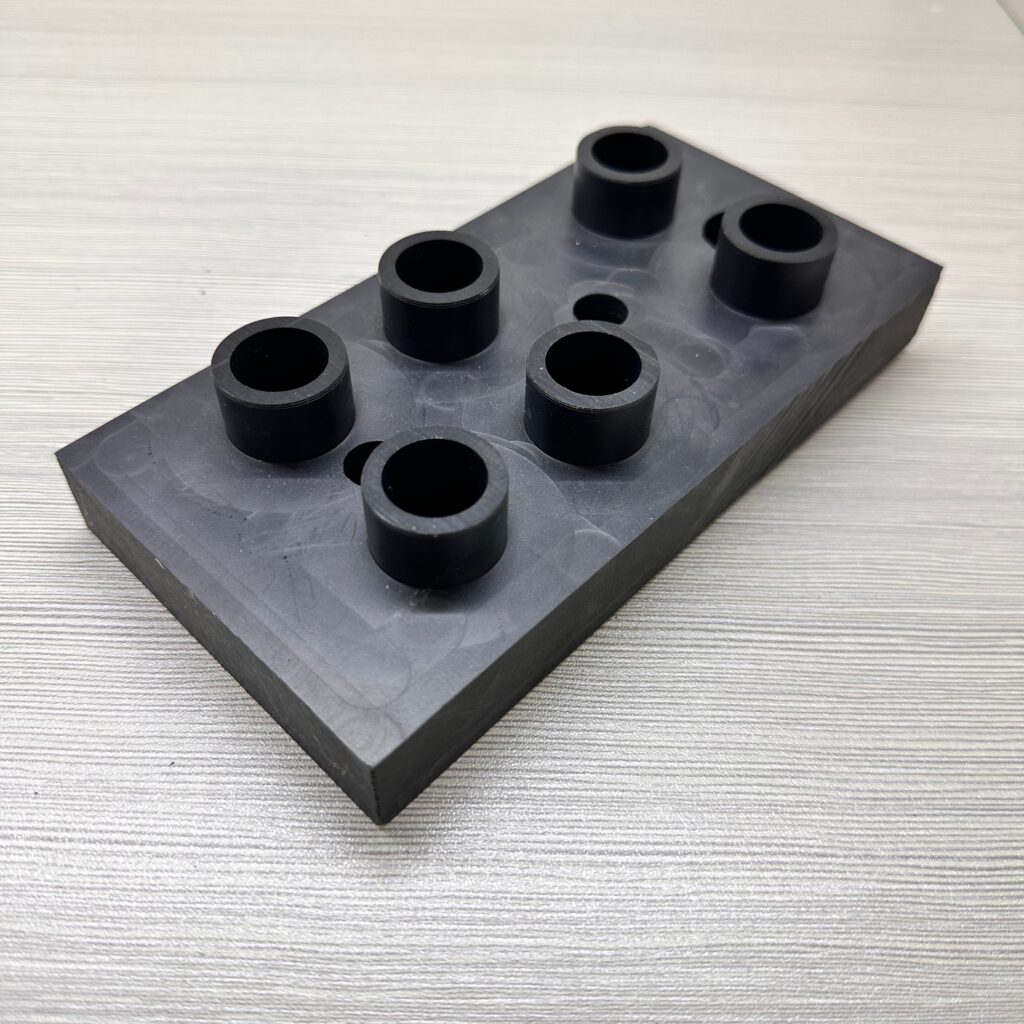
Electric vehicle battery systems have opened new PPS automotive applications. Battery module separators, cell holders, and busbar insulation components all benefit from PPS properties. The material’s dielectric strength prevents cell-to-cell shorting, while its thermal stability provides a safety margin during thermal runaway events. PPS battery separators maintain structural integrity at temperatures where other plastics soften and fail, protecting adjacent cells from cascade failure.
Inverter and power electronics housings also use PPS for its combination of thermal management and electrical insulation. Additionally, the material’s thermal conductivity of 0.3 W per meter-Kelvin can be enhanced with ceramic fillers for heat dissipation applications. Moreover, PPS components in EV charging connectors handle high voltage and current while maintaining UL94 V-0 rating and comparative tracking index above 400V. Consequently, the shift toward electrification has positioned PPS as a critical material in next-generation vehicle platforms, replacing metals in applications that demand both electrical isolation and thermal performance.
Designing with Glass-Filled PPS Stock
Designing PPS automotive components requires understanding how glass fiber affects performance. Glass-filled PPS at 40 percent loading delivers tensile strength of 150 to 200 MPa and flexural modulus above 12,000 MPa. However, glass fiber orientation during molding or extrusion creates anisotropic properties, meaning strength values differ between the flow direction and the transverse direction. Designers should orient critical features along the fiber direction whenever possible.
Machining PPS stock shapes eliminates the anisotropy concern for prototype and low-volume parts. NAGOMER supplies glass-filled PPS (SG12B) sheets and rods for CNC machining of automotive components. Furthermore, the material machines cleanly with carbide tooling and holds tolerances of plus or minus 0.05 mm without special fixturing. Additionally, recycled PPS compounds are gaining traction in automotive sustainability programs. Post-industrial PPS regrind maintains 85 to 90 percent of virgin mechanical properties, making it suitable for non-critical interior components. Moreover, the inherent flame retardancy of PPS eliminates the need for halogenated additives, meeting European ELV directive restrictions on hazardous substances.
NAGOMER supplies glass-filled PPS sheets and rods for automotive fuel system, sensor housing, and EV battery components. Contact info@nagomer.com for material datasheets and PPAP documentation support.