
News Centre
News Type
Send your inquiry
POM-C vs POM-H: Copolymer or Homopolymer — Which Acetal Should You Choose?
Side-by-Side Comparison
Property | POM-H (Homopolymer) | POM-C (Copolymer) |
Crystallinity | Higher (~75%) | Lower (~70%) |
Tensile strength | Slightly higher | Slightly lower |
Stiffness & hardness | Higher | Lower |
Fatigue & wear resistance | Better | Good |
Thermal stability in melt | Narrower processing window | Broader, more forgiving |
Resistance to hot water & alkali | Moderate | Better |
Sensitivity to acids | Better | Slight weakness |
Large-diameter centre porosity | More likely | Less likely |
The two grades are chemically related but behave differently in three practical dimensions: strength, processing robustness, and chemical exposure. Nobody chooses on datasheet numbers alone — they choose on duty.
Where POM-H Wins
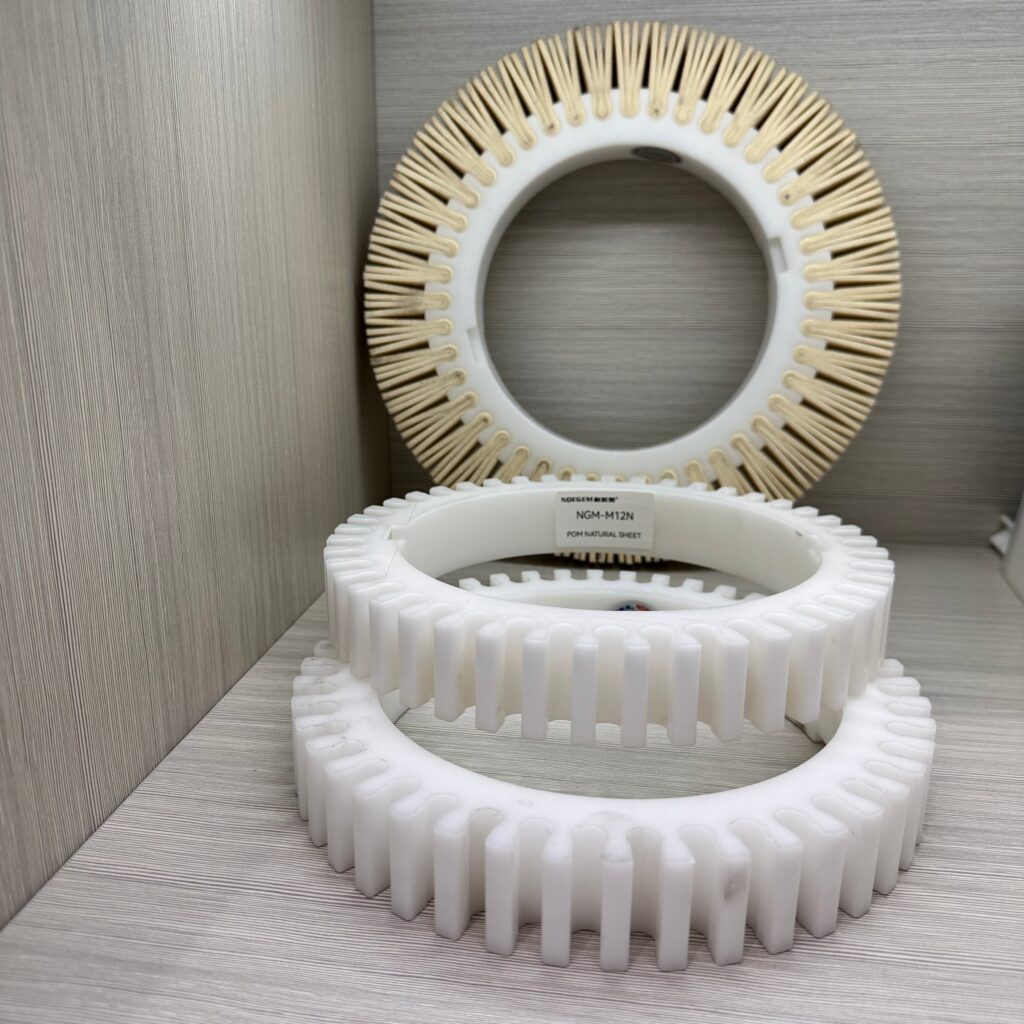
· High-cycle fatigue parts such as small precision gears
· Applications needing maximum stiffness and creep resistance
· Tight-tolerance machined components where hardness aids finish
· Dry-running bearings where low friction and wear matter most
· Parts where the design is optimised and processing is well controlled
Where POM-C Wins
· Repeated exposure to hot water, weak alkalis, or cleaning agents
· Large-diameter rod and thick sections where centre porosity is a risk
· Parts with complex geometry where the wider processing window helps
· Food and medical applications where the copolymer grades dominate
· Any duty where hydrolytic stability outweighs peak strength
Matching Material to Duty
In day-to-day practice the differences are modest, and most applications are served perfectly well by either grade. The exceptions matter, though: a POM-H bushing running in a hot detergent wash line can develop surface cracks within months, while a POM-C gear under high fatigue load will wear faster than the homopolymer equivalent. If your part sees sustained heat with moisture or cleaning chemistry, choose the copolymer. If it sees dry, high-cycle mechanical load, choose the homopolymer. When in doubt, tell us the duty cycle and cleaning regime — the answer usually becomes obvious. NAGOMER stocks both chemistries in sheet and rod and machines finished parts to drawing.
One last practical note: both acetal grades take up a little moisture and should be stored in a dry, ventilated area away from direct sunlight. Machined parts benefit from annealing at around 140–150°C for a period matched to wall thickness, which relieves internal stress and markedly reduces the risk of cracking in service. It is a cheap step that prevents an expensive failure.
Related reading: POM Plastic Sheet Properties, POM Gears Design Guide, and Engineering Plastics for Food & Beverage Processing.
FAQ
Q1: What is the difference between POM-C and POM-H?
POM-H is a homopolymer with higher crystallinity, giving slightly higher strength, stiffness, and wear resistance. POM-C is a copolymer with better thermal stability and hydrolytic resistance.
Q2: Which acetal is better for gears?
POM-H offers the best fatigue and wear performance for small, high-cycle gears. POM-C is preferred where the gears see moisture, cleaning agents, or large sections.
Q3: Is POM-C more resistant to chemicals than POM-H?
It is more resistant to hot water and weak alkalis, while POM-H handles acids somewhat better. Both are attacked by strong acids and oxidising agents.
Q4: Why is POM-H more prone to centre porosity?
Its higher crystallinity and narrower processing window make it harder to consolidate thick sections, so large-diameter homopolymer rod can show voids at the core. Copolymer handles thick sections more predictably.
Q5: Can the two grades be used together?
They can, but avoid running them against each other in sliding contact, as similar materials tend to adhere and wear rapidly. Pair acetal with steel, PEEK, or PTFE-filled materials instead.
Not sure which acetal suits your part? Contact NAGOMER for material guidance and machined POM components in both copolymer and homopolymer grades.
────────────────────────────────────────
NAGOMER — Professional Engineering Plastics Solutions
www.nagomer.com | info@nagomer.com