
News Centre
News Type
Send your inquiry
Plastic Sheet Cutting Methods: CNC, Waterjet & Laser Cutting Compared
Method 1: CNC Routing/Milling
Uses a rotating cutting tool to remove material along a programmed path.
Advantages: Excellent accuracy (±0.1mm), clean edges, complex profiles, can add features in one setup
Disadvantages: Generates chips, tool wear on abrasive materials, slower for straight cuts
Best for: Parts requiring tight tolerances and complex profiles
Setup cost: USD 50-150 | Per-part: USD 5-50
Method 2: Waterjet Cutting
High-pressure water stream (with abrasive particles) erodes material along the cut path.
Advantages: No heat-affected zone (critical for PEEK and POM), cuts thick materials (100mm+), smooth edges
Disadvantages: Lower accuracy (±0.15mm), slower for thick materials, moisture exposure
Best for: Thick sheets where thermal damage is a concern, large flat parts
Setup cost: USD 30-80 | Per-part: USD 3-30
Method 3: Laser Cutting
Focused laser beam melts and vaporizes material. CO2 lasers are most common for plastics.
Advantages: Fast for thin sheets, high accuracy (±0.05mm), clean edges, minimal waste
Disadvantages: Heat-affected zone, limited to thin sheets (<12mm), not suitable for PTFE (toxic fumes)
Best for: Thin sheets requiring high accuracy, high-volume simple profiles
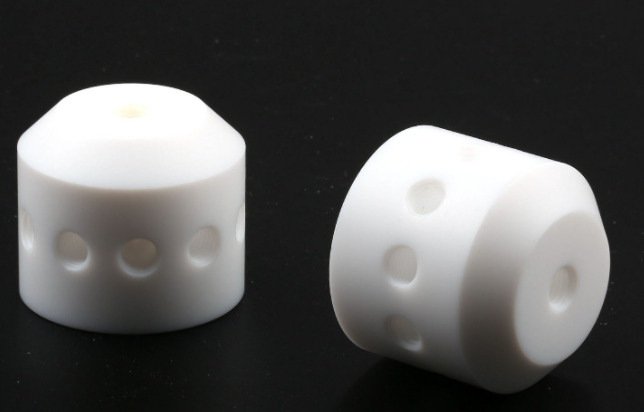
Material Suitability for Laser
Material | Laser Suitability | Notes |
POM | Good | Clean cut |
PA66 | Good | May yellow slightly |
PEEK | Moderate | Edge discoloration |
PEI | Moderate | Color darkens |
PPS GF40 | Difficult | Glass fibers interfere |
PTFE | ✗ Not recommended | Toxic fumes |
Comparison Summary
Factor | CNC | Waterjet | Laser |
Accuracy | ±0.1mm | ±0.15mm | ±0.05mm |
Max thickness | 100mm+ | 100mm+ | 12mm |
Heat effect | Minimal | None | Yes (HAZ) |
Speed | Moderate | Slow (thick) | Fast (thin) |
Cost (setup) | Medium | Low | Low |
Cost (per-part) | Medium | Low-Med | Low |
How to Choose
1. Heat sensitivity critical (PEEK, POM): Waterjet or CNC with cooling
2. Accuracy paramount: Laser (thin) or CNC (thick)
3. Thick sheets (>30mm): Waterjet or CNC
4. High-volume thin parts: Laser
5. Complex profiles with features: CNC
FAQ
Q1: Best method for cutting PEEK sheets?
Waterjet (no heat-affected zone). CNC for parts with features. Laser for thin sheets (may discolor).
Q2: Can you laser cut all engineering plastics?
No. POM/PA66 cut well. PEEK/PEI discolor. PTFE produces toxic fumes. PPS GF40 is difficult.
Q3: How thick can waterjet cut?
Up to 100mm+. Speed decreases with thickness, but edges are clean without thermal damage.
Ready to source quality engineering plastics? Contact NAGOMER today for a free quote, or browse our PEEK sheets, POM rods, and ESD materials.
NAGOMER — Professional Engineering Plastics Solutions
www.nagomer.com | info@nagomer.com