
News Centre
News Type
Send your inquiry

Plastic Material Substitution: When and How to Switch from Metal to Plastic
Benefits of Substitution
Weight Reduction
Material | Density (g/cm³) | Weight vs Steel |
Steel | 7.8 | — |
Aluminum | 2.7 | -65% |
PEEK | 1.30 | -83% |
PEEK CF30 | 1.41 | -82% |
POM | 1.41 | -82% |
Other Benefits
· Corrosion elimination: No coatings, plating, or galvanic corrosion
· Cost reduction: No secondary surface treatments, part consolidation
· Design freedom: Complex geometries, integrated features, color options
When to Consider Substitution
Good Candidates
· Operating temps below 250°C (PEEK), 200°C (PPS), 100°C (POM/PA66)
· Low to moderate load applications
· Corrosive environments
· Complex geometry parts
· Weight-critical applications
Poor Candidates
· Temperatures >300°C
· Very high loads (>200 MPa)
· Precision surfaces requiring <0.01mm tolerance
· Applications requiring thermal conductivity (unless PEEK CF30)
Material Selection
Replacing Steel
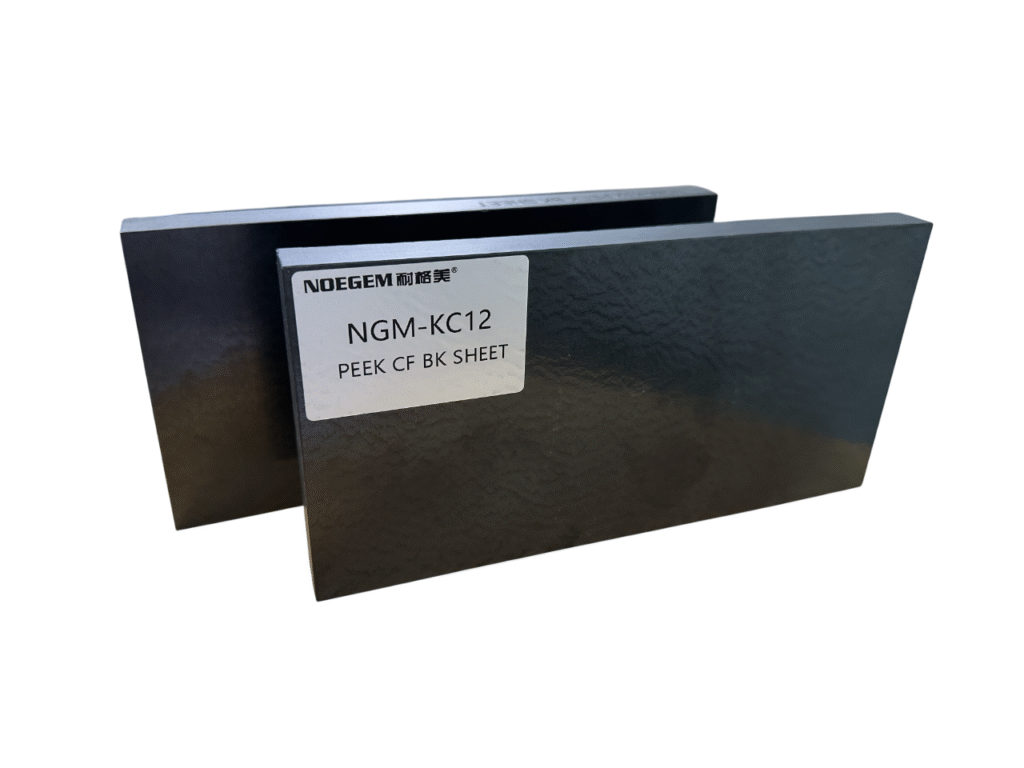
· High performance: PEEK CF30 (220 MPa, -82% weight)
· Medium: PEEK GF30 (170 MPa) or PPS GF40 (150 MPa)
· Cost-effective: PA66 GF30 (temperature-limited to 120°C)
Replacing Aluminum
· PEEK for structural components
· POM for brackets and housings
· PEI for high-temperature structural
Replacing Brass/Bronze
· POM for gears and bushings
· PEEK+PTFE for high-load bearings
Design Guidelines
· Wall thickness: Min 1.5mm (machined), 2.0mm (molded)
· Ribs: 50-60% of nominal wall thickness
· Corners: Min 0.5mm internal radius (prevents stress concentration)
· Tolerances: ±0.05mm (machined), ±0.1mm (molded)
· Redesign for plastic: Don’t copy metal design — use plastic-appropriate geometry
Substitution Process
1. Analyze current metal part (loads, temps, environment, failures)
2. Select plastic material (consult NAGOMER technical team)
3. Redesign for plastic manufacturing (use FEA with plastic material models)
4. Prototype from stock shapes and test
5. Validate with long-term testing (fatigue, creep, aging)
Common Pitfalls
· Ignoring creep (plastics deform under sustained load)
· Over-specifying (PEEK when POM suffices — see PEEK vs PPS)
· Copying metal design instead of redesigning for plastic
· Neglecting thermal expansion (plastics expand 5-10× more than metals)
FAQ
Q1: When to replace metal with plastic?
Below 250°C, weight reduction matters, corrosion is a concern, complex geometry, or secondary operations can be eliminated.
Q2: How much weight savings?
4-6× lighter than steel. PEEK: ~83% weight reduction vs steel.
Q3: Can plastics match metal strength?
PEEK CF30 reaches 200-220 MPa — approaching aluminum. Weight-adjusted strength exceeds most metals.
Ready to source quality engineering plastics? Contact NAGOMER today for a free quote, or browse our PEEK sheets, POM rods, and ESD materials.
NAGOMER — Professional Engineering Plastics Solutions
www.nagomer.com | info@nagomer.com