
News Centre
News Type
Send your inquiry
PEI Plastic Sheet (ULTEM): Properties, Processing & Applications Guide
Key Properties of PEI Sheet
Mechanical Properties
Property | Value | Standard |
Tensile strength | 105 MPa | ISO 527 |
Tensile modulus | 3.0 GPa | ISO 527 |
Flexural strength | 150 MPa | ISO 178 |
Flexural modulus | 3.3 GPa | ISO 178 |
Impact strength (Charpy, notched) | 5 kJ/m² | ISO 179 |
Hardness (Rockwell) | M109 | ASTM D785 |
Thermal Properties
Property | Value |
Glass transition temperature (Tg) | 217°C |
Continuous service temperature | 170°C |
HDT (1.8 MPa) | 200°C |
Thermal conductivity | 0.22 W/m·K |
CLTE | 5.6 × 10⁻⁵ /°C |
Fire Performance (Inherent, No Additives)
Test | Result |
UL94 V-0 | Pass at 0.4mm |
Limiting Oxygen Index (LOI) | 47% |
OSU heat release (65/65) | Pass |
Smoke density (Ds, 4 min) | < 30 |
NBS smoke (flaming) | Ds max < 70 |
Physical Properties
Property | Value |
Density | 1.27 g/cm³ |
Water absorption 24h | 0.25% |
Refractive index | 1.66 (amber-transparent) |
PEI vs Other Engineering Plastics
Property | PEI | PEEK | PPS | POM |
Service temp (°C) | 170 | 250 | 200 | 100 |
Tensile (MPa) | 105 | 98 | 70 (unfilled) | 70 |
Fire rating | V-0 (inherent) | V-0 (inherent) | V-0 | HB |
Cost index | 25 | 100 | 15 | 5 |
Transparency | Amber-clear | Opaque | Opaque | Opaque |
FDA compliant | ✓ | ✓ | ✗ | ✓ |
PEI offers the best value when fire retardancy + high strength + transparency are all required.
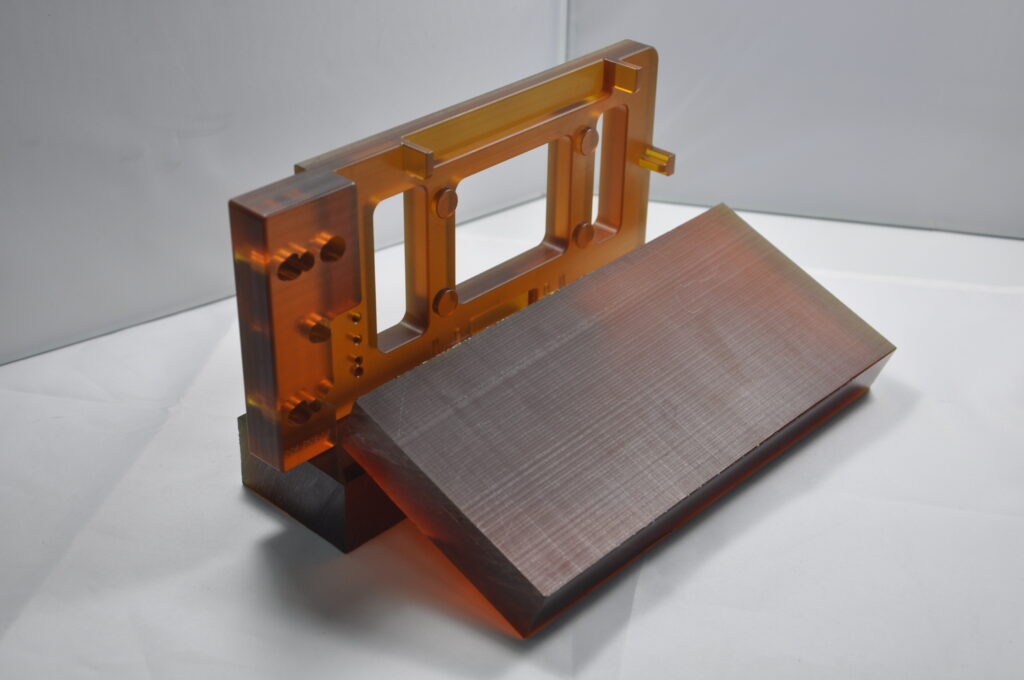
Processing Methods
CNC Machining
PEI is easily machined with standard CNC equipment:
· Use carbide tools with positive rake
· Cutting speed: 100–300 m/min
· Feed: 0.05–0.15 mm/rev
· No coolant needed for light cuts
· Achievable tolerance: ±0.05mm
Thermoforming
PEI sheets can be thermoformed at 180–200°C:
· Pre-dry sheets at 150°C for 4 hours before forming
· Mould temperature: 130–150°C
· Forming vacuum: 0.08–0.1 MPa
Bonding & Welding
· Adhesive bonding: epoxy or polyurethane adhesives
· Ultrasonic welding: frequency 20–40 kHz
· Hot plate welding: 320–350°C plate temperature
· Vibration welding: 100–240 Hz, 0.7–1.8mm amplitude
Applications by Industry
Aerospace
· Interior panels and trim
· Air ducting and ventilation
· Window masks and surrounds
· Seat armrest components
Medical
· Surgical instrument handles
· Sterilisation trays
· Dental instrument components
· Diagnostic equipment housings
Electronics
· PCB connectors
· Chip carriers
· Switch housings
· LED reflectors
Industrial
· Sight glasses (transparent grades)
· Pump and valve components
· Food processing equipment
· Analytical instrument parts
For comparison with PEEK, see our PEEK vs PEI guide. For aerospace applications, read Engineering Plastics in Aerospace.
FAQ
Q1: Is PEI the same as ULTEM?
PEI (polyetherimide) is the generic material name. ULTEM is the brand name for PEI manufactured by SABIC. Other manufacturers produce PEI under different brand names (e.g., TECAPEI by Ensinger). NAGOMER supplies PEI sheets manufactured to the same material specifications.
Q2: What temperature can PEI sheets withstand?
PEI has a glass transition temperature of 217°C and a continuous service temperature of 170°C. Its heat deflection temperature (HDT) at 1.8 MPa is 200°C. PEI can withstand short-term thermal excursions up to 200°C.
Q3: Is PEI FDA compliant?
Yes, PEI is FDA compliant for food contact under 21 CFR. Natural (unfilled) PEI grades meet food contact requirements and can be used in food processing equipment and food-contact surfaces.
Q4: How does PEI compare to PEEK in cost?
PEI typically costs 60–70% less than PEEK. While PEEK offers higher temperature resistance (250°C vs 170°C) and better chemical resistance, PEI provides comparable mechanical strength and inherent flame retardancy at a fraction of the cost.
Looking for PEI/ULTEM sheets? Contact NAGOMER for specifications and pricing, or explore our PEI products and PEEK alternatives.
NAGOMER — Professional Engineering Plastics Solutions
www.nagomer.com | info@nagomer.com