
News Centre
News Type
Send your inquiry
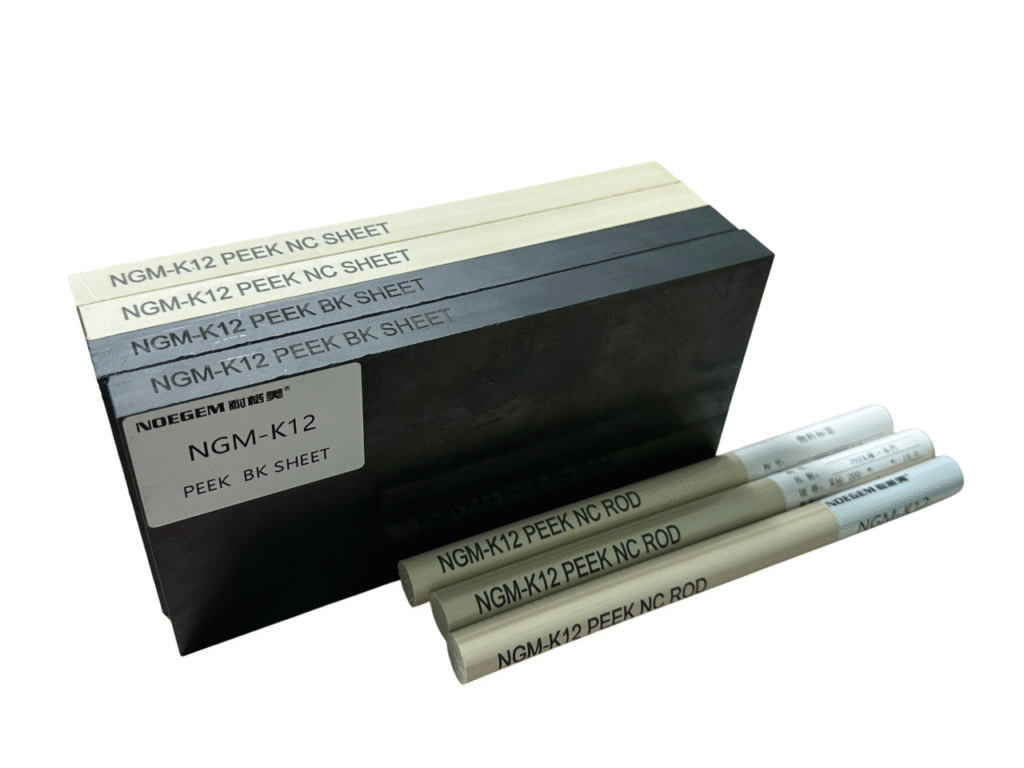
PEEK Sheet vs PEEK Rod: Which Form Factor Is Right for Your Application?
PEEK (Polyether Ether Ketone) is available in two primary stock shapes — flat sheets/plates and cylindrical rods/bars. While both deliver the same exceptional base material performance, the right choice between PEEK sheet and PEEK rod depends critically on your machining requirements, part geometry, dimensional constraints, and application environment.
This guide provides a definitive comparison to help engineers and procurement teams make the right decision the first time — saving both material cost and machining time.
What Is PEEK? A Quick Technical Primer
PEEK (Polyether Ether Ketone) is a semi-crystalline, high-performance thermoplastic widely regarded as the gold standard in engineering polymers. Its key properties make it indispensable in demanding applications:
Property | Value |
Continuous Service Temp. | Up to 260°C (500°F) |
Tensile Strength | ~100 MPa (standard grade) |
Chemical Resistance | Excellent — resists acids, bases, hydrocarbons, and most solvents |
Biocompatibility | ISO 10993 compliant; suitable for implant and medical contact |
ESD Safety | ESD grades: 10⁶–10⁸ Ω | CON grades: 10²–10⁵ Ω |
UL 94 Flame Rating | V-0 (self-extinguishing) |
Density | ~1.32 g/cm³ (lighter than aluminum at 2.7 g/cm³) |
PEEK Sheet: Specifications, Advantages, and Applications
Standard Dimensions
• Thickness range: 3 mm – 100 mm
• Standard sheet size: 620×620mm, 1000×1000mm, 1220×1000mm, 2000×1000mm
• Maximum sheet size: 3000×1000mm (NAGOMER production capability)
• Color options: Natural (off-white/beige) | Black
• ESD grades: Surface resistivity 10⁶–10⁸ Ω per ANSI/ESD S4.1-2006
Key Advantages of PEEK Sheet
• Ideal for flat, plate-like parts: gaskets, spacers, backing plates, wear pads
• Large flat surfaces enable multiple parts per sheet — maximizing material utilization in CNC cutting
• Consistent material properties throughout the thickness: no anisotropy concerns for most applications
• Easier to inspect incoming dimensions and surface quality
• Cost-effective for producing multiple flat parts in a single setup
Best Application Areas for PEEK Sheet
• Semiconductor: Wafer handling trays, process chamber components, test socket body, IC handling fixtures, ESD-safe enclosures
• Medical: Sterilization instrument trays, surgical guide plates, implant tooling jigs
• Industrial: Valve seats, bearing pads, slide plates, anti-corrosion liners
• Aerospace: Structural brackets, antenna components, thermal insulation panels
• Laboratory: Fluid cell body, HPLC instrument components, sample holders
PEEK Rod: Specifications, Advantages, and Applications
Standard Dimensions
• Diameter range: Ø6 mm – Ø300 mm
• Standard length: 1000mm | 2000mm (NAGOMER standard stock)
• Tolerance: h8 (precision turned finish available on request)
• Color options: Natural (off-white/beige) | Black
• ESD grades available: K6B (ESD), K2B (CON) in rod form
Key Advantages of PEEK Rod
• Directly machinable to cylindrical parts with minimal waste: bushings, sleeves, pistons, plugs
• Superior for rotational parts: the radial symmetry of rod stock eliminates anisotropy in circular cross-sections
• Efficient for lathe-turned components: no need to saw out cylindrical blanks from sheet
• Available in large diameters that would be impractical to achieve from sheet
• Ground-finish rods offer tighter dimensional tolerance for precision fit applications
Best Application Areas for PEEK Rod
• Pumps & Fluid Systems: Pump casings, impellers, piston rings, valve stems, check valve seats
• Medical: Surgical instrument handles, endoscope components, implant delivery tools, sample pipette bodies
• Industrial Machinery: Wear-resistant bushings, guide rods, rollers, cams, bearing housings
• Semiconductor: Robotic arm end-effectors, ESD-safe spindle components, chemical process fittings
• Oil & Gas: Downhole seal inserts, valve plug bodies, chemical-resistant fittings

Head-to-Head Comparison: PEEK Sheet vs PEEK Rod
Factor | PEEK Sheet | PEEK Rod |
Part Geometry | Flat, plate-like, 2D profiles | Cylindrical, rotational, tubular |
Machining Method | CNC milling, routing, waterjet | CNC lathe turning, milling |
Material Utilization | Higher (multiple parts per sheet) | High for cylindrical parts |
Max Thickness / Diameter | 100mm thick | Ø300mm diameter |
Available Grades | Full range (standard, ESD, CON, GF30) | Most grades available |
Cost for Flat Parts | Lower | Higher (more material waste) |
Cost for Round Parts | Higher (more material waste) | Lower |
Tight OD Tolerance | Requires additional machining | Available in precision-ground finish |
Large Size Availability | Up to 3000×1000mm | Up to Ø300mm × 2000mm |
NAGOMER PEEK Grades: Complete Product Reference
NAGOMER manufactures PEEK sheets and rods across the following grade families — all available in both form factors unless otherwise noted:
• K12N — Natural (beige) standard PEEK, unfilled. Best balance of properties for general industrial use.
• K12B — Black standard PEEK, unfilled. Opaque, UV-stable, commonly specified in semiconductor environments.
• KG30B — Black PEEK + 30% glass fiber (GF30). Enhanced stiffness, compressive strength, and dimensional stability at elevated temperatures. Ideal for structural parts.
• K6B — ESD PEEK (black). Surface resistivity 10⁶–10⁸ Ω. Meets ANSI/ESD S4.1-2006. Critical for semiconductor and electronics assembly applications.
• K2B — CON PEEK (conductive, black). Surface resistivity 10²–10⁵ Ω. For applications requiring conductive, charge-dissipative material.
| Custom Grades & Sizes Available NAGOMER can supply custom-specification PEEK in non-standard thicknesses, oversized sheets, large-diameter rods, and specialty compounded grades (PTFE-filled, carbon fiber-filled). Contact our technical team for specifications beyond our standard product list. |
Decision Framework: How to Choose
Use this quick checklist to select the right PEEK stock form:
• If your part is predominantly flat, planar, or plate-like → Choose PEEK Sheet
• If your part is predominantly cylindrical, tubular, or round → Choose PEEK Rod
• If the part has both flat and cylindrical features → Consider which geometry dominates; evaluate material yield (cut-from-sheet vs. turned-from-rod)
• If surface resistivity is specified → Confirm ESD or CON grade is available in your required form and dimensions
• If tightest possible OD tolerance is required → Request precision-ground PEEK rod
• If budget is the primary driver → Request quotes for both; sometimes sheet cut-outs are surprisingly competitive for small cylindrical blanks
Conclusion
Both PEEK sheet and PEEK rod deliver the same world-class polymer performance — the choice is purely about geometry efficiency and machining economics. Choose sheet for flat and planar parts, choose rod for cylindrical and rotational components. When in doubt, contact NAGOMER’s technical team: we can help you select the right form, grade, and dimension to optimize your costs and lead times.
Request PEEK Sheet/Rod Samples and Datasheet