News Centre
News Type
Send your inquiry
PEEK Material Cost: 7 Factors Affecting Price & Sourcing Strategy
Factor 1: PEEK Grade and Formulation
The base PEEK grade is the single largest cost driver:
· Unfilled/natural PEEK: Standard grade, most affordable within the PEEK family
· Glass-filled PEEK (GF30): 15-25% premium over natural grade
· Carbon-filled PEEK (CF30): 30-40% premium, highest mechanical performance
· PTFE-filled PEEK: 20-30% premium, optimized for low-friction applications
· Medical-grade PEEK: 50-100% premium, requires ISO 10993 biocompatibility testing
Selecting the minimum grade that meets your application requirements is the first step in cost optimization. Over-specifying PEEK grade is a common — and costly — mistake. Learn more about PEEK filled grades to make informed selections.
Factor 2: Stock Shape and Dimensions
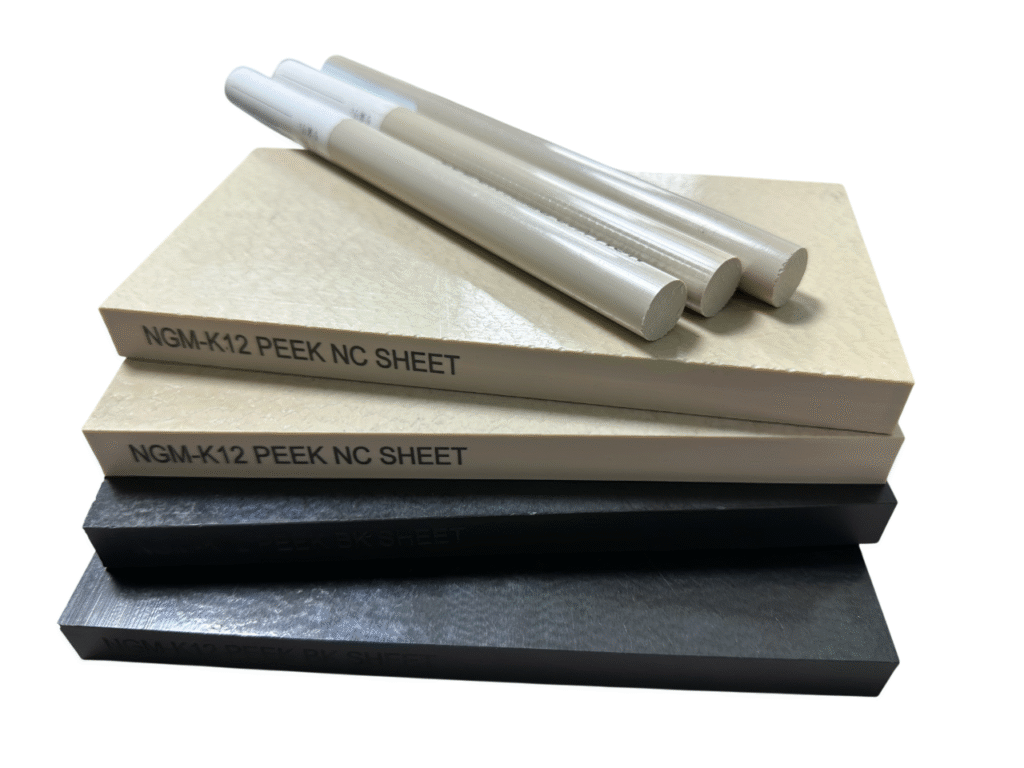
PEEK is available as sheets, rods, and tubes. Processing costs vary significantly by shape:
· Thin sheets (≤10mm): Higher cost per kg due to precision extrusion
· Thick sheets (≥50mm): Lower cost per kg but longer lead times
· Small-diameter rods (≤20mm): Efficient to produce, competitive pricing
· Large-diameter rods (≥100mm): Significant premium due to pressing challenges
· Thin-wall tubes: Highest processing cost due to complexity
Factor 3: Order Volume and MOQ
Volume discounts for PEEK are substantial. Typical pricing tiers:
Order Size | Price Reduction |
Under 50 kg | Base price |
50-200 kg | 5-10% discount |
200-500 kg | 10-15% discount |
Over 500 kg | 15-20% discount |
Consolidating orders across multiple projects or departments can unlock significant savings. See our MOQ guide for minimum order thresholds.
Factor 4: Color and Custom Requirements
Natural (tan/beige) PEEK is the most cost-effective. Black PEEK (carbon black pigmented) carries a 5-10% premium. Custom colors require special pigmentation and minimum batch sizes, potentially increasing cost by 20-30%.
Factor 5: Quality and Certification Level
PEEK with full material certifications — including UL94 V-0 flammability, FDA compliance, or aerospace traceability — commands a premium. Determine which certifications your application actually requires rather than defaulting to the highest specification.
Factor 6: Geographic Sourcing Location
PEEK resin is produced by a limited number of global manufacturers (Victrex, Solvay, Pan Jin Yuan). Chinese manufacturers who purchase resin and produce stock shapes offer 20-35% cost savings compared to European or American suppliers, without compromising material properties.
Factor 7: Market Conditions and Resin Availability
PEEK resin prices fluctuate based on crude oil markets, production capacity utilization, and semiconductor/medical industry demand. The PEEK market trend for 2026 shows prices stabilizing in the second half of the year.

Sourcing Strategy Recommendations
1. Standardize grades: Limit the number of PEEK grades your company uses to maximize volume discounts
2. Forward contract: Lock in pricing for 6-12 months if demand is predictable
3. Dual-source: Establish relationships with 2-3 suppliers for supply security
4. Optimize dimensions: Design parts to use standard stock shape dimensions, minimizing machining waste
5. Request quotes strategically: Learn how to request a PEEK quote effectively
FAQ
Q1: What is the typical price range for PEEK material?
PEEK stock shapes typically range from USD 80-200 per kilogram, depending on grade, dimensions, order volume, and certification level.
Q2: How can I reduce PEEK procurement costs?
Strategies include standardizing PEEK grades, consolidating orders, sourcing from Chinese manufacturers, and optimizing part dimensions.
Q3: Which PEEK grade is most cost-effective?
Natural (unfilled) PEEK is the most cost-effective grade. Glass-filled and carbon-filled grades carry 15-40% premiums.
Ready to source quality engineering plastics? Contact NAGOMER today for a free quote, or browse our PEEK sheets, POM rods, and ESD materials.
NAGOMER — Professional Engineering Plastics Solutions
www.nagomer.com | info@nagomer.com