
News Centre
News Type
Send your inquiry

PEEK Filled Grades Complete Guide: Carbon, Glass & PTFE-Filled PEEK
Overview of PEEK Filled Grades
Filled PEEK grades incorporate reinforcing fibers or particles into the PEEK matrix during compounding. The filler type, loading level, and fiber length determine the resulting properties:
Grade | Filler | Loading | Key Enhancement |
PEEK GF30 | Glass fiber | 30% | Stiffness, strength, dimensional stability |
PEEK CF30 | Carbon fiber | 30% | Highest strength/stiffness, thermal conductivity |
PEEK PTFE | PTFE + carbon/graphite | 10-20% | Low friction, wear resistance |
Natural PEEK | None | 0% | Base properties, FDA/medical compatibility |
PEEK GF30 (30% Glass-Filled PEEK)
Key Properties
· Tensile strength: 150-170 MPa (vs. 90-100 MPa unfilled)
· Flexural modulus: 9,000-11,000 MPa (vs. 3,800-4,200 MPa unfilled)
· HDT (1.8 MPa): 315°C (vs. 152°C unfilled)
· Density: 1.49 g/cm³ (vs. 1.30 g/cm³ unfilled)
Advantages
Glass fiber reinforcement dramatically improves PEEK‘s stiffness and heat resistance. GF30 PEEK maintains structural integrity at temperatures approaching 300°C, making it suitable for under-hood automotive and aerospace structural components.
Limitations
· Glass fibers are abrasive to machining tools — expect 30-50% shorter tool life
· Anisotropic properties: strength is higher along the fiber orientation direction
· Not suitable for FDA/medical applications
· Higher density increases weight and cost per part
Best Applications
· Structural brackets and housings in aerospace
· High-temperature structural components
· Pump and valve bodies in chemical processing
· Electrical insulation components requiring high stiffness
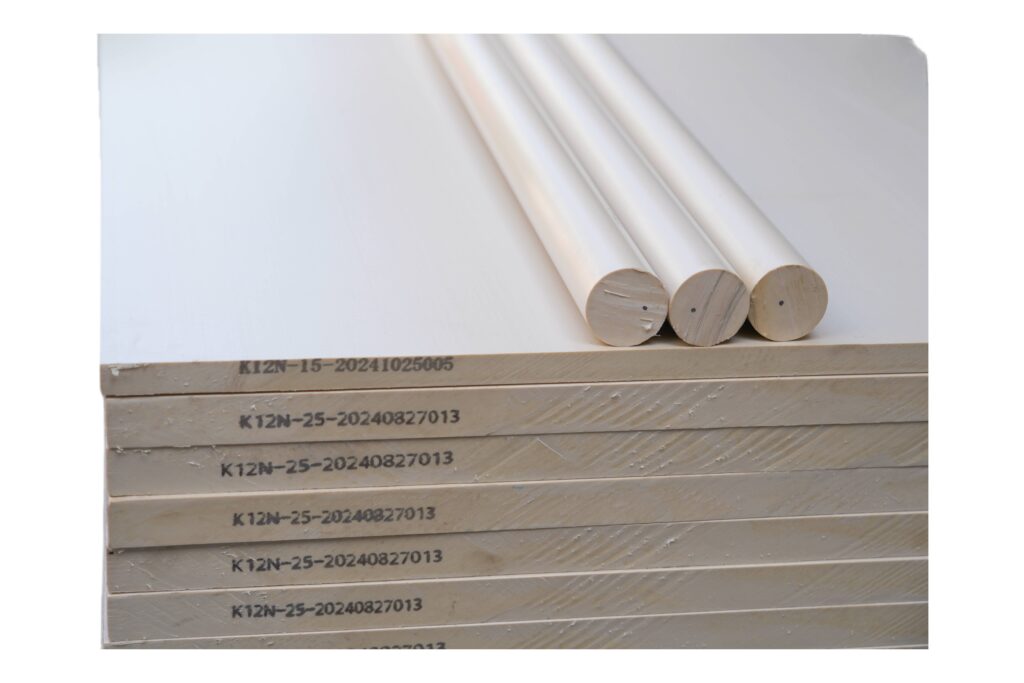
PEEK CF30 (30% Carbon-Filled PEEK)
Key Properties
· Tensile strength: 200-220 MPa
· Flexural modulus: 15,000-18,000 MPa
· HDT (1.8 MPa): 315°C
· Thermal conductivity: 0.95 W/m·K (vs. 0.25 W/m·K unfilled)
· Density: 1.41 g/cm³
Advantages
Carbon fiber provides the highest strength-to-weight ratio of any PEEK grade. Additionally, carbon-filled PEEK offers thermal conductivity — dissipating heat from friction or electronics — and is electrically conductive, making it suitable for EMI shielding applications.
Limitations
· Highest cost of all PEEK grades
· Electrically conductive (not suitable for electrical insulation)
· Abrasive to machining tools
· Not FDA-compliant
Best Applications
· Structural components in aerospace (weight-critical)
· EMI/RFI shielding housings
· Thermal management in electronics
· High-performance bearings and bushings
· See our PEEK vs PPS comparison for how CF30 PEEK compares to filled PPS
PEEK + PTFE (PTFE-Filled PEEK)
Key Properties
· Coefficient of friction: 0.15-0.20 (vs. 0.35-0.45 unfilled PEEK)
· Wear rate: 50-80% lower than unfilled PEEK
· Tensile strength: 80-90 MPa
· Density: 1.40-1.45 g/cm³
Advantages
PTFE-filled PEEK is the premier tribological engineering plastic. It combines PEEK‘s mechanical strength and temperature resistance with PTFE‘s exceptional lubricity. This grade is ideal for dry-running bearings, seals, and wear components where external lubrication is impossible or undesirable.
Limitations
· Lower mechanical strength than unfilled PEEK (PTFE is softer)
· May contain carbon graphite (check for FDA compliance)
· Premium pricing
Best Applications
· Dry-running bearings and bushings
· Piston rings and seals
· Valve seats in chemical processing
· Food processing equipment (FDA-compliant versions)
Selection Guide: Which PEEK Grade to Choose?
If you need… | Choose |
Highest strength and stiffness | PEEK CF30 |
High temperature structural | PEEK GF30 |
Low friction/wear | PEEK + PTFE |
Medical/FDA compliance | Natural PEEK |
Cost-effective general purpose | Natural PEEK |
Electrical conductivity | PEEK CF30 |
Thermal conductivity | PEEK CF30 |
Best machinability | Natural PEEK |
FAQ
Q1: What is the strongest PEEK grade?
PEEK CF30 (30% carbon fiber-filled) is the strongest, with tensile strength of 200-220 MPa and flexural modulus of 15,000-18,000 MPa.
Q2: Which PEEK grade has the lowest friction?
PTFE-filled PEEK has the lowest coefficient of friction (0.15-0.20), ideal for dry-running bearings and wear components.
Q3: Can filled PEEK grades be used in medical applications?
Generally no. Filled grades are not FDA-compliant. Use natural (unfilled) PEEK for medical applications meeting ISO 10993.
Ready to source quality engineering plastics? Contact NAGOMER today for a free quote, or browse our PEEK sheets, POM rods, and ESD materials.
NAGOMER — Professional Engineering Plastics Solutions
www.nagomer.com | info@nagomer.com