
News Centre
News Type
Send your inquiry
PEEK Bearing Material: PV Limit and Performance vs Metal Bearings
How PEEK Bearing Material Performs Under Load
Polymer bearings replaced metal in applications where lubrication is difficult or impossible. PEEK bearing material extends the operating envelope of polymer bearings into higher pressure and temperature regions. In fact, the PV limit, the product of pressure and velocity at which a bearing can operate continuously, sets the practical performance boundary. The polymer reaches PV limits of 10 to 20 MPa-m/s in unlubricated service against metal shafts.
Bronze bearings handle higher PV values but require continuous lubrication. PEEK works dry or with minimal lubrication. The friction coefficient against steel measures 0.15 to 0.30 unlubricated. Bronze against steel measures 0.08 to 0.15 but with a hydrodynamic lubricant film. The comparison favors PEEK when lubrication maintenance is impractical. NAGOMER supplies PEEK rod stock for bearing machining operations.
Furthermore, the load capacity of the polymer depends on the sliding speed. At low speeds, the material handles higher static loads. At high speeds, the dynamic load capacity drops as heat builds in the contact zone. Therefore, the operating speed and the available cooling determine the practical load limit. In addition, the clearance between bearing and shaft affects the contact pressure. Tighter clearances increase pressure but improve alignment.
The proper balance of clearance, load, and speed allows PEEK bearing material to deliver reliable service across many industrial applications. Furthermore, the temperature stability supports applications beyond the reach of standard polymers. Additionally, the dimensional stability under load prevents clearance changes in precision equipment. Furthermore, the temperature stability of PEEK bearing material supports applications beyond the reach of standard polymers. Additionally, the dimensional stability of PEEK bearing material under load prevents clearance changes in precision equipment.
Friction and Wear Rate Data
Friction and wear testing follows standard methods. The thrust washer test under 1 MPa pressure and 1 m/s sliding velocity against steel shows wear rates of 2 to 5 microns per hour for unfilled material. Filled grades with PTFE, carbon fiber, or graphite show different results. In fact, PTFE-filled PEEK drops friction to 0.10 to 0.15 but reduces wear by 50 percent compared to unfilled PEEK.
The operating temperature affects both friction and wear. The polymer works to 200 degrees Celsius continuous. The PV limit drops as temperature rises. At 150 degrees Celsius, the safe PV limit is about half the room temperature value. Beyond 250 degrees Celsius, the polymer softens and the wear rate climbs rapidly. For high-temperature bearing applications above 200 degrees Celsius, PAI or PI materials are required. NAGOMER provides technical data for bearing design with PEEK grades.
In addition, the counterface material affects friction and wear significantly. Harder shaft surfaces at HRC 50 or above extend PEEK bearing life. Softer shafts wear faster themselves and create abrasive debris that accelerates polymer wear. Surface finish at 0.2 to 0.4 micrometers Ra is optimal. Therefore, the shaft material specification matters as much as the bearing grade selection in achieving reliable performance with PEEK bearings in demanding applications. Moreover, the wear debris is generally benign in food and pharmaceutical applications. In addition, the chemical resistance extends the operating envelope in aggressive environments. Moreover, the wear debris from this material is generally benign in food and pharmaceutical applications. In addition, the chemical resistance of PEEK bearing material extends the operating envelope in aggressive environments.
Filled PEEK Bearing Grades
Unfilled PEEK works in many bearing applications. For more demanding service, filled grades extend the operating envelope. In fact, PTFE-filled grades reduce friction and eliminates stick-slip at low speeds. Carbon fiber reinforced PEEK increases the PV limit and improves thermal conductivity. Graphite-filled PEEK reduces friction at higher temperatures. The combination of carbon fiber and PTFE plus graphite creates the premium bearing grade for severe service.
Material selection for specific applications follows the load, speed, temperature, and environment. Dry oscillating bearings in food processing use PTFE-filled PEEK. High-load bushings in hydraulic systems use carbon fiber reinforced PEEK. Pumps handling hot water use graphite-filled grades. Each combination targets a specific performance window. NAGOMER supplies the full range of filled PEEK grades for bearing manufacturers and machining operations.
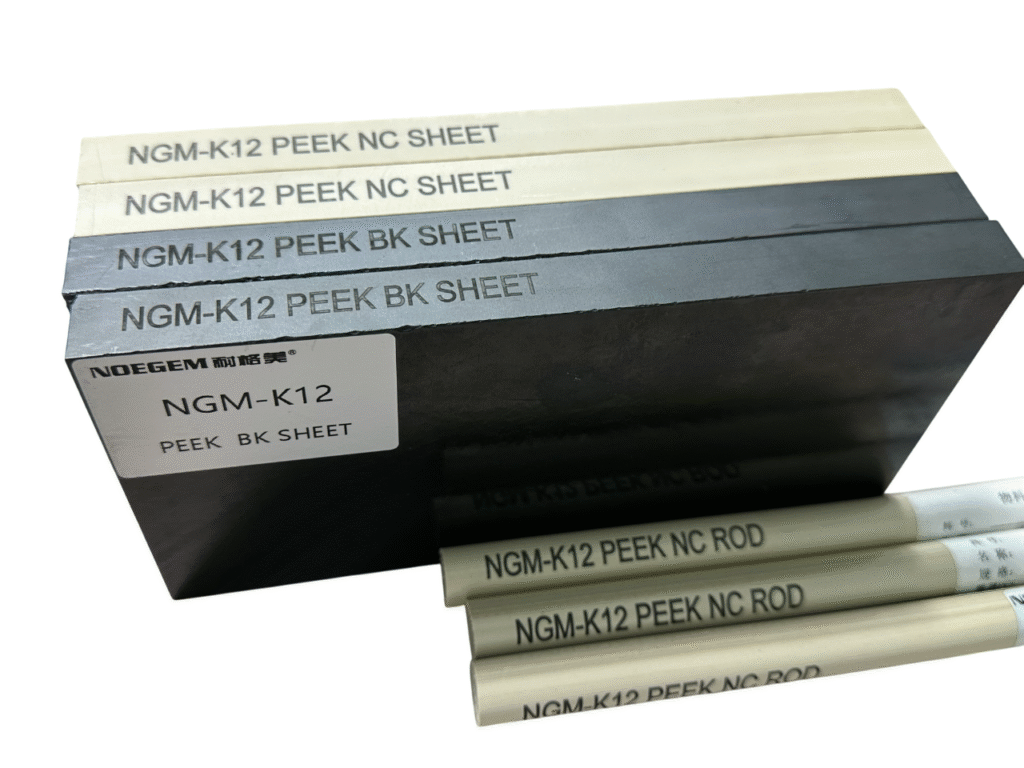
Furthermore, the color and visual identification of filled grades help prevent mix-ups in production. PTFE-filled PEEK is typically tan or brown. Carbon fiber reinforced grades are black. Graphite-filled grades are dark gray. The visual identification supports quality control in bearing manufacturing. As a result, the filled PEEK grade options allow designers to fine-tune the bearing performance for specific operating conditions in valves, pumps, and industrial machinery. Additionally, the color coding of filled grades supports quality control in manufacturing. Furthermore, the machinability allows custom geometries for specialized designs. Additionally, the color coding of filled PEEK bearing material grades supports quality control in manufacturing. Furthermore, the machinability of PEEK bearing material allows custom geometries for specialized bearing designs.
Comparison with Bronze and PTFE Bearings
Bronze bearings handle higher loads at higher speeds than PEEK. The PV limit of bronze against steel reaches 100 MPa-m/s with proper lubrication. The polymer cannot match this. However, PEEK works without lubrication, while bronze bearings fail quickly without it. The application environment determines the practical choice. In accessible locations with regular maintenance, bronze works well. In sealed or remote locations, PEEK provides longer service life.
PTFE bearings work at lower loads and speeds than PEEK. The PV limit of pure PTFE is 1 to 5 MPa-m/s. Filled PTFE reaches 5 to 10 MPa-m/s. PEEK outperforms PTFE in most load and speed combinations. However, PTFE handles chemical resistance better than PEEK in some environments. The comparison depends on the specific chemicals and temperatures. NAGOMER supplies PEEK, PTFE, and bronze bearing stock for various application requirements.
In addition, the wear life comparison depends on the operating conditions. Under boundary lubrication or dry running, PEEK outperforms both bronze and PTFE. Under full hydrodynamic lubrication, bronze outperforms everything. Therefore, the lubrication regime determines the best material choice. Polymer bearings including these filled variants serve in applications where metal bearings fail prematurely due to lubrication breakdown or maintenance access limitations. Moreover, the maintenance requirements are minimal compared to lubricated metal bearings. Additionally, the weight reduction supports energy efficiency in rotating equipment. Moreover, the maintenance requirements for PEEK bearing material systems are minimal compared to lubricated metal bearings. Additionally, the weight reduction using this polymer supports energy efficiency in rotating equipment.
Design Guidelines and Application Examples
Bearing design requires attention to clearance, surface finish, and shaft hardness. The recommended clearance for PEEK bearings runs 1 to 2 percent of the shaft diameter. Shaft surface finish should be 0.2 to 0.4 micrometers Ra. Harder shafts at HRC 50 or above extend bearing life significantly. Furthermore, the bearing length-to-diameter ratio should not exceed 1.5 to prevent edge loading and overheating.
Applications include valve stems, pump impellers, marine equipment, and food processing machinery. In each case, the material handles the combination of load, speed, temperature, and environment. NAGOMER works with bearing manufacturers and end users to specify PEEK grades for specific applications. The technical data, design guidelines, and application support help ensure proper material selection and bearing performance.
Additionally, the installation procedures for PEEK bearings require clean handling and proper tooling. Contamination during installation accelerates wear. The bearing housing must meet specified tolerance and surface finish requirements. Press-fit forces must stay within the polymer strength limits. Therefore, following the recommended installation practices ensures the long service life that PEEK bearing material is designed to provide in industrial applications across many sectors. Furthermore, the installation flexibility allows press-fit, slip-fit, and bonded assembly methods. Additionally, the field repair options extend equipment service life in remote installations. Furthermore, the installation flexibility allows press-fit, slip-fit, and bonded assembly methods. Additionally, the field repair options for PEEK bearing material components extend equipment service life in remote installations.
NAGOMER supplies PEEK bearing stock in filled and unfilled grades for valve, pump, and industrial applications. Contact info@nagomer.com for design support and grade selection.