
News Centre
News Type
Send your inquiry
PEEK 3D Printing: Industrial Applications & Material Properties
PEEK 3D Printing Technologies
FDM/FFF (Fused Deposition Modeling)
The most common method. PEEK filament is melted and extruded through a nozzle:
· Nozzle temperature: 360-420°C
· Chamber temperature: 120-150°C (heated chamber required)
· Layer height: 0.1-0.3mm
· Only specialized industrial printers can process PEEK
SLS (Selective Laser Sintering)
Laser-sintered PEEK powder produces parts with isotropic properties:
· Bed temperature: 350-380°C
· Advantage: No support structures; complex geometries possible
· Limitation: Higher equipment cost
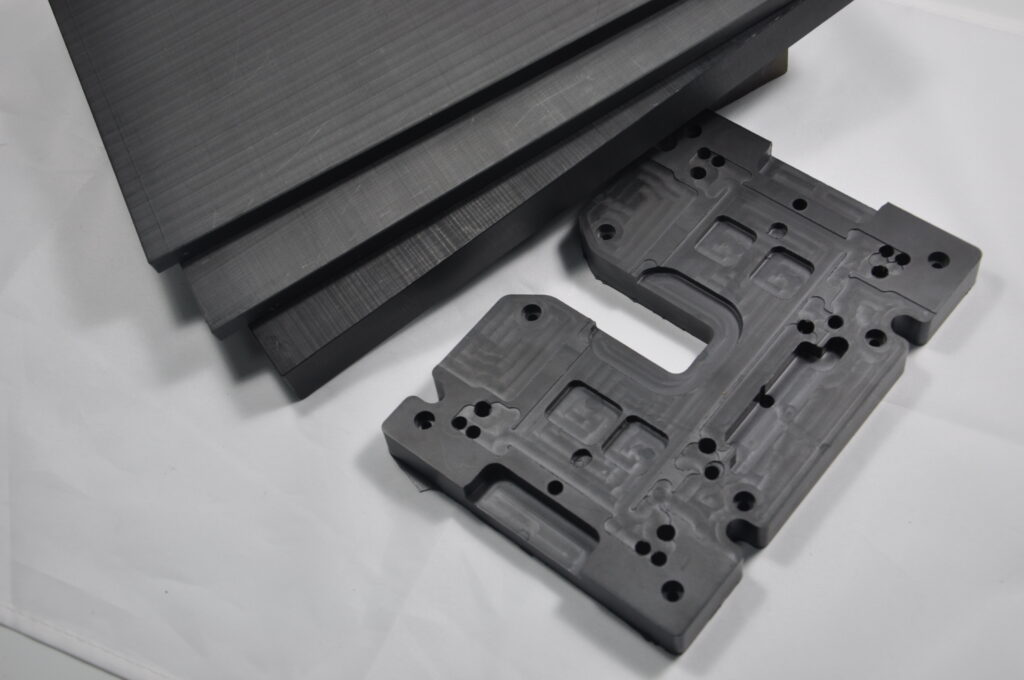
Properties: 3D Printed vs Machined PEEK
Property | Machined PEEK | FDM Printed | SLS Printed |
Tensile strength (MPa) | 90-100 | 50-70 (X-Y) | 70-85 |
Elongation at break (%) | 30-50 | 3-8 | 5-10 |
Isotropy | Isotropic | Anisotropic (weaker in Z) | Near-isotropic |
Surface finish | Excellent | Layer lines visible | Fine grain |
3D printed PEEK has 30-50% lower mechanical properties than machined PEEK, particularly in the Z-axis for FDM.
Applications of PEEK 3D Printing
Aerospace
· Complex ducting with internal channels impossible to machine
· Lightweight lattice structures
· Custom jigs and fixtures
Medical
· Patient-specific surgical guides and implants
· Custom dental frameworks
· Drug delivery devices
Oil & Gas
· Seals with complex cross-sections
· Downhole components with internal flow channels
When to Use 3D Printed vs Machined PEEK
Choose 3D Printed when:
· Geometry is too complex for machining
· Low volume (1-20 pieces)
· Rapid prototyping needed (3-5 day lead time)
· Custom/patient-specific geometry required
Choose Machined when:
· Maximum mechanical properties required
· High-volume production (>50 pieces)
· Tight tolerances (±0.05mm or better)
· Smooth surface finish critical
· See PEEK CNC machining guide
FAQ
Q1: Can PEEK be 3D printed?
Yes, using specialized industrial FDM printers (360-420°C) or SLS systems. Consumer printers cannot process PEEK.
Q2: How strong is 3D printed PEEK vs machined?
30-50% lower tensile strength, especially in Z-axis for FDM. SLS is closer but still 15-25% lower.
Q3: When to use 3D printed vs machined PEEK?
3D printed for complex geometries, low volumes, prototyping. Machined for strength, tight tolerances, smooth surfaces.
Ready to source quality engineering plastics? Contact NAGOMER today for a free quote, or browse our PEEK sheets, POM rods, and ESD materials.
NAGOMER — Professional Engineering Plastics Solutions
www.nagomer.com | info@nagomer.com