News Centre
News Type
Send your inquiry
PA66 Plastic Sheet: Properties, Advantages & Common Applications
PA66 Sheet Properties
Mechanical Properties (Dry Condition)
Property | Value | Standard |
Tensile strength | 85 MPa | ISO 527 |
Tensile modulus | 3.0 GPa | ISO 527 |
Flexural strength | 120 MPa | ISO 178 |
Flexural modulus | 2.8 GPa | ISO 178 |
Impact strength (Charpy, notched) | 12 kJ/m² | ISO 179 |
Hardness (Rockwell) | M85 | ASTM D785 |
Thermal Properties
Property | Value |
Melting point | 260°C |
Glass transition (dry) | 70°C |
HDT (1.8 MPa) | 80°C (dry) |
Continuous service temp | 100°C (dry) |
Thermal conductivity | 0.23 W/m·K |
Physical Properties
Property | Value |
Density | 1.14 g/cm³ |
Water absorption 24h | 1.5% |
Water absorption (saturation) | 8.0% |
Crystallinity | 40–50% |
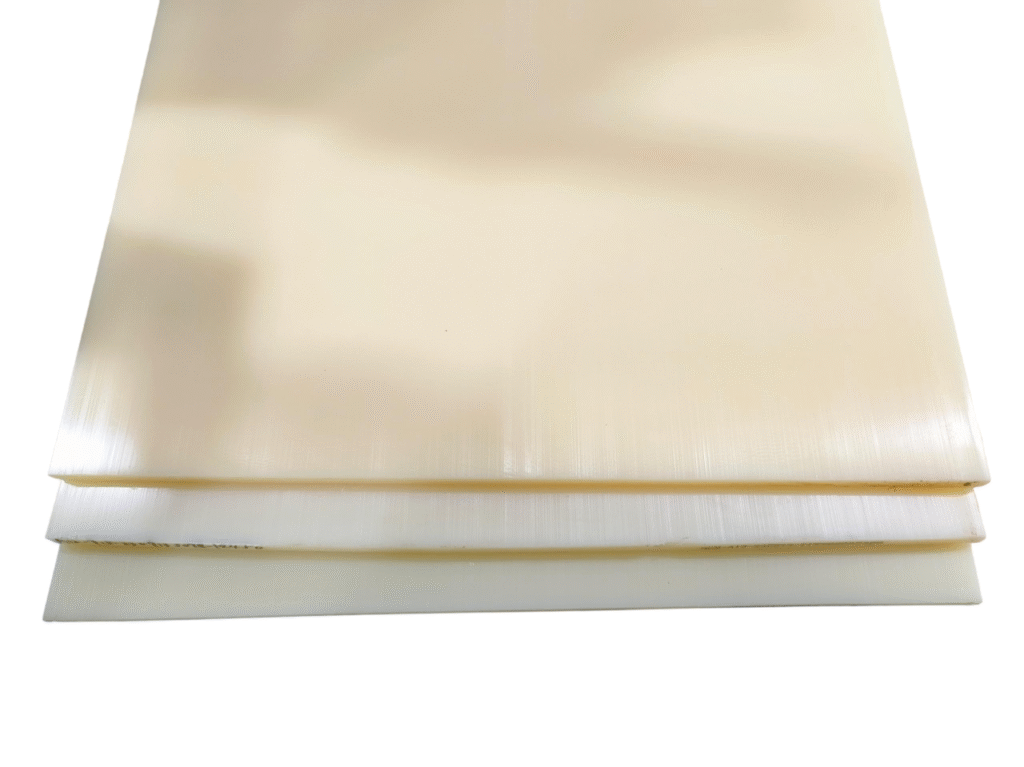
Key Advantages of PA66
High Impact Toughness
PA66‘s most significant advantage is its impact strength — 50% higher than POM and 2× that of PEEK (unfilled). This makes it ideal for components subject to sudden impact loads.
Good Temperature Resistance
With a melting point of 260°C and continuous service temperature of 100°C (dry), PA66 outperforms POM (100°C) and competes with higher-priced materials for moderate-temperature applications.
Excellent Reinforcement Response
PA66 responds exceptionally well to glass fibre reinforcement:
· Unfilled: 85 MPa tensile strength
· PA66 GF30: 180 MPa tensile strength
· PA66 GF50: 220 MPa tensile strength
Glass-filled PA66 can replace die-cast aluminium in many structural applications at half the weight.
Wear Resistance
PA66 has good inherent wear resistance, further enhanced with additives:
· PA66 + MoS2: excellent for bearing and slide applications
· PA66 + PTFE: low-friction sliding components
Limitations of PA66
Moisture Absorption
PA66‘s biggest drawback is its high moisture absorption (up to 8% at saturation), causing:
· Dimensional swelling of 2–3%
· Tensile strength reduction of 30–50%
· Decrease in flexural modulus
· Reduced hardness
For applications in humid or wet environments, POM is often a better choice due to its 0.8% saturation absorption.
UV Degradation
Unprotected PA66 degrades under UV exposure. Black (carbon black filled) grades are required for outdoor applications.
Common Applications
Automotive
· Engine cover components
· Radiator end tanks
· Intake manifolds (glass-filled)
· Door handle mechanisms
· Seat structural components
Consumer Goods
· Power tool housings
· Sports equipment (ski bindings, racket components)
· Furniture structural parts
· Kitchen appliance gears
Electrical & Electronics
· Cable ties and connectors
· Switch housings
· Circuit breaker components
· Terminal blocks
Industrial
· Gear wheels and racks
· Bearing bushes
· Conveyor components
· Pneumatic system parts
For comparison with POM, see our POM vs PA66 guide. For material overview, read our Engineering Plastics Overview.
FAQ
Q1: What is the difference between PA66 and PA6?
PA66 has a higher melting point (260°C vs 220°C), lower moisture absorption, better mechanical properties, and higher heat deflection temperature than PA6. PA66 is preferred for engineering applications, while PA6 is used for cost-sensitive applications where slightly lower performance is acceptable.
Q2: How much moisture does PA66 absorb?
PA66 absorbs up to 8% water by weight at full saturation, which can cause 2–3% dimensional swelling and reduce tensile strength by 30–50%. This is the main drawback of PA66 compared to POM (0.8% saturation absorption). Pre-drying before processing is essential.
Q3: Can PA66 be used outdoors?
Natural PA66 degrades under UV exposure and is not recommended for outdoor use. Black (carbon black filled) PA66 grades have UV resistance and can be used outdoors. For long-term outdoor structural applications, consider UV-stabilised or glass-filled black grades.
Q4: Is PA66 FDA approved for food contact?
No, PA66 is not FDA approved for food contact due to potential amine migration. For food contact applications, use POM (FDA 21 CFR 177.2470/2480), PEEK, or PEI instead.
Looking for PA66 plastic sheets? Contact NAGOMER for specifications and pricing, or explore our PA66 products.
NAGOMER — Professional Engineering Plastics Solutions
www.nagomer.com | info@nagomer.com