
News Centre
News Type
Send your inquiry
PA6 vs PA66 Selection Guide: Properties, Applications, and Cost Comparison
PA6 and PA66: Understanding the Nylon Family
PA6 (Nylon 6) and PA66 (Nylon 66) are the two most widely used polyamide engineering plastics. Together they account for approximately 25% of global engineering plastics consumption. Despite their chemical similarity and often interchangeable appearance, PA6 and PA66 have distinct property profiles that make each better suited for specific applications.
PA6 is produced by ring-opening polymerization of caprolactam, while PA66 is produced by condensation polymerization of hexamethylene diamine and adipic acid. This seemingly subtle difference in chemistry results in meaningful differences in crystallinity, melting point, moisture absorption, and mechanical properties.
This guide provides engineers and procurement professionals with a clear framework for selecting between PA6 and PA66 based on application requirements.
Mechanical Properties Comparison
PA66 generally offers superior mechanical properties at both room and elevated temperatures:
Tensile strength: PA66 typically achieves 80-85 MPa at 23C dry, compared to 70-80 MPa for PA6. The difference becomes more pronounced at elevated temperatures.
Flexural modulus: PA66 at 2,800-3,000 MPa vs PA6 at 2,400-2,800 MPa (dry). PA66‘s higher crystallinity contributes to its greater stiffness.
Impact strength: PA6 typically offers slightly better impact resistance, particularly at low temperatures. This is due to PA6‘s slightly lower crystallinity, which provides more amorphous regions for energy absorption.
Hardness: PA66 is harder (Rockwell M85-90) than PA6 (M80-85), making it more wear-resistant in many applications.
For NAGOMER‘s PA6 (A12N/B) and PA66 (A6612N) grades, we provide detailed mechanical property datasheets including conditioned (moisture-equilibrated) values.
Moisture Absorption: The Critical Difference
Moisture absorption is one of the most important differentiating factors:
PA6 absorbs approximately 2.5-3.0% moisture at 50% RH equilibrium, while PA66 absorbs approximately 2.0-2.5%. This may seem modest, but moisture acts as a plasticizer, significantly affecting mechanical properties:
Tensile strength decreases by 40-50% when conditioned vs dry. Elongation at break increases dramatically. Impact strength typically improves. Dimensions change as the material swells (0.2-0.3% per 1% moisture absorption).
The practical implication: PA66 parts generally maintain better dimensional stability and strength in humid environments than PA6 parts. For precision components exposed to variable humidity, PA66 is usually preferred. For less demanding applications where cost is the primary concern, PA6 is often the economical choice.
Thermal Performance and Processing
PA66 offers superior thermal performance:
Melting point: PA66 at 260C vs PA6 at 220C. Heat deflection temperature (1.82 MPa): PA66 at 75-90C vs PA6 at 65-75C. Continuous service temperature: PA66 up to 120C vs PA6 up to 100C.
For under-hood automotive applications where temperatures routinely exceed 100C, PA66 is almost always specified. For general industrial applications operating at ambient temperatures, PA6 is often sufficient.
Both materials machine well, but PA6‘s lower melting point means it is slightly more forgiving during machining with less tendency to gum up cutting tools. Both benefit from annealing before final machining to relieve internal stresses and improve dimensional stability.
Application Recommendations
Prefer PA66 when: Operating temperature exceeds 80C. Dimensional stability in humid environments is critical. Maximum strength and stiffness are required. The application involves gears or bearings where wear resistance matters. Automotive under-hood applications are the target.
Prefer PA6 when: Cost is the primary consideration. The application operates at moderate temperatures. Impact resistance is more important than stiffness. Easier machinability is beneficial. These are general industrial components.
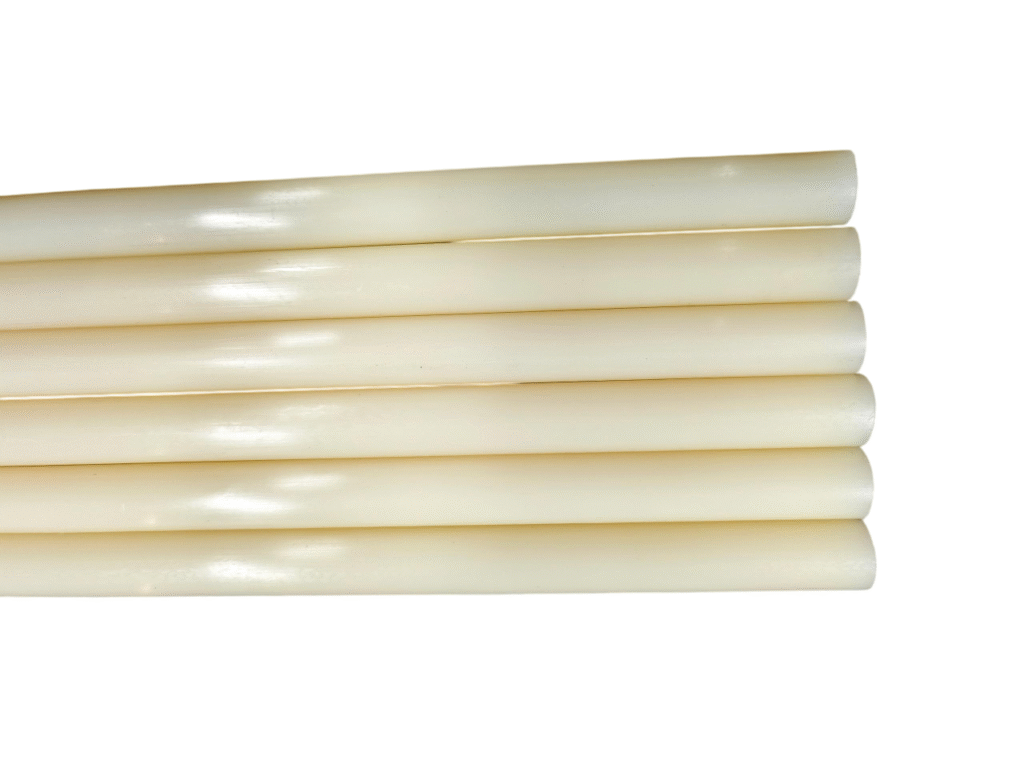
NAGOMER supplies both PA6 and PA66 in natural (white/cream) and black grades, as sheets and rods in standard and custom sizes.
Need help selecting between PA6 and PA66? Contact NAGOMER for technical consultation and free material samples at nagomer.com.