
News Centre
News Type
Send your inquiry
High-Performance Engineering Plastics: A Complete Material Overview 2026The Engineering Plastics Hierarchy
Engineering plastics are categorised by performance tier:
|
Tier |
Materials |
Continuous Service Temp |
Price (USD/kg) |
|
Commodity |
PP, PE, PVC, ABS |
50–80°C |
$1–3 |
|
Engineering |
80–120°C |
$3–8 |
|
|
Advanced Engineering |
150–180°C |
$10–25 |
|
|
High-Performance |
PEEK, PAI, PBI, LCP |
200–260°C |
$40–200 |
NAGOMER specialises in the upper tiers — from POM through PEEK — where performance demands exceed commodity plastics.
Material Family Profiles
PEEK (Polyetheretherketone)
· Service temperature: 250°C continuous
· Key strength: Best all-around high-performance plastic
· Applications: Semiconductor, medical implants, aerospace, oil & gas
· Price: $85–110/kg (unfilled)
· NAGOMER grades: NGM-S12B (natural), GF30, CF30, bearing grade
POM (Polyoxymethylene / Polyacetal)
· Service temperature: 100°C continuous
· Key strength: Best machinability and cost-performance ratio
· Applications: Gears, bearings, food processing, semiconductor handling
· Price: $4–8/kg
· NAGOMER grades: NGM-POM-H, NGM-POM-C, NGM-PESD (ESD)
PPS (Polyphenylene Sulfide)
· Service temperature: 200°C continuous
· Key strength: Chemical resistance and dimensional stability
· Applications: Automotive under-hood, electrical connectors, chemical processing
· Price: $8–15/kg
PEI (Polyetherimide / ULTEM)
· Service temperature: 170°C continuous
· Key strength: Inherent flame retardancy and high strength
· Applications: Aerospace interiors, medical, electrical insulation
· Price: $20–35/kg
· NAGOMER grades: PEI sheet and rod
PA66 (Nylon 66 / Polyamide 66)
· Service temperature: 100°C continuous (120°C short-term)
· Key strength: High impact strength and toughness
· Applications: Automotive, consumer goods, industrial components
· Price: $3–6/kg
· NAGOMER grades: PA66 sheet and rod
PTFE (Polytetrafluoroethylene / Teflon)
· Service temperature: 260°C continuous
· Key strength: Lowest friction coefficient and chemical inertness
· Applications: Seals, gaskets, chemical processing, electrical insulation
· Price: $8–15/kg
· NAGOMER grades: PTFE sheet and rod
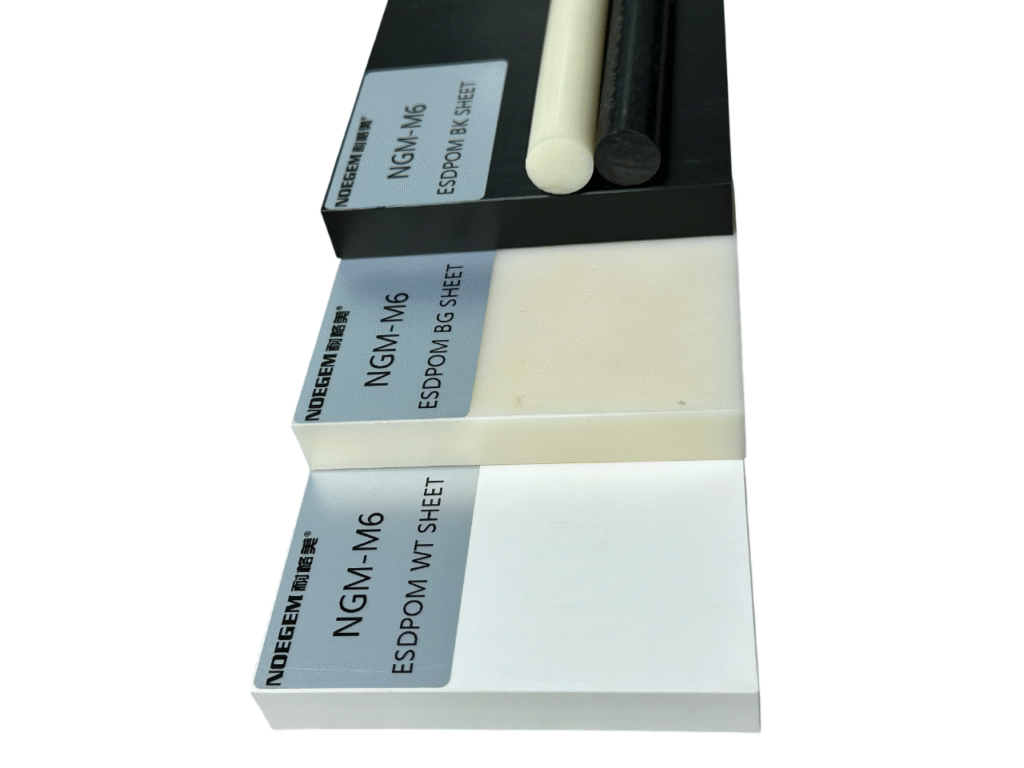
ESD Variants
· Materials: ESD POM, ESD PEEK, ESD PEI
· Key strength: Static dissipative (10^6–10^9 Ω/sq)
· Applications: Semiconductor, electronics, explosive environments
· Price: 1.5–3× base material cost
Selection Decision Tree
· Temperature requirement?→ PEEK or PTFE > 200°C
· Need structural strength?–→ PEEK
· Need chemical inertness? → PTFE
· Need chemical resistance? → PPS
· Need flame retardancy? → PEI
· ─ 80–150°C → PA66 or POM
· Need impact strength? → PA66
· Need dimensional stability? → POM
· ESD protection needed? → ESD POM
· < 80°C → Commodity plastics (not NAGOMER focus)
Cross-Material Property Comparison
Property | PEEK | PPS | PEI | PA66 | PTFE | |
Tensile (MPa) | 98 | 70 | 100 | 70 | 80 | 25 |
Service temp (°C) | 250 | 200 | 170 | 100 | 100 | 260 |
Chemical resist. | ★★★★ | ★★★★★ | ★★★ | ★★★ | ★★ | ★★★★★ |
Cost index | 100 | 15 | 25 | 5 | 4 | 10 |
Machinability | ★★★★ | ★★★ | ★★★★ | ★★★★★ | ★★★★ | ★★ |
Wear resistance | ★★★★ | ★★★ | ★★★ | ★★★★★ | ★★★ | ★★★★★ |
FDA compliant | ✓ | ✗ | ✓ | ✓ | ✗ | ✓ |
For detailed comparisons, see our PEEK vs PTFE guide and POM vs PA66 guide.
FAQ
Q1: Which engineering plastic has the highest temperature resistance?
PEEK (250°C continuous) and PTFE (260°C continuous) offer the highest temperature resistance among commonly available engineering plastics. For extreme temperatures above 260°C, specialty materials like PAI (Aramid) or PBI can be used but at significantly higher cost.
Q2: What is the most cost-effective engineering plastic?
POM (polyoxymethylene) is the most cost-effective engineering plastic for the majority of industrial applications. At $4–8/kg, it offers excellent mechanical properties, machinability, and wear resistance at a fraction of the cost of high-performance plastics like PEEK.
Q3: Which engineering plastic is best for semiconductor applications?
PEEK is the premium choice for semiconductor components due to its purity, high temperature resistance, and mechanical strength. ESD POM is the cost-effective alternative for wafer handling components where temperature is not a concern. The choice depends on the specific process requirements.
Q4: Can engineering plastics replace metal?
Yes, engineering plastics can replace metal in many applications, offering 50–70% weight reduction, corrosion resistance, and design flexibility. PEEK and PEI can replace aluminium in structural components, while POM replaces brass/bronze in wear applications. Material substitution requires careful engineering analysis.
Need help selecting the right engineering plastic? Contact NAGOMER for expert material advice, or browse our full product range: PEEK, POM, ESD materials.
NAGOMER — Professional Engineering Plastics Solutions
www.nagomer.com | info@nagomer.com