
News Centre
News Type
Send your inquiry

Fuel Cell Plastics: PEEK, PPS and PTFE Components
Fuel Cell Plastics Inside a Hydrogen Stack
A fuel cell converts hydrogen into electricity with only water as exhaust. Inside the stack, however, conditions are harsh: hot gases, humidified streams, acidic membranes, and high clamping forces. Fuel cell plastics handle the insulation, sealing, and framing duties that metals cannot. Three engineering polymers appear again and again: PEEK for hot structural parts, PPS for cost-effective frames, and PTFE for seals and dielectric barriers.
Moreover, the stack’s clamping force compresses every seal evenly. Any variation in plate thickness changes that force locally. Therefore, flatness tolerances are tight across the whole stack. Precision parts make assembly predictable.
Each polymer earns its place through a different strength. PEEK resists high temperature and steam while holding stiffness. PPS offers similar chemical resistance at a lower price, which matters for large stacks. PTFE, meanwhile, provides the lowest friction and best sealing compliance in gaskets. Together, these fuel cell plastics cover the mechanical, thermal, and sealing needs of both PEM and solid-oxide designs.
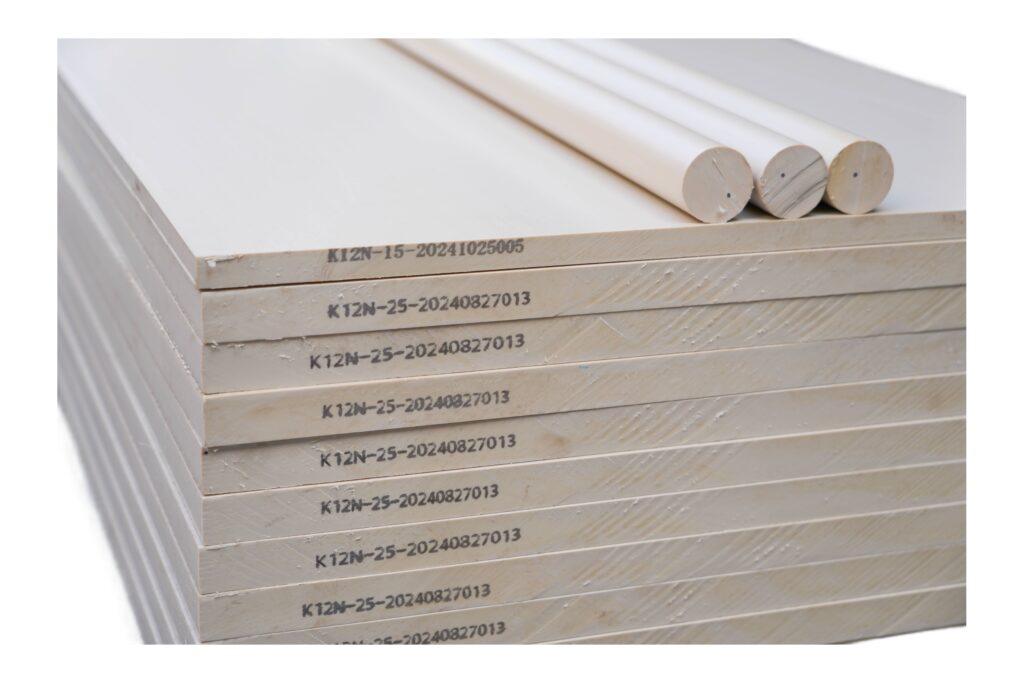
PEEK: Structural Parts in the Hot Zone
PEM fuel cells run near 80 degrees Celsius, but solid oxide cells operate above 600 degrees. Between those extremes, balance-of-plant components see hot, humid gas streams. PEEK supports service near 250 degrees Celsius continuous, and it shrugs off the acidic condensate that forms in fuel and oxidant lines. Therefore, PEEK appears in end plates, manifolds, valve bodies, and sensor housings in the hot zone.
Furthermore, hydrogen is a small molecule that seeks leaks. Polymer parts with good dimensional control help contain it. As a result, sealing systems combine soft gaskets with rigid frames. Each layer has a defined job.
Furthermore, PEEK‘s dimensional stability keeps sealing surfaces flat under stack compression. Its low moisture uptake prevents the swelling that could relax a gasket. In addition, PEEK is electrically insulating, which prevents short circuits where conductive hardware passes near cell voltage. For the most demanding positions, carbon-fiber-reinforced PEEK adds stiffness, though design care is needed to keep the part non-conductive where insulation is required.
PPS: Balanced Performance for Frames and Manifolds
Not every stack component needs the top-temperature capability of PEEK. Bipolar plate frames, gas distribution manifolds, and stack housings often use PPS. Glass-filled PPS provides high stiffness, low creep, and excellent resistance to the humid, mildly acidic environment of a PEM stack. In addition, PPS is inherently flame resistant and dimensionally stable, which helps stack assembly hold tolerances.
Furthermore, PPS frames keep their flatness through humid cycling. In addition, low moisture uptake holds manifold bolt torque stable over time.
For example, busbar insulators isolate the stack voltage from the chassis. PTFE and PEEK both serve this role well. Meanwhile, sensors and fittings add complexity at the stack edges. Material selection should include every auxiliary component.
Cost drives the choice. Because PPS is significantly less expensive than PEEK, stack designers use it wherever temperature stays below roughly 200 degrees Celsius. Furthermore, PPS resists hydrogen permeation better than many thermoplastics, reducing leakage through thin frame sections. For high-volume automotive stacks, PPS frames can be injection molded, while prototype and low-volume stacks use PPS parts machined from sheet and rod.
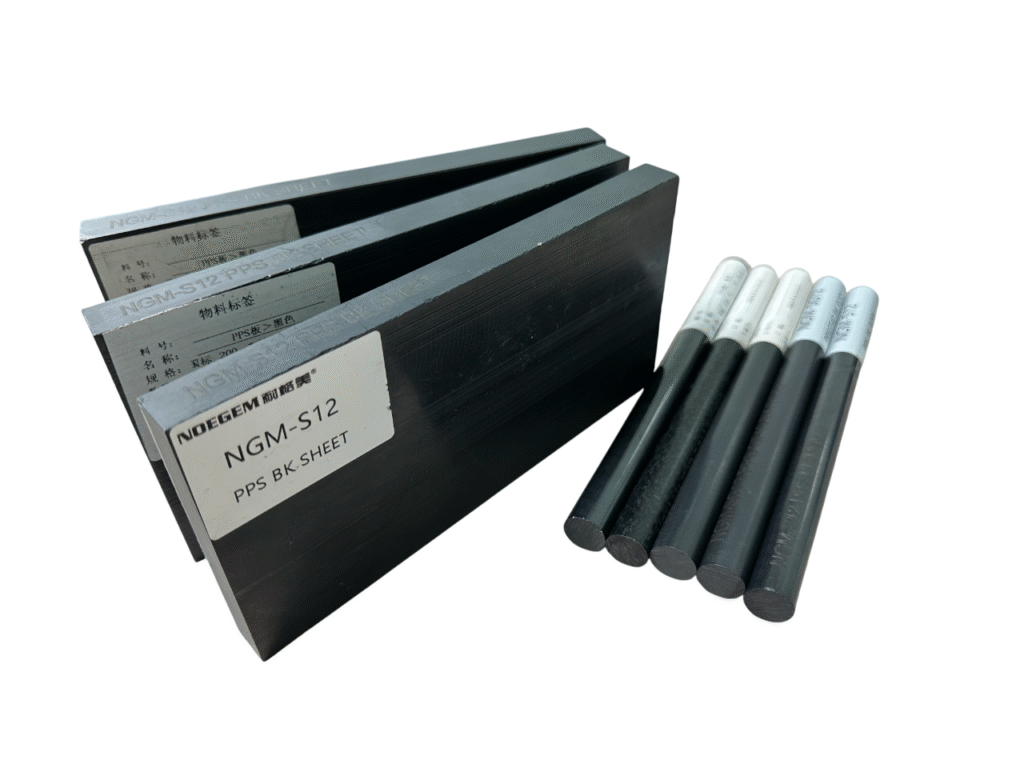
PTFE: Seals and Dielectric Barriers
Sealing a fuel cell stack is a constant challenge. The stack must contain hydrogen, separate gas streams, and hold coolant without leaks across hundreds of cells. PTFE gaskets and seals excel here because the material compresses easily, conforms to surfaces, and resists every chemical in the system. In addition, PTFE‘s very low friction prevents cold flow into flow fields when the stack is clamped.
In addition, documentation speeds up safety certification. Traceable material data answers questions from testing laboratories. Therefore, suppliers who provide full reports reduce project risk. NAGOMER delivers this level of support.
PTFE also acts as a dielectric barrier. Busbar insulators and feed-through plates made from PTFE isolate high voltage from the stack enclosure. Moreover, PTFE film and machined parts withstand the temperature of PEM systems indefinitely. For solid oxide systems, where temperatures exceed PTFE‘s 260-degree limit, designers move to mica or ceramic, but PTFE remains the standard in PEM fuel cell plastics.
Moreover, PTFE‘s high dielectric strength permits thinner insulation barriers. For example, a compact feed-through can isolate a conductor where bulkier materials would not fit.
Moreover, PTFE‘s high dielectric strength permits thinner insulation barriers. For example, a compact feed-through can isolate a conductor where bulkier materials would not fit.
Choosing Fuel Cell Plastics for Your Stack Design
Material selection starts with the cell chemistry and operating temperature. PEM stacks at 80 degrees can use PPS frames and PTFE seals, with PEEK reserved for hot balance-of-plant parts. SOFC systems need ceramics and metals in the hot core, while PEEK and PPS serve the cooler periphery. In every case, the designer must verify chemical resistance to the specific coolant and cleaning agents used.
Prototyping favors machined parts, which is where stock suppliers add value. NAGOMER Engineering Plastics, nagomer.com, supplies PEEK, PPS, and PTFE in sheet, rod, and tube form for fuel cell developers. The company machines manifolds, insulator plates, gasket blanks, and frames to drawing, and provides the material documentation that stack developers need for qualification testing.
Developing a hydrogen stack? NAGOMER supplies PEEK, PPS, and PTFE stock plus machined fuel cell plastics components. Contact info@nagomer.com for material data.