
News Centre
News Type
Send your inquiry
ESD POM Sheet vs Standard POM: Key Differences and Selection Guide
Understanding Standard POM Sheet
Standard POM sheet — available in both homopolymer (Delrin-type) and copolymer grades — offers:
l Tensile strength: 60–70 MPa
l Operating temperature: –40°C to 100°C (continuous)
l Low moisture absorption: 0.22% (copolymer) at saturation
l Excellent dimensional stability
l Good wear and friction properties
l Surface resistivity: typically 10^13–10^14 ohms/sq (insulative)
Standard POM is ideal for mechanical parts, gears, bearings, and food-contact components where static electricity is not a concern.
What Makes ESD POM Different?
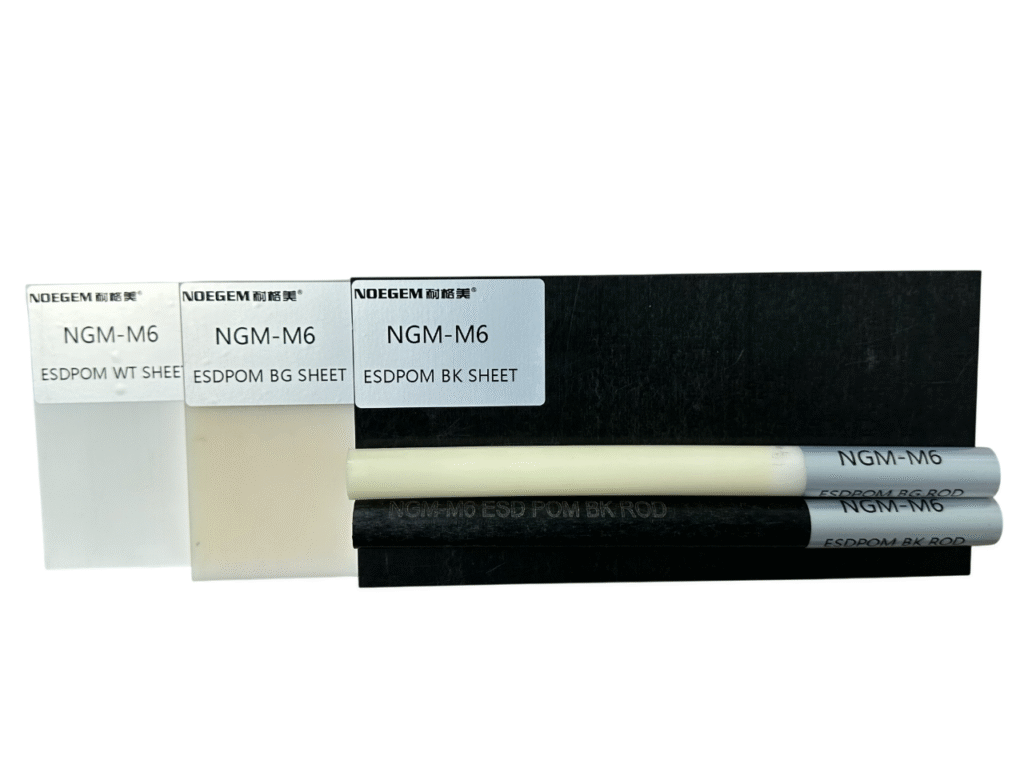
ESD POM (also called anti-static or static-dissipative POM) is a modified grade that incorporates conductive carbon or proprietary additive packages to achieve a controlled surface resistance range:
| Property | Standard POM | ESD POM
| Surface resistivity | 10^13–10^14 Ω/sq | 10^6–10^9 Ω/sq
| Volume resistivity | 10^14 Ω·cm | 10^6–10^8 Ω·cm
| Colour | Natural (white) / Black | Black (typically)
| Charge decay time | N/A (insulative) | < 0.05 seconds
| Cost | Lower | 1.5–2.5× higher
| Mechanical properties | Baseline | Slightly reduced impact strength
The key distinction is that ESD POM actively dissipates static charges rather than allowing them to accumulate. This is critical in environments where a single electrostatic discharge event can destroy semiconductor wafers, microprocessors, or precision electronics worth thousands of dollars.
When to Choose ESD POM vs Standard POM
Choose ESD POM when:
· Manufacturing components for semiconductor cleanrooms (wafer carriers, transport cassettes, handling trays)
· Building ESD-safe workstations and EPA (Electrostatic Protected Area) furniture
· Producing parts for electronics assembly lines (guide rails, pick-and-place nozzles)
· Handling explosive or flammable materials where static sparks are hazardous
· Operating in low-humidity environments where static build-up is more likely
Choose Standard POM when:
· Mechanical parts with no ESD risk (gears, bushings, conveyor links)
· Food and beverage applications (FDA-compliant natural grades)
· Cost-sensitive projects where static dissipation is unnecessary
· Outdoor or high-UV environments (black carbon-filled grades)
NAGOMER‘s ESD POM Products
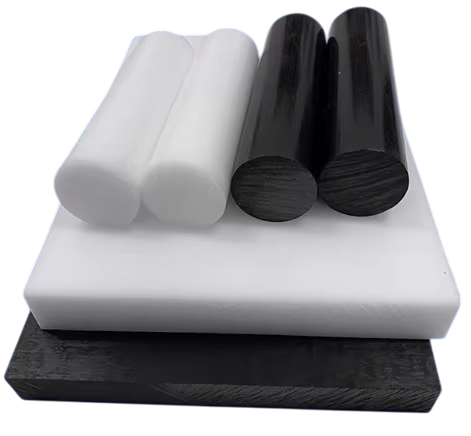
· NAGOMER offers ESD POM in both sheet and rod forms:
· ESD POM Sheet (NGM-PESD-S) — 1000×2000mm sheets, 5–50mm thickness, surface resistance 10^6–10^8 Ω/sq
· ESD POM Rod M6B — diameter 6–200mm, ideal for machined semiconductor components
For more on ESD material selection across all plastic types, see our ESD Plastic Materials Selection Guide. To learn about ESD POM in semiconductor applications, read ESD POM in Semiconductor Cleanroom.
FAQ
Q1: What is the surface resistance of ESD POM sheet?
ESD POM sheet typically has a surface resistance of 10^6 to 10^9 ohms per square, which falls in the static-dissipative range. This allows controlled dissipation of static charges without creating sparks.
Q2: Can ESD POM be used in cleanroom environments?
Yes, ESD POM is specifically designed for semiconductor and electronics cleanroom environments. It meets the particle and outgassing requirements of ISO Class 5 (Class 100) cleanrooms when properly processed.
Q3: Is ESD POM more expensive than standard POM?
Yes, ESD POM typically costs 1.5 to 2.5 times more than standard POM due to the conductive additives and specialized manufacturing process required. However, the cost is justified by preventing ESD damage to expensive electronic components.
Q4: What colour is ESD POM available in?
ESD POM is typically available in black, as the conductive carbon additives give the material its dark colour. Some manufacturers offer custom colours, but black is the standard and most reliable option.
Need ESD POM sheets for your semiconductor application? Contact NAGOMER for technical data sheets and pricing, or explore our ESD POM products and standard POM sheets.
NAGOMER — Professional Engineering Plastics Solutions
www.nagomer.com | info@nagomer.com