
News Centre
News Type
Send your inquiry
ESD Cleanroom Materials Selection Guide: Engineering Plastics for Controlled Environments
Cleanroom Material Requirements: Beyond ESD Protection
Cleanroom environments impose some of the most stringent material requirements found in any industry. Materials used in cleanrooms must simultaneously satisfy multiple, often competing, requirements:
Electrostatic discharge (ESD) protection to prevent damage to sensitive electronic components. Low particle emission to maintain cleanroom classification. Low outgassing to prevent contamination of processes and products. Chemical resistance to cleaning agents and process chemicals. Mechanical performance for structural and functional applications.
Engineering plastics, particularly ESD grades of high-performance polymers, have become essential materials for cleanroom equipment, fixtures, and tooling. This comprehensive guide covers the key considerations and material recommendations for cleanroom applications.

ISO 14644 Cleanroom Classifications and Material Implications
ISO 14644-1 defines cleanroom classifications based on maximum allowable particle concentrations:
ISO Class 1-3 (most stringent): Semiconductor wafer fabrication at advanced nodes. Requires materials with near-zero particle emission and ultra-low outgassing. Only the highest-grade ESD PEEK and ESD PEI are typically suitable.
ISO Class 4-6: Semiconductor packaging, advanced electronics assembly, pharmaceutical aseptic processing. ESD PEI, ESD PPS, and ESD POM are commonly used, with careful attention to surface finish and cleaning protocols.
ISO Class 7-8: General electronics assembly, medical device manufacturing. A wider range of ESD engineering plastics including ESD ABS and ESD PC can be considered.
The cleanroom classification directly drives material selection because it determines acceptable particle emission limits and influences the frequency and aggressiveness of cleaning procedures.
Particle Emission and Surface Properties
Particle emission from engineering plastics depends on several factors:
Material composition: Filled and reinforced grades typically generate more particles than unfilled grades. Glass fiber reinforcement can be particularly problematic if fibers protrude from the surface.
Surface finish: Machined surfaces generally produce fewer particles than molded surfaces if properly finished. Surface roughness (Ra) below 0.8 um is recommended for ISO Class 5 and below.
Wear characteristics: Materials used in sliding or rotating applications must have excellent wear resistance to minimize particle generation over time. PTFE-filled and carbon fiber-reinforced grades offer the best wear performance.
NAGOMER provides ESD materials with optimized surface finishes for cleanroom applications, including post-machining cleaning and packaging in cleanroom-compatible materials.
Outgassing: The Hidden Contamination Risk
Outgassing of volatile compounds from plastics can cause serious contamination issues:
Condensation on optical surfaces: Outgassed compounds can condense on lenses, mirrors, and sensors.
Chemical interference: Volatile organic compounds (VOCs) can affect sensitive chemical processes.
Thin film contamination: In semiconductor manufacturing, even monolayer-level contamination can affect device performance.
PEEK and PEI are among the lowest-outgassing engineering plastics, making them preferred choices for the most demanding cleanroom applications. PPS also offers low outgassing characteristics. Nylon and POM may release small amounts of formaldehyde and should be evaluated carefully for sensitive applications.
Material Recommendations by Application
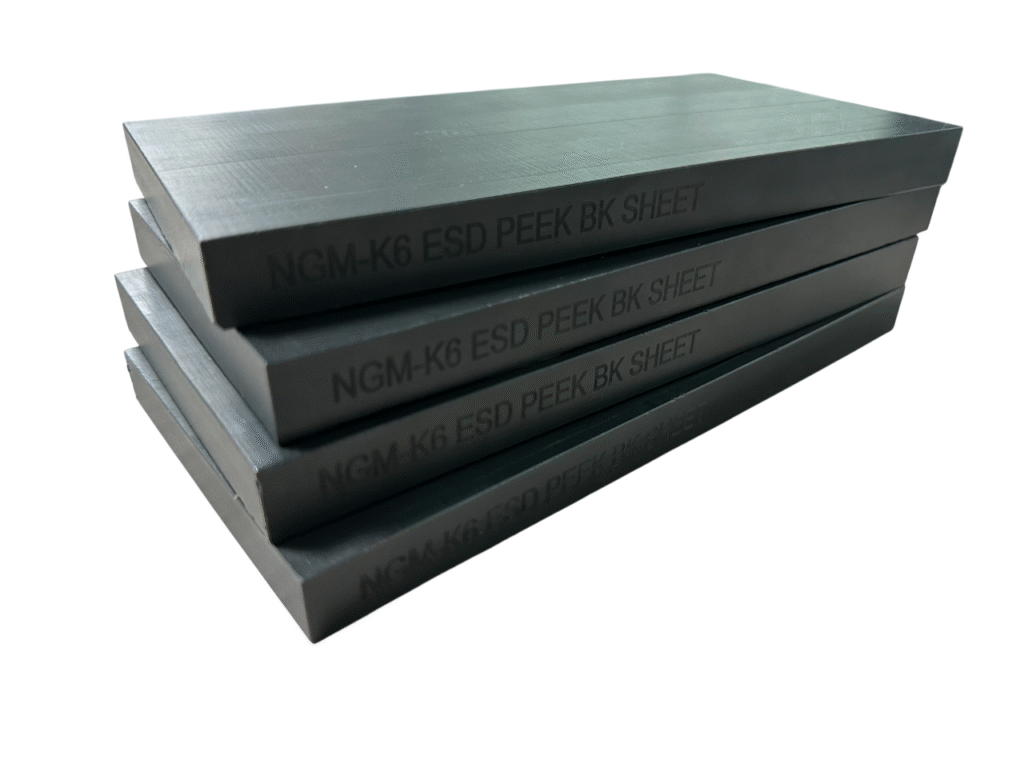
For semiconductor wafer fabrication (ISO 1-4): ESD PEEK K6B is the top recommendation for wafer carriers, end effectors, and process tool components. Its ultra-low outgassing, excellent chemical resistance, and high-temperature capability meet the most demanding requirements.
For electronics assembly (ISO 5-7): ESD PEI I6B offers an excellent cost-performance balance for assembly fixtures, test sockets, and handling tools. ESD POM M6B is suitable for less demanding applications where cost is a primary concern.
For pharmaceutical cleanrooms (ISO 5-8): ESD PPS S6B provides the chemical resistance needed for aggressive cleaning and sterilization agents. Its dimensional stability ensures consistent performance through repeated autoclave cycles.
Contact NAGOMER for cleanroom-grade material samples with full certification documentation.
Request cleanroom-grade ESD material samples from NAGOMER. Visit nagomer.com or email info@nagomer.com for technical consultation.