
News Centre
News Type
Send your inquiry
Engineering Plastics for Food & Beverage Processing: Compliance and Material Guide
Regulatory Requirements Explained
Food-contact compliance is the first filter in material selection:
· FDA 21 CFR — the benchmark for food contact in the United States
· EU Regulation 10/2011 and EC 1935/2004 — European food-contact framework
· USP Class VI / ISO 10993 — relevant where pharma-adjacent hygiene applies
· Blue metal-detectable grades — standard in many meat and bakery lines for contamination control
Recommended Materials by Application
|
Component |
Recommended Material |
Why |
|
Conveyor guide rails & wear strips |
UHMW-PE |
Very low friction, impact resistant, quiet |
|
Star wheels & timing screws |
POM-C (natural or blue detectable) |
Dimensional stability, FDA grade, low wear |
|
High-temperature guides & insulators |
Natural PEEK |
Steam resistant, chemically inert |
|
Scraper blades & non-stick surfaces |
PTFE |
Release properties, widest chemical resistance |
|
Rollers & bushings |
PA66 (food-grade) |
Tough, dampening, wear resistant |
|
Seals & gaskets in CIP loops |
Filled PTFE |
Resists caustic and acid cleaning agents |
Surviving CIP Cleaning and Steam
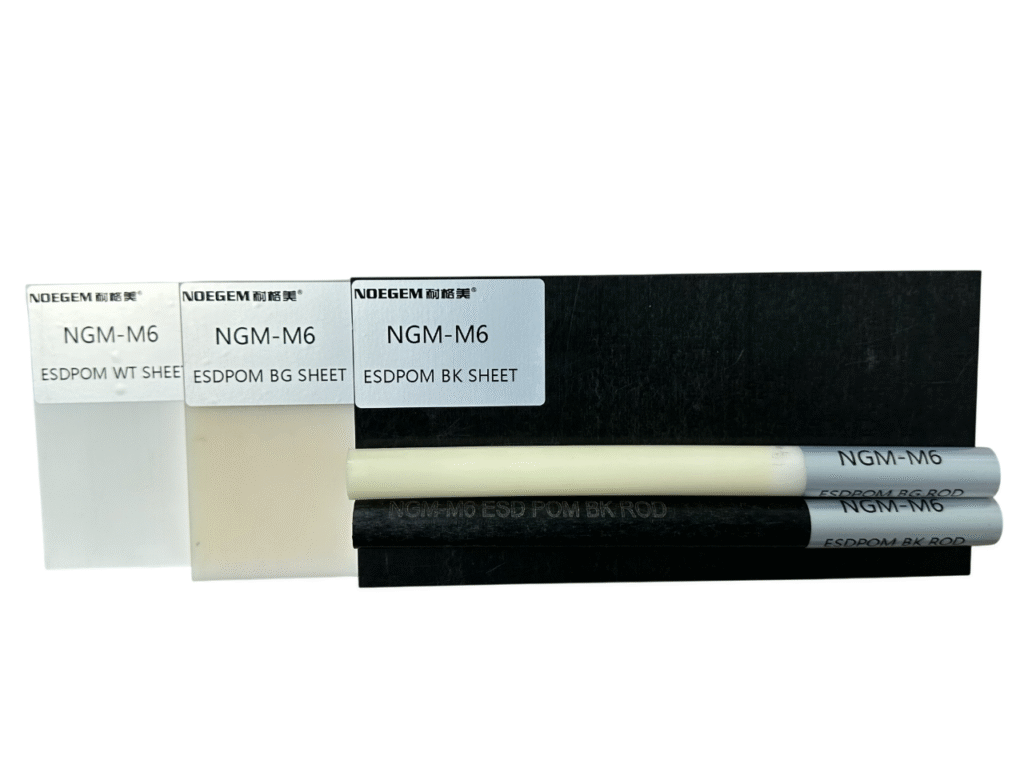
Clean-in-place (CIP) routines expose plastics to caustic soda, nitric acid, and 121°C steam. Natural PEEK handles repeated steam cycles without hydrolysis; POM-C resists most cleaning agents but should not see sustained strong alkali; PTFE resists essentially all CIP chemistry. Matching the material to the cleaning regime prevents premature replacement and contamination risk.
Why Replace Stainless Steel?
Plastic guides and wear parts run dry or with minimal lubrication, eliminating food-safe lubricant costs; they cannot seize or gall against product contact surfaces; and they cut noise on high-speed lines. Weight reduction also simplifies changeovers and reduces drive loads.
Hygienic Design Considerations
Material compliance is only half the story — the shape and installation of plastic components decide whether a line can actually be kept clean. Design parts and mounting arrangements so that product contact surfaces are smooth, continuous, and free of crevices where residue can build up. Use generous radii instead of right angles wherever guides meet frames, and prefer tool-free, quick-release fittings so components can be lifted out for inspection during changeovers. Colour-coding by line or product type helps operators spot misplaced parts instantly, while blue detectable grades make any fragment visible against food matrices. Finally, set a documented inspection interval for wear parts such as guide rails and star wheels: replacing them on schedule costs far less than a contamination incident or an unplanned line stop.
For more on compliant materials, see our Engineering Plastic Certifications guide and POM Plastic Sheet Properties guide.
FAQ
Q1: Which engineering plastics are food safe?
Natural PEEK, POM-C, UHMW-PE, PA66, and PTFE are all available in FDA-compliant grades. Always request the declaration of compliance for the exact grade and colour.
Q2: What are metal-detectable plastics?
Blue, metal-detectable POM and PE grades contain a detectable filler so that fragments can be caught by inline metal detectors — standard practice in meat, poultry, and bakery processing.
Q3: Can plastics survive 121°C steam sterilisation?
Natural PEEK and PTFE withstand repeated steam cycles at 121°C. POM-C, PA66, and UHMW-PE are limited to lower temperatures and should be positioned away from SIP zones.
Q4: Do plastic guide rails wear faster than stainless steel?
No — against stainless chains and glass, UHMW-PE and POM typically outlast steel guides several times over because they do not gall and they are gentler on mating surfaces.
Q5: Is UHMW-PE suitable for cutting surfaces?
Yes. UHMW-PE is widely used for cutting boards and scrapers thanks to its low moisture uptake and knife-friendliness.
Specify food-compliant engineering plastics with confidence — contact NAGOMER for FDA-grade sheets, rods, and machined parts with full documentation.
────────────────────────────────────────
NAGOMER — Professional Engineering Plastics Solutions
www.nagomer.com | info@nagomer.com