
News Centre
News Type
Send your inquiry
Conductive vs ESD vs Insulating Engineering Plastics: A Complete Selection Guide
The Static Control Spectrum
Static electricity is one of the most underestimated threats in modern manufacturing. An electrostatic discharge of as little as 100 volts can damage or destroy sensitive semiconductor devices. In explosive environments, a static spark can ignite vapors or dust. In high-speed manufacturing, static attraction causes contamination, material jamming, and product defects.
The solution lies in selecting the right electrical property in your engineering plastic — but the terminology is often misunderstood. “Conductive,” “ESD,” and “insulating” describe distinct points on the electrical resistance spectrum, and choosing the wrong one can be as dangerous as using no protection at all.

Understanding Surface Resistivity
Surface resistivity, measured in ohms per square (Ω/sq), is the primary metric for categorizing a material’s electrical behavior. The classification follows internationally recognized standards (ANSI/ESD S20.20, IEC 61340-5-1).
The critical distinction is between ESD (dissipative) and conductive materials. ESD materials dissipate charge slowly enough to prevent damaging discharge currents. Conductive materials dissipate charge rapidly, which can itself create a discharge event if the charge finds a path through a sensitive component.
Category | Surface Resistivity | Function |
Insulating | >10¹² Ω/sq | Prevents current flow; isolates components |
Anti-static | 10⁹-10¹² Ω/sq | Reduces triboelectric charging |
ESD (Dissipative) | 10⁶-10⁸ Ω/sq | Controlled charge dissipation |
Conductive | 10²-10⁵ Ω/sq | Rapid charge dissipation; EMI shielding |
When to Use Each Category
Insulating (>10¹² Ω/sq): Insulating plastics prevent current flow between electrical components. NAGOMER’s standard grades of PPO, PEEK, PEI, PPS, PC, and PA all serve as insulators. PPO (NAGOMER O12N/B) is particularly valued for its excellent dielectric properties.
ESD Dissipative (10⁶-10⁸ Ω/sq): ESD materials provide controlled static dissipation — fast enough to prevent charge accumulation, slow enough to avoid damaging discharge. The standard for semiconductor manufacturing, cleanroom components, IC trays, test sockets, and workstation surfaces.
Conductive (10²-10⁵ Ω/sq): Conductive plastics provide rapid charge dissipation and electromagnetic shielding. Used for ATEX environments, EMI/RFI shielding, Faraday cage containers, and grounding components. Important: conductive materials should not contact energized electronics directly.
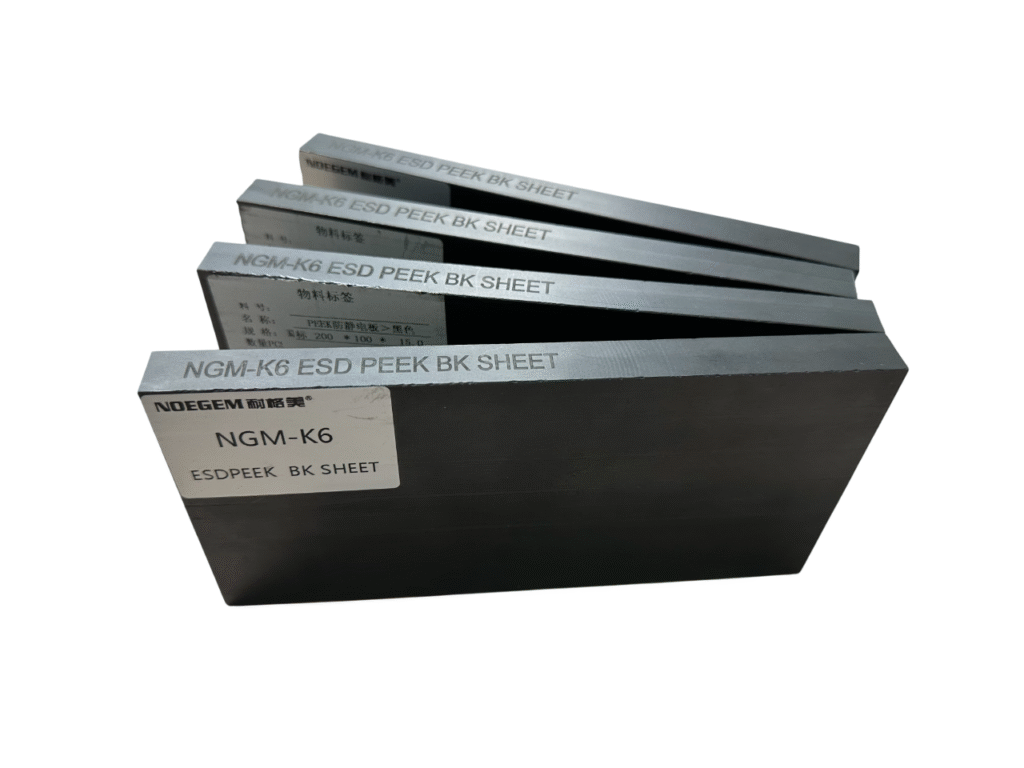
NFP Zero-Powder ESD Technology
NAGOMER offers the industry’s most comprehensive ESD product range: ESD PEEK (K6B), ESD PEI (I6B), ESD PPS (S6B), ESD POM (NFP Series), ESD PA6 (A6B), ESD ABS (B6B), and ESD PTFE (NGM-F6B) — all at 10⁶-10⁸ Ω/sq.
The NFP advantage: Traditional ESD plastics achieve dissipative properties through carbon black fillers that can shed particles, contaminating sensitive components. NAGOMER‘s NFP (Non-Flaking Powder) technology delivers verified zero-particle-shedding ESD performance — the only ESD POM in the world with this capability.
For semiconductor packaging, electronics assembly, and other contamination-critical applications, NFP eliminates the trade-off between static protection and cleanliness. NFP is available in sheets and rods in standard dimensions.
Selection Framework
Step 1 — Identify electrical requirement: Does the application need insulation, controlled dissipation, or conductivity? This determines the resistivity category.
Step 2 — Identify non-electrical requirements: What mechanical, thermal, chemical, and wear properties are needed? This narrows the material choice within the resistivity category.
Step 3 — Consider cleanliness: For semiconductor and cleanroom applications, NFP ESD POM is the only choice that eliminates particle contamination risk.
Step 4 — Optimize for cost: Start with the most economical material that meets all requirements. ESD ABS and ESD POM are the most cost-effective ESD options; ESD PEEK is the premium choice for the most demanding applications.
NAGOMER offers the industry’s most complete range of insulating, ESD, and conductive engineering plastics. Visit nagomer.com for the full product catalog and selection support.