
News Centre
News Type
Send your inquiry
Anti-Static POM Material: ESD Protection for Semiconductor Manufacturing
The ESD Problem in Semiconductor Manufacturing
Modern semiconductor fabrication involves processing silicon wafers through hundreds of steps. At each step, the wafer is at risk from:
l Triboelectric charging — contact and separation between wafer and transport fixtures
l Inductive coupling — proximity to charged insulators (standard plastics)
l Human body discharge — operator contact in non-EPA zones
l Charge device model (CDM) events — charged device discharging to ground
Device sensitivity thresholds have decreased dramatically with shrinking node sizes. At 7nm and below, a 30V ESD event can cause latent damage that manifests as field failure weeks or months later.
How Anti-Static POM Solves the Problem
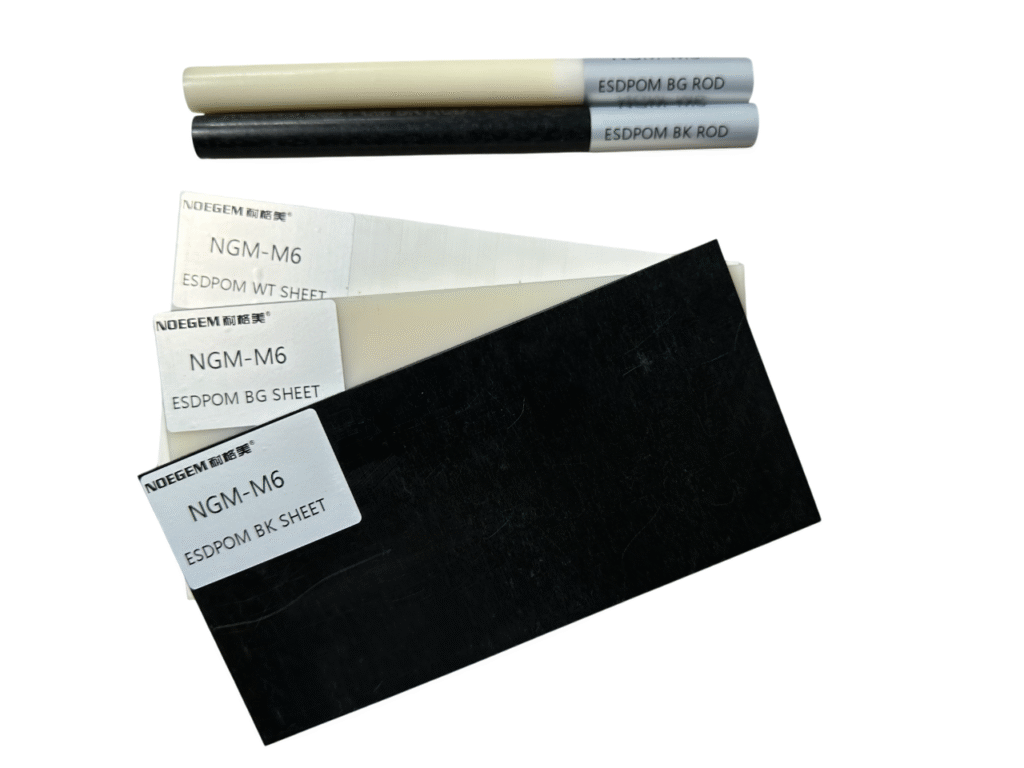
Anti-static POM incorporates conductive carbon black or proprietary polymer alloys that create a continuous conductive network throughout the material. This network:
1. Prevents charge accumulation — surface resistance of 10^6–10^9 Ω/sq allows charges to dissipate safely
2. Provides uniform conductivity — isotropic resistance distribution (unlike surface-coated materials)
3. Maintains mechanical integrity — retains 85–90% of standard POM’s tensile and impact strength
4. Resists degradation — conductive properties are permanent, not surface treatments that wear off
Key Properties for Semiconductor Applications
Property | Standard POM | ESD POM (NAGOMER NGM-PESD) |
Surface resistance (Ω/sq) | 10^13–10^14 | 10^6–10^9 |
Volume resistance (Ω·cm) | 10^14 | 10^7–10^8 |
Outgassing (TML, %) | < 1.0 | < 1.0 |
Outgassing (CVCM, %) | < 0.1 | < 0.1 |
Particle generation | Moderate | Low |
Cleanroom class | ISO 7–8 | ISO 4–5 |
Wear resistance | Excellent | Good |
Machinability | Excellent | Good |
Typical Semiconductor Components Made from ESD POM
l Wafer carriers and transport cassettes — Open and closed cassettes for 150mm, 200mm, and 300mm wafers
l Handling trays — IC tray and lead frame carriers with ESD-safe pockets
l CMP ring guides — Chemical mechanical polishing consumables
l Test socket components — Burn-in socket bodies and contactor housings
l Cleanroom furniture — Workbench tops, shelving, and cart components
l Conveyor system parts — Guide rails, star wheels, and pick-and-place fingers
Selecting the Right ESD POM Grade
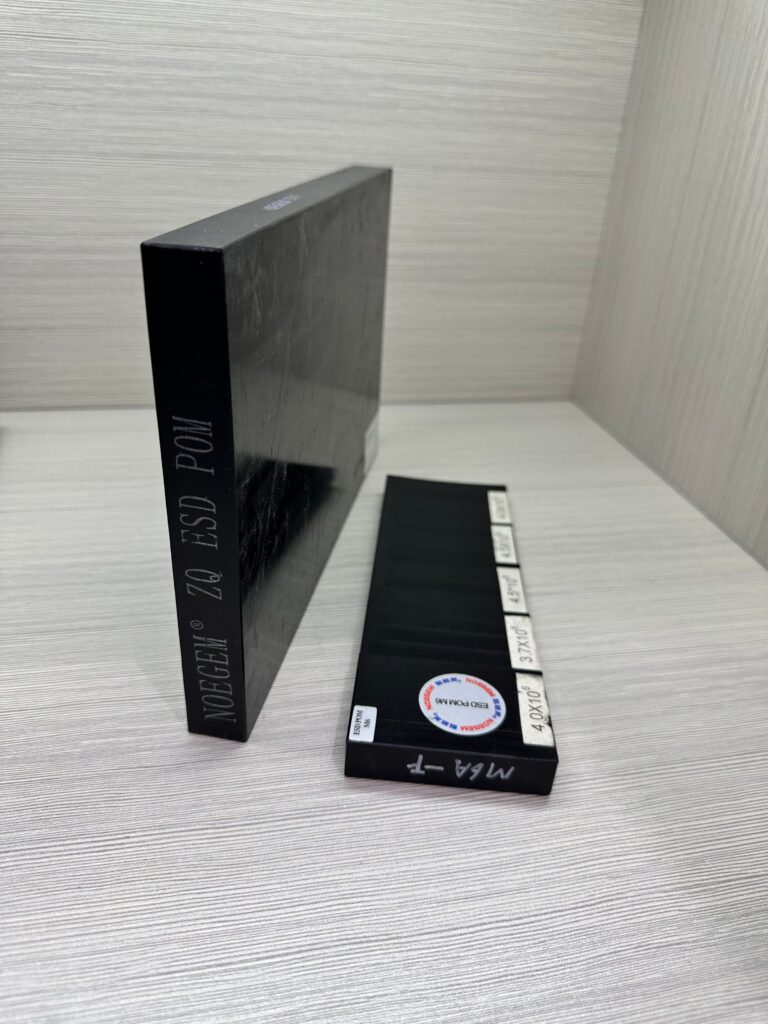
NAGOMER offers multiple ESD POM grades tailored to semiconductor needs:
l NGM-PESD-S (Sheet) — for flat components, trays, and panels
l NGM-PESD-M6B (Rod) — for machined precision parts like test sockets and guides
l Custom formulations — for specific resistance ranges or particle count requirements
For comparison between ESD POM and standard POM, see our ESD POM vs Standard POM guide. For broader ESD material selection, read our ESD Plastic Materials guide.
FAQ
Q1: What surface resistance is required for semiconductor ESD materials?
For semiconductor manufacturing, ESD materials should have a surface resistance between 10^6 and 10^9 ohms per square (static-dissipative range). This range provides controlled charge dissipation without the risk of sparking that can occur with conductive materials below 10^6 ohms.
Q2: Is ESD POM compatible with ISO Class 4 cleanrooms?
Yes, properly processed ESD POM materials like NAGOMER‘s NGM-PESD grades meet the particle and outgassing requirements for ISO Class 4 (Class 10) cleanrooms. However, all machined parts should be cleaned and packaged in cleanroom conditions before introduction to the fabrication area.
Q3: How long does ESD POM maintain its anti-static properties?
ESD POM maintains its anti-static properties permanently because the conductive network is built into the material matrix, not applied as a surface coating. The properties will not wear off or degrade with normal handling, cleaning, or machining.
Q4: Can ESD POM components be cleaned with standard semiconductor solvents?
Yes, ESD POM is resistant to most semiconductor cleaning chemicals including isopropyl alcohol (IPA), acetone, and mild acidic solutions. Avoid strong acids (sulfuric, nitric) and strong bases for prolonged exposure.
Protect your semiconductor components with ESD POM from NAGOMER. Contact us for technical data sheets and samples, or explore our ESD materials and POM products.
NAGOMER — Professional Engineering Plastics Solutions
www.nagomer.com | info@nagomer.com