
News Centre
News Type
Send your inquiry

Thermal Expansion & Dimensional Stability: Designing with Engineering Plastics
Coefficients of Linear Thermal Expansion
Material | CLTE (×10⁻⁵ /K) | vs Steel | Notes |
PEEK (unfilled) | 4.5–5.0 | ~4× | Lowest of common engineering plastics |
PEEK GF30 | 2.5–3.0 | ~2× | Glass fibre cuts expansion sharply |
PC | 6.5–7.0 | ~5× | Along flow direction typical |
PA66 | 8–10 | ~7× | Plus moisture-driven swelling |
POM-C | 10–12 | ~9× | Consistent, low moisture effect |
PTFE | 12–14 | ~11× | High, and non-linear at transitions |
UHMW-PE | 18–20 | ~15× | Highest of common grades |
Steel (reference) | 1.2 | — | — |
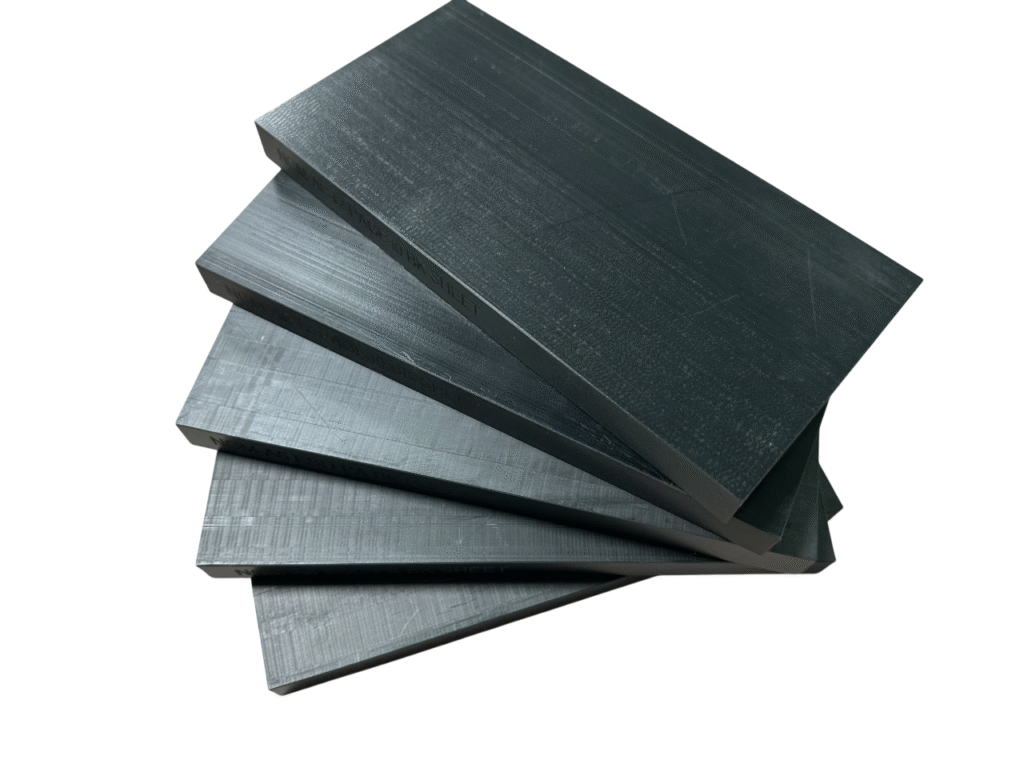
Glass and carbon fillers reduce expansion substantially, which is one reason filled grades dominate precision applications. Filled grades also shrink less in moulding, improving as-moulded tolerances.
Practical Design Rules
· Anchor long plastic parts at a single point and let the rest slide — never clamp both ends rigidly
· Use slotted holes or oversized clearance holes sized for the maximum temperature swing
· Keep metal fasteners and plastic bosses at similar expansion, or add a compliant washer
· For press fits, calculate interference at the hottest expected temperature, not at 20°C
· Separate thermal expansion from moisture swelling — nylon is affected by both
Moisture Swelling: The Second Variable
Polyamides and other hygroscopic materials change dimension with humidity as well as temperature. PA6 and PA66 swell roughly 0.2% per 1% of absorbed moisture, which for a fully conditioned part means 0.5–0.7% total growth — comparable to a 60°C temperature rise. POM, PEEK, PTFE, and UHMW-PE are largely immune, which is why they dominate precision parts in humid or washdown environments. If your application combines heat and humidity, choose a low-absorption material rather than trying to compensate for both effects at once.
Compensating in Practice
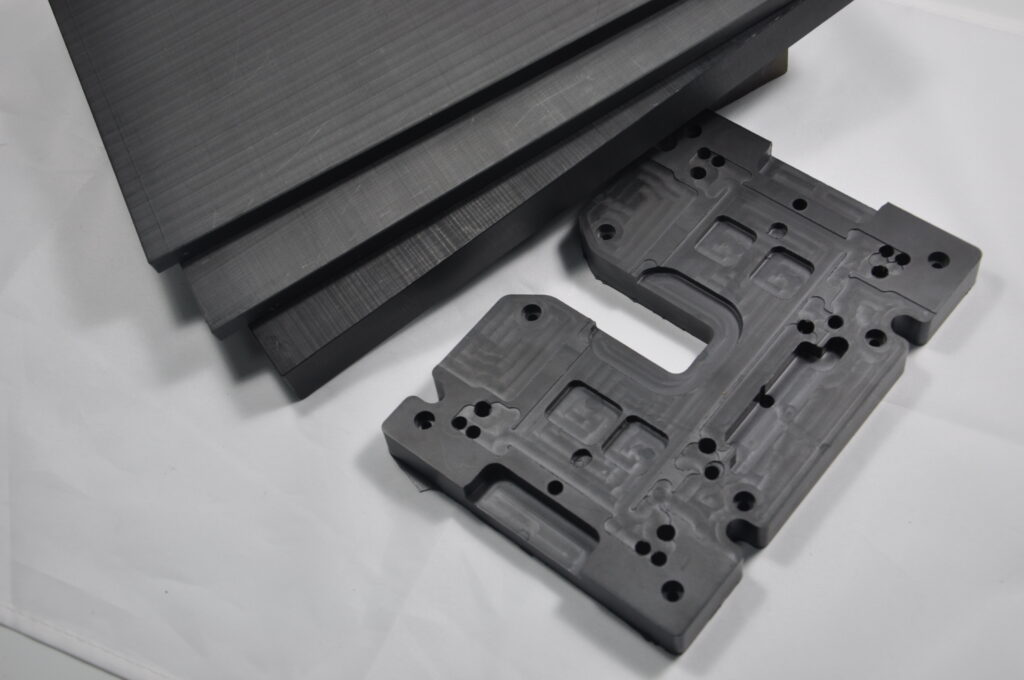
When a plastic part must mate with metal at tight tolerance, three techniques solve most problems: design the plastic as the compliant member (it will yield before the metal does); add an elastomer element to absorb relative movement; or use a filled grade to bring expansion close to aluminium (23 × 10⁻⁶ /K). For high-precision applications, NAGOMER can supply machined components to drawing with documented expansion data, so the thermal behaviour is engineered in rather than discovered on the line.
Finally, remember that expansion data is a material property, not a part property. Fibre orientation, machining direction, and residual stress all shift real behaviour away from the published coefficient. Where tolerance is critical, machine the part, measure it hot and cold, and let the measurement — not the datasheet — set the final clearance. It is a small extra step in development that prevents an expensive surprise on the assembly line.
Related reading: Engineering Plastic Tolerance & Thickness Standards, PEEK Filled Grades Guide, and Cast Nylon & PA12 Guide.
FAQ
Q1: Which engineering plastic has the lowest thermal expansion?
Filled PEEK, particularly 30% glass fibre grades at 2.5–3.0 × 10⁻⁵ /K — the closest match to aluminium among common engineering plastics.
Q2: How much will a plastic part grow when heated?
Multiply the coefficient by the length and the temperature change. A 200 mm POM part heated 40°C grows about 0.9 mm.
Q3: Why do plastic parts bind in summer?
Usually a combination of higher ambient temperature and humidity. Nylon is especially prone because it swells with moisture as well as expanding with heat.
Q4: Should I use metal inserts?
Where fastening loads are high or repeated assembly is required, yes. Design the insert with adequate wall thickness to avoid hoop stress cracking.
Q5: Do fillers always reduce expansion?
Yes for glass, carbon, and mineral fillers, though the reduction depends on orientation in moulded parts. Machined stock shapes show more uniform behaviour.
Designing for tight tolerance across temperature? Contact NAGOMER for filled grades and machined components with published expansion data.
────────────────────────────────────────
NAGOMER — Professional Engineering Plastics Solutions
www.nagomer.com | info@nagomer.com