
News Centre
News Type
Send your inquiry
Engineering Plastics for Automotive Under-the-Hood Applications
Material Map for Engine-Bay Components
Component | Typical Material | Operating Demand |
Air intake manifolds & ducts | PA66-GF30/35 | 120–150°C, pressure, vibration |
Water pump housings & impellers | PPS-GF40, PA66-GF | Coolant at 120°C, hydrolysis resistance |
Sensor housings & connectors | PPS, PBT, PA66-GF | Soldering heat, dimensional stability |
Throttle & actuator gears | POM-C, PA46 | Wear, fatigue, temperature |
Turbo & EGR components | PEEK, PPS | 200–250°C continuous |
Fuel system parts & seals | POM, PVDF, FKM/PTFE | Fuel, ethanol blends, permeation |
Transmission & shift components | PA66-GF, PEEK | Oil at 150°C, fatigue |
What Makes Under-the-Hood Duty Demanding
· Continuous heat soak at 120–150°C, with peaks far higher near turbos and exhaust
· Coolant, engine oil, and fuel exposure — each attacks different polymers
· Hydrolysis — hot glycol coolant degrades PA over time; PPS and PEEK resist it
· Vibration fatigue over millions of cycles
· Tight tolerances that must hold across −40°C to +150°C swings
Prototyping and Low-Volume Production
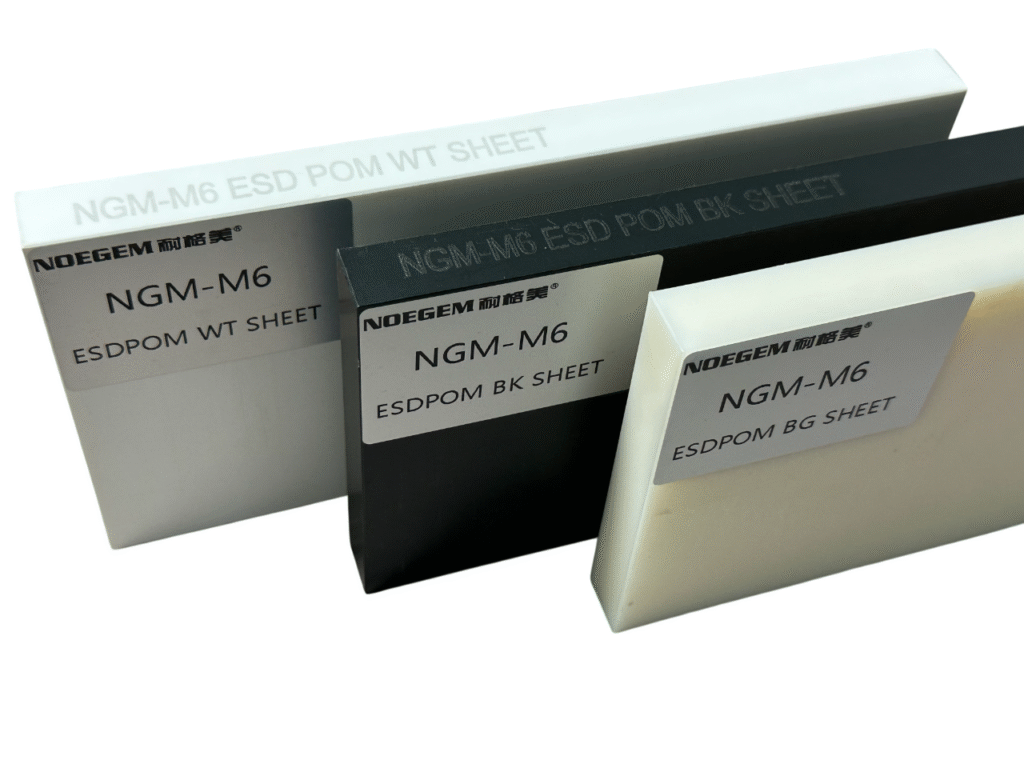
For development work and low-volume vehicles, machined stock shapes are often faster than tooling: a glass-filled PA66 or PPS manifold prototype can be machined from sheet in days, tested on the engine, and iterated before committing to injection moulding. PEEK components for hot zones and POM gears for actuators can be produced the same way. NAGOMER machines automotive prototypes and test fixtures to drawing from certified stock.
Why Weight Reduction Matters
Every kilogram removed from the front of a vehicle pays back twice — once in fuel or range, and again in the load the engine, brakes, and suspension do not have to carry. A plastic intake manifold weighs roughly half its aluminium equivalent, dampens intake noise better, and does not conduct heat into the charge air. For electric vehicles, the same logic applies to thermal-management components and battery enclosures — see our new-energy materials guide for that side of the picture.
One further consideration for development teams: material choice must be settled against the actual fluid exposure of the vehicle platform, not against a generic specification. Ethanol-blended fuels, new coolant chemistries, and long-life oils interact differently with polymers, and a material validated five years ago may need re-testing for a formulation introduced last year. Requesting supplier data on fuel and coolant compatibility — then confirming it with immersion tests on the finished part — is far cheaper than discovering incompatibility after tooling is cut. NAGOMER supports this with sample components machined from production stock.
Related reading: Engineering Plastics for New Energy (EV Battery & Solar), PPS GF40 Sheet Guide, and PEEK in Oil & Gas Applications.
FAQ
Q1: Which plastic is used for intake manifolds?
Glass-fibre reinforced PA66 (typically 30–35% GF) dominates, chosen for strength at 150°C, vibration resistance, and low weight versus aluminium.
Q2: Can plastics survive turbocharger temperatures?
Near-turbo parts generally require PEEK or PPS, which serve continuously at 200–250°C. Standard PA66 is limited to around 150°C continuous.
Q3: Why does PA66 degrade in coolant?
Hot glycol solution hydrolyses the amide bonds in polyamide, reducing molecular weight over thousands of hours. PPS and PEEK resist this hydrolysis and are used for pump and thermostat housings.
Q4: Are plastic automotive parts strong enough?
Glass- and carbon-filled grades reach tensile strengths and stiffness comparable to die-cast aluminium while weighing roughly half as much.
Q5: Can I get prototypes before tooling?
Yes — machined prototypes from PA66-GF, PPS, or PEEK stock allow full functional testing, including temperature cycling and fluid exposure, before mould investment.
Developing under-the-hood components? Contact NAGOMER for high-temperature stock shapes and machined prototypes in PA66-GF, PPS, and PEEK.
────────────────────────────────────────
NAGOMER — Professional Engineering Plastics Solutions
www.nagomer.com | info@nagomer.com