
News Centre
News Type
Send your inquiry
Key Properties of UHMW-PE
· Molecular weight: 3–6 million g/mol — the source of its wear performance
· Excellent abrasion resistance, often better than carbon steel in sliding duty
· Coefficient of friction: 0.10–0.25, among the lowest of any thermoplastic
· Virtually zero moisture absorption — dimensions do not move in wet service
· Continuous service temperature: −200°C to +80°C
· Extremely high impact strength, including at cryogenic temperatures
· FDA-compliant grades available; chemical resistance to most acids and alkalis
Where UHMW-PE Beats Other Plastics
Duty | Why UHMW-PE Wins | Watch Out For |
Conveyor & chain guides | Lowest friction, no moisture movement, quiet | Temperature limit 80°C |
Impact pads & bumpers | Highest impact energy absorption | Poor creep under static load |
Cutting boards & scrapers | Knife-friendly, FDA grades | Not for hot wash-down above 80°C |
Slurry & bulk handling liners | Outwears steel, no corrosion | Needs mechanical fixing; hard to bond |
Cryogenic spacers | Retains toughness at −200°C | Very high thermal contraction |
Machining and Fixing
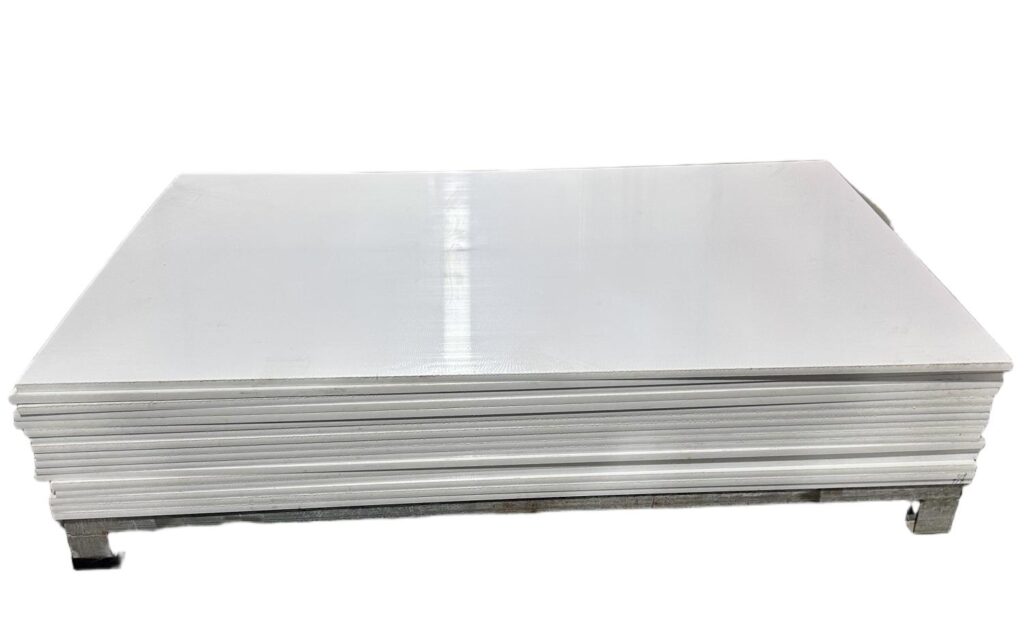
UHMW-PE machines easily but demands sharp, positive-rake tooling and light feeds: the material is soft enough to be pushed rather than cut, and heat build-up causes stringy chips and poor finish. Because it cannot be bonded with conventional adhesives, joints must be mechanical. Use counterbored fasteners with large washers, or dovetail/tenon arrangements for replaceable liners, and allow for thermal expansion — UHMW-PE moves roughly ten times as much as steel over the same temperature change. Flame or plasma treatment can raise surface energy where bonding or printing is unavoidable.
Common Applications
· Food processing — conveyor guides, wear strips, cutting boards, star wheel components
· Logistics — chute liners, impact bars, roller covers, chain guides
· Mining & bulk handling — truck bed liners, hopper liners, slurry pipe liners
· Industrial — machine guide rails, suction box covers, wear pads
One practical caution: UHMW-PE is often specified for duties that actually call for HDPE or POM. If the application is structural, if it runs above 80°C, or if the part must be bonded rather than bolted, the abrasion advantage is not worth the compromise. Sheet thickness deserves the same scrutiny — a guide strip machined from 20 mm stock can be re-faced several times before replacement, which is usually cheaper than buying two thinner plates. Our engineers will tell you honestly when a cheaper, stiffer material will outlast UHMW-PE: the aim is the right part, not the premium one.
Related reading: Engineering Plastics for Food & Beverage Processing, Bearings & Bushings Material Selection, and Engineering Plastics at Cryogenic Temperatures.
FAQ
Q1: Is UHMW-PE really more wear resistant than steel?
In sliding abrasion against bulk materials, yes — UHMW-PE typically outlasts mild steel several times over, and it never corrodes. It cannot, however, carry structural loads or withstand high temperatures.
Q2: What is the maximum temperature for UHMW-PE?
About 80°C in continuous service. Above this the material softens and creeps; switch to POM, PA, or PEEK for higher temperatures.
Q3: Can UHMW-PE be glued?
Not reliably with standard adhesives. Flame, plasma, or corona treatment improves bondability, but mechanical fastening remains the practical solution for most installations.
Q4: Does UHMW-PE absorb water?
Essentially none — water absorption is below 0.01%. Dimensions stay constant in wet or humid service, a major advantage over nylon.
Q5: How is UHMW-PE different from HDPE?
UHMW-PE has a molecular weight 10–20 times higher, giving dramatically better wear resistance and impact strength, at a higher cost.
Specifying UHMW-PE liners or wear strips? Contact NAGOMER for sheet, rod, and machined components in food-grade and standard grades.
────────────────────────────────────────
NAGOMER — Professional Engineering Plastics Solutions
www.nagomer.com | info@nagomer.com