
News Centre
News Type
Send your inquiry
Engineering Plastics for New Energy: EV Battery & Solar Panel Applications
Engineering Plastics in EV Battery Systems
Battery Module & Pack Components
EV battery packs contain hundreds of components made from engineering plastics:
Component | Material | Key Requirement |
Cell holders/spacers | PA66 GF30 | Electrical insulation + dimensional stability |
Module frames | PPS GF40 | High stiffness + thermal stability |
Busbar insulators | PEEK | High voltage insulation + temperature |
Cooling plate gaskets | PTFE | Chemical resistance + temperature |
Battery case components | PA66 / PPS | Impact resistance + weight |
Thermal interface pads | PEEK | Thermal conductivity + insulation |
Pressure relief valves | PEEK | High pressure + temperature |
Sensor housings | PA66 | Cost-effective protection |
Key Requirements for EV Battery Materials
Electrical insulation: Withstand 400–800V DC bus voltage without dielectric breakdown
Thermal stability: Operate at –40°C to 85°C continuous (cell surface temp)
Fire resistance: Meet UN 38.3 thermal runaway test requirements
Chemical resistance: Resist electrolyte (LiPF6 in organic solvents)
Crash safety: Maintain structural integrity in vehicle impact
Weight: Minimise weight to maximise driving range
PEEK in EV Batteries
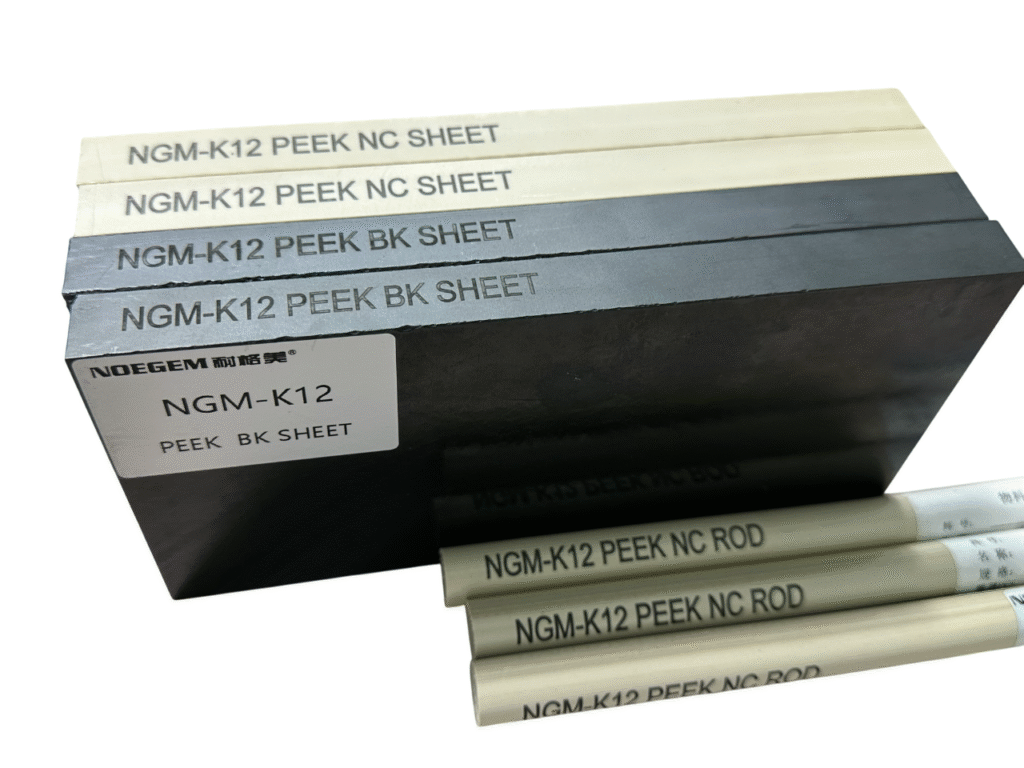
PEEK is increasingly used in premium EV battery systems for:
· High-voltage connector insulators (800V+ architectures)
· Battery cell fuses and thermal fuses
· Cooling system manifold components
· Pressure equalisation valves
· Bus bar insulation barriers
PEEK‘s 250°C temperature resistance and excellent dielectric properties make it ideal for next-generation 800V and 1000V EV battery architectures.
Engineering Plastics in Solar Energy
Solar Panel Components
Component | Material | Function |
Junction boxes | PA66 GF30 | Electrical housing |
Connector bodies | PA66 | Cable connection |
Mounting brackets | PPS GF40 | Structural support |
Frame components | PA66 / PPS | Lightweight framing |
Inverter housings | PA66 GF30 | Electronics protection |
Cable management | PEEK | High-temp routing |
Requirements for Solar Applications
· UV resistance: 25+ year outdoor service life
· Thermal cycling: –40°C to +85°C daily cycling
· Moisture resistance: Humidity, rain, condensation
· Electrical insulation: 1000–1500V DC systems
· Cost efficiency: High-volume, cost-sensitive market
PA66 dominates solar junction boxes and connectors due to its cost-performance balance. PPS GF40 is gaining share in structural mounting components due to better UV and thermal stability.
Engineering Plastics in Wind Energy
Wind Turbine Applications
· Generator insulation: PEEK slot liners and wedge insulation
· Slip ring components: PEEK wear-resistant parts
· Lightning protection: PEEK insulating components
· Blade root components: PPS GF40 structural bushings
· Tower cable management: PA66 routing components
Future Trends
· Solid-state batteries: Will require materials resistant to solid electrolytes — PEEK and PPS are leading candidates
· Higher voltage systems: 800V–1200V architectures driving demand for PEEK insulation
· Thinner cell designs: Requiring thinner, stronger spacer materials
· Thermal runaway protection: New PEEK composites with enhanced thermal barrier properties
· Recyclability: Growing focus on using recyclable engineering plastics for sustainability
For material overview, see our Engineering Plastics Overview. For PEEK properties, read our PEEK Plastic Sheet Guide.
FAQ
Q1: Which engineering plastic is best for EV battery components?
PA66 GF30 is the most commonly used material for battery cell holders and module frames due to cost-effectiveness. PPS GF40 is used for structural components requiring higher temperature and chemical resistance. PEEK is used for high-voltage insulation and premium battery systems operating at 800V+.
Q2: Are engineering plastics used in solar panel junction boxes?
Yes, PA66 GF30 is the standard material for solar junction boxes and connector bodies. It provides excellent electrical insulation, UV resistance, and cost-effectiveness for 25-year outdoor service life.
Q3: Can PEEK withstand EV battery electrolytes?
Yes, PEEK has excellent resistance to LiPF6 electrolyte solutions in organic carbonate solvents (EC, DMC, EMC). This makes it suitable for battery seals, gaskets, and insulation barriers in direct electrolyte contact zones.
Q4: What voltage can engineering plastics insulate in EV systems?
Engineering plastics like PA66 and PPS can insulate up to 600V DC in standard EV systems. For 800V+ architectures, PEEK is preferred due to its higher dielectric strength (190 kV/mm) and superior tracking resistance.
Supplying engineering plastics for clean energy? Contact NAGOMER for EV and solar material solutions, or explore our PEEK, PA66, and PPS products.
NAGOMER — Professional Engineering Plastics Solutions
www.nagomer.com | info@nagomer.com