
News Centre
News Type
Send your inquiry
POM Rod Supplier Selection: Quality Standards & Certifications to Check
POM Rod Grades & Specifications
Before evaluating suppliers, understand what you need:
Homopolymer POM Rod (POM-H / Delrin-type)
l Higher tensile strength (70 MPa)
l Higher hardness (Rockwell M92)
l Better creep resistance
l Best for mechanical/structural applications
Copolymer POM Rod (POM-C)
l Better chemical resistance (hot water, alkalis)
l Lower outgassing
l Better for food contact and chemical processing
l Slightly lower mechanical properties
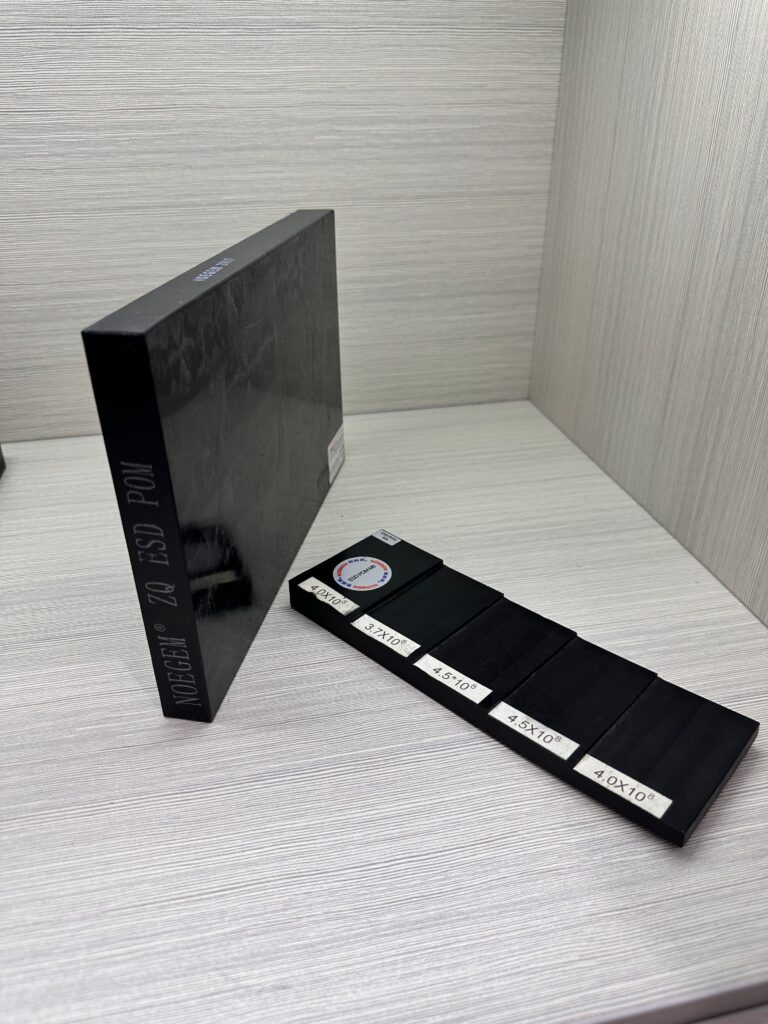
ESD POM Rod
l Surface resistance 10^6–10^9 Ω/sq
l For semiconductor and electronics applications
l Black colour (carbon-filled)
Standard Dimensions
Diameter (mm) | Length (mm) | Tolerance |
6–30 | 1000 / 2000 / 3000 | ±0.1mm |
35–80 | 1000 / 2000 | ±0.2mm |
85–200 | 1000 | ±0.3mm |
Quality Standards to Verify
Material Standards
l ISO 9988 — POM moulding and extrusion materials specification
l ASTM D4181 — Standard specification for acetal (POM) moulding and extrusion materials
l DIN 16781 — POM moulding materials classification
Manufacturing Standards
l ISO 9001 — Quality management system (minimum requirement)
l IATF 16949 — For automotive supply chain
l ISO 13485 — For medical device components
Product Standards
l FDA 21 CFR §177.2470 (homopolymer) / §177.2480 (copolymer) — Food contact
l RoHS — Restriction of hazardous substances
l REACH — Registration, evaluation, authorisation of chemicals
l UL94 HB — Horizontal burn rating for POM
Supplier Evaluation Checklist
Manufacturing Capability
l [ ] Produces POM rods from virgin resin (not regrind)
l [ ] Uses compression moulding or extrusion (not rod built from sheet)
l [ ] Can produce rods up to 200mm diameter
l [ ] Offers both homopolymer and copolymer grades
l [ ] Produces ESD/anti-static POM rods
l [ ] Custom diameters and lengths available
Quality Documentation
l [ ] Provides Certificate of Analysis per batch
l [ ] Includes actual measured properties (not just datasheet values)
l [ ] Material traceability from resin to finished rod
l [ ] Dimensional inspection report per shipment
l [ ] RoHS and REACH compliance certificates
Technical Support
l [ ] In-house engineering team for grade selection
l [ ] Custom formulation capabilities
l [ ] Failure analysis support
l [ ] Material testing laboratory on-site
l [ ] Can provide samples for evaluation
Commercial Terms
l [ ] Competitive pricing (compare at least 3 suppliers)
l [ ] Reasonable MOQ (typically 50–100kg)
l [ ] Flexible payment terms
l [ ] Clear lead time commitments (2–4 weeks standard)
l [ ] Sample availability at reasonable cost
Common Quality Issues to Avoid
Issue | Cause | Impact | Prevention |
Porosity/voids | Improper moulding pressure | Weak points, surface defects | X-ray inspection, density check |
Inconsistent diameter | Poor extrusion control | Machining problems, waste | CMM inspection, tight tolerances |
Contamination | Contaminated resin or equipment | Black spots, property variation | Visual inspection, spectroscopy |
Poor crystallinity | Incorrect cooling rate | Reduced mechanical properties | DSC analysis of crystallinity |
Internal stress | Rapid cooling | Warpage during machining | Stress relief process |
For ESD POM rod specifications, see our ESD POM M6B Rod guide. For broader POM product information, read our POM Plastic Sheet guide.
FAQ
Q1: What is the difference between POM-H and POM-C rods?
POM-H (homopolymer) rods have higher strength and hardness but are more susceptible to chemical degradation in hot water and alkalis. POM-C (copolymer) rods have better chemical resistance and lower outgassing but slightly lower mechanical properties. Choose POM-H for structural parts, POM-C for chemical or food applications.
Q2: What diameter POM rods are available?
NAGOMER supplies POM rods from 6mm to 200mm in diameter. Standard lengths are 1000mm, 2000mm, and 3000mm. Custom dimensions are available upon request. Tolerances range from ±0.1mm for small diameters to ±0.3mm for larger sizes.
Q3: How should POM rods be stored?
Store POM rods flat on clean, dry surfaces at temperatures between 10–30°C. Avoid direct sunlight and UV exposure. Keep in original packaging until use. POM absorbs minimal moisture, but acclimatize rods to workshop temperature for 24 hours before machining.
Q4: Are POM rods FDA approved for food contact?
Natural (unpigmented) POM rods are FDA compliant under 21 CFR 177.2470 (homopolymer) and 177.2480 (copolymer) for repeated food contact. Black or coloured grades may not be food-safe depending on pigments used.
Looking for quality POM rods? Contact NAGOMER for specifications and pricing, or browse our POM rod products and ESD POM rods.
NAGOMER — Professional Engineering Plastics Solutions
www.nagomer.com | info@nagomer.com