
News Centre
News Type
Send your inquiry
ESD Plastic Materials: Choosing the Right Anti-Static Engineering Plastic
Understanding ESD Material Categories
ESD plastics are classified by their surface resistance:
Category | Surface Resistance (Ω/sq) | Typical Use |
Insulative | > 10^12 | General purpose (standard plastics) |
Static dissipative | 10^6 – 10^12 | ESD protection (most common) |
Conductive | 10^2 – 10^6 | Shielding, grounding paths |
Anti-static (surface treated) | 10^9 – 10^12 | Temporary ESD protection |
The static dissipative range (10^6–10^9 Ω/sq) is the sweet spot for most electronics and semiconductor applications — it dissipates charges safely without risking sparks.
Comparison of ESD Plastic Materials
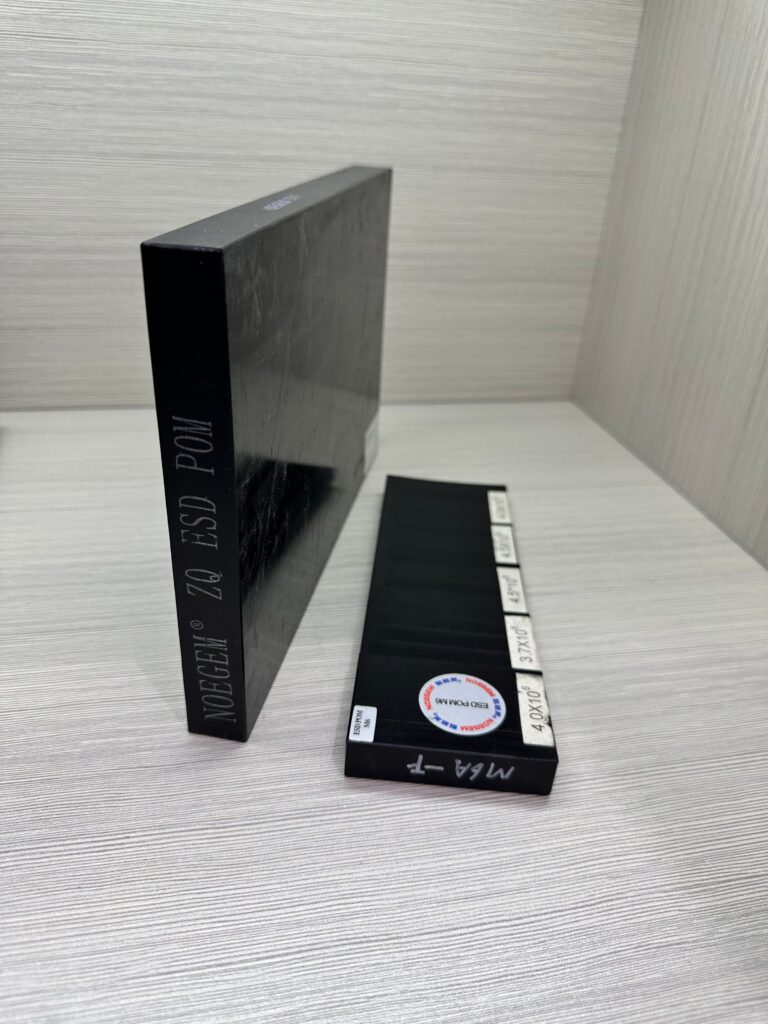
ESD POM (Anti-Static POM)
Property | Value |
Surface resistance | 10^6–10^9 Ω/sq |
Tensile strength | 55–60 MPa |
Operating temp | –40°C to 90°C |
Cost | Low (most economical ESD plastic) |
Best for | Semiconductor handling, electronics assembly, cleanroom furniture |
Advantages: Best value, easy to machine, excellent wear resistance, good dimensional stability
Limitations: Lower temperature resistance, not suitable for high-temp applications
ESD PEEK
Property | Value |
Surface resistance | 10^6–10^9 Ω/sq |
Tensile strength | 80–90 MPa |
Operating temp | –40°C to 250°C |
Cost | Very high |
Best for | High-temperature ESD environments, semiconductor CMP, medical electronics |
Advantages: Highest mechanical strength, excellent chemical resistance, high temperature
Limitations: Very expensive, typically over-specified for general ESD applications
ESD PEI (ULTEM)
Property | Value |
Surface resistance | 10^6–10^9 Ω/sq |
Tensile strength | 90–100 MPa |
Operating temp | –50°C to 170°C |
Cost | High |
Best for | Aerospace interiors, high-strength ESD components |
Advantages: Inherent flame retardancy (UL94 V-0), high strength-to-weight ratio
Limitations: Higher cost than POM, lower temperature resistance than PEEK
ESD PTFE (Carbon-Filled)
Property | Value |
Surface resistance | 10^4–10^6 Ω/sq |
Tensile strength | 15–20 MPa |
Operating temp | –200°C to 260°C |
Cost | Medium |
Best for | Chemical processing, cryogenic ESD applications |
Advantages: Ultimate chemical resistance, widest temperature range
Limitations: Low mechanical strength, conductive (not dissipative) range
Selection Framework: 5 Steps
Step 1: Define Your Resistance Requirement
l Electronics assembly → 10^8–10^10 Ω/sq (dissipative)
l Semiconductor wafer handling → 10^6–10^9 Ω/sq (dissipative)
l Explosive environments → 10^6–10^8 Ω/sq (dissipative to conductive)
Step 2: Determine Temperature Requirements
l < 90°C → ESD POM is sufficient
l 90–170°C → Consider ESD PEI
l > 170°C → ESD PEEK required
Step 3: Evaluate Mechanical Load
l Light load (trays, fixtures) → ESD POM
l Moderate load (structural parts) → ESD PEI
l Heavy load (structural, pressure) → ESD PEEK
Step 4: Check Chemical Compatibility
l General industrial → ESD POM handles most chemicals
l Aggressive chemical exposure → ESD PTFE (carbon-filled)
Step 5: Balance Cost vs Performance
l Budget-driven → ESD POM (80% of applications)
l Performance-driven → ESD PEEK (critical applications)
l Specialized → ESD PEI or carbon-filled PTFE
For ESD POM specifics, see our ESD POM vs Standard POM guide. For semiconductor applications, read ESD POM in Semiconductor Cleanroom.
FAQ
Q1: What is the difference between anti-static and ESD plastic?
Anti-static plastics prevent triboelectric charging (charge generation) but may not dissipate existing charges. ESD (electrostatic discharge) plastics actively dissipate charges through controlled conductivity. All ESD plastics are anti-static, but not all anti-static plastics are ESD-rated.
Q2: Which ESD plastic is most cost-effective?
ESD POM is the most cost-effective ESD plastic for the majority of applications. It offers good mechanical properties, easy machinability, and adequate temperature resistance for most electronics and semiconductor handling applications at 40–60% of the cost of ESD PEI or ESD PEEK.
Q3: How is conductivity achieved in ESD plastics?
ESD plastics achieve conductivity through three main methods: carbon black dispersion (most common, black colour), carbon fibre reinforcement (also adds mechanical strength), and inherently conductive polymer alloys (ICPs). Carbon black is the most widely used due to cost-effectiveness and uniform conductivity.
Q4: Do ESD plastic properties degrade over time?
No, ESD plastics with carbon-based additives maintain their conductive properties permanently. Unlike surface anti-static sprays or coatings that wear off, the conductive network in ESD plastics is integral to the material matrix and does not degrade under normal conditions.
Need help selecting the right ESD plastic? Contact NAGOMER for expert advice and material samples, or browse our ESD materials and ESD POM products.
NAGOMER — Professional Engineering Plastics Solutions
www.nagomer.com | info@nagomer.com