
News Centre
News Type
Send your inquiry

PEEK vs PTFE: Which High-Performance Plastic Is Right for Your Application?
Side-by-Side Property Comparison
Property | PEEK | PTFE (Teflon) |
Density (g/cm³) | 1.32 | 2.18 |
Tensile strength (MPa) | 90–100 | 20–30 |
Flexural modulus (GPa) | 3.6–4.0 | 0.5–0.7 |
Hardness (Shore D) | 85 | D55–D65 |
Continuous service temp (°C) | 250 | 260 |
Melting point (°C) | 343 | 327 |
Coefficient of friction | 0.35 (unfilled) | 0.05–0.10 |
Thermal conductivity (W/m·K) | 0.25 | 0.25 |
Water absorption 24h (%) | 0.06 | 0.01 |
Chemical resistance | Excellent | Superior |
Cost (relative) | High | Medium |
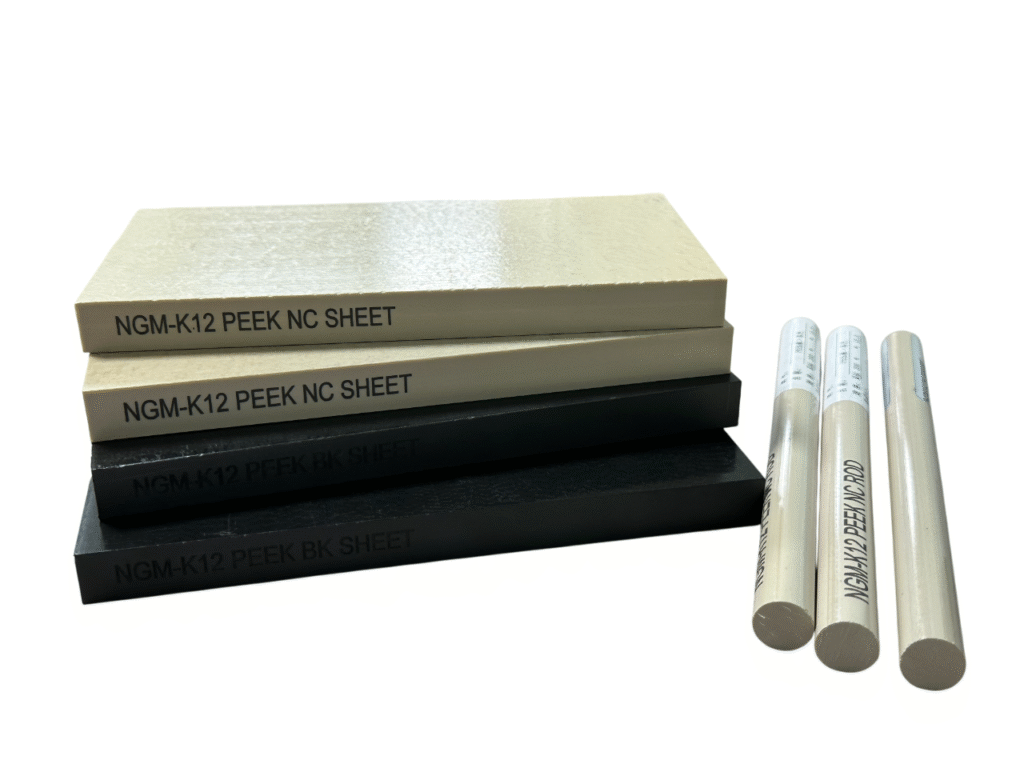
Where PEEK Excels
PEEK is the clear winner when your application demands:
Structural Performance Under Load
With 3–5× the tensile and flexural strength of PTFE, PEEK maintains mechanical integrity under sustained loads at elevated temperatures. This makes it ideal for structural brackets, bearing cages, and load-bearing seals.
High-Temperature Mechanical Stability
PEEK retains over 50% of its room-temperature strength at 200°C, while PTFE‘s already-low strength drops dramatically above 150°C. For components that must carry load at high temperatures, PEEK is the only option.
Dimensional Precision
PEEK‘s low creep and moisture absorption ensure tight tolerances are maintained over the component’s service life. PTFE exhibits significant cold flow (creep) even under moderate loads, making it unsuitable for precision dimensional applications.
Regulatory Compliance
PEEK meets FDA, USP Class VI, and ISO 10993 standards for medical and food contact. While PTFE is also FDA compliant, PEEK offers a broader regulatory profile for implantable devices.
Where PTFE Excels
PTFE is the better choice when your application requires:
Ultimate Chemical Inertness
PTFE is virtually chemically inert, resisting attack from virtually all acids, bases, and solvents at temperatures up to 260°C. PEEK, while excellent, can be attacked by concentrated sulfuric acid and some halogenated solvents.
Lowest Friction Coefficient
With a coefficient of friction of 0.05–0.10, PTFE is one of the slipperiest solids known. For sliding bearings, non-lubricated guides, and release surfaces, PTFE outperforms PEEK (0.35 unfilled, 0.15 with PTFE additive).
Cost-Sensitive Chemical Resistance
PTFE costs roughly 30–50% less than PEEK, making it the preferred choice when chemical resistance is the primary requirement and mechanical strength is secondary.
Electrical Insulation at High Frequency
PTFE has a very low dielectric constant (2.1) and dissipation factor, making it ideal for RF/microwave applications. PEEK‘s dielectric properties are good but inferior to PTFE for high-frequency electronics.
Filled Grade Considerations
Both materials benefit from fillers:
l PEEK + 30% glass fibre (GF30): Doubles flexural modulus, ideal for structural parts
l PEEK + 30% carbon fibre (CF30): Adds static dissipativity, highest stiffness
l PEEK + PTFE + graphite: Excellent bearing material, combines PEEK strength with PTFE lubricity
l PTFE + glass/carbon: Improves wear and creep resistance, but remains structurally inferior
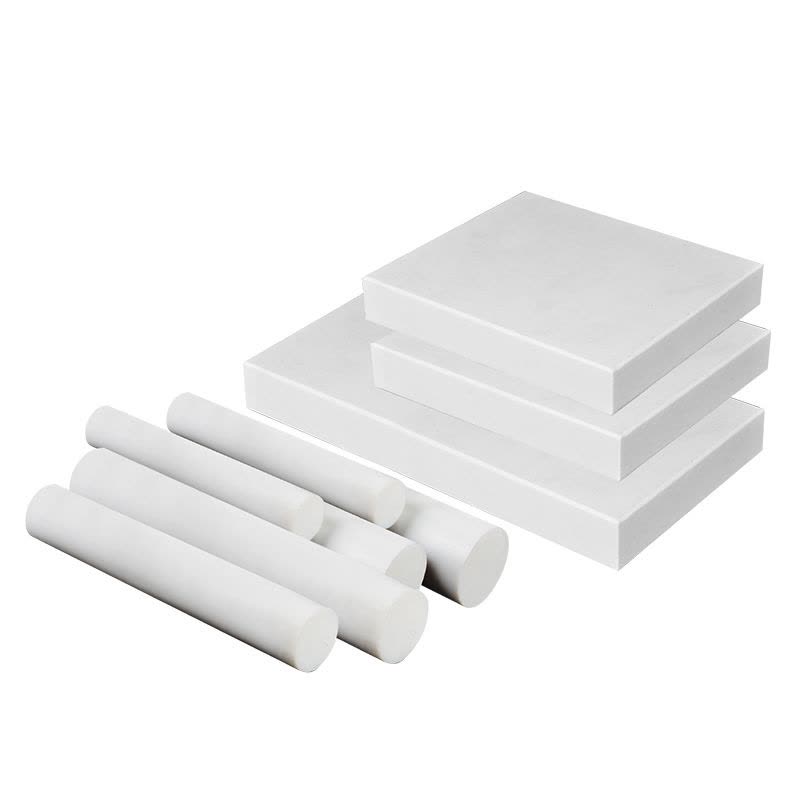
Application Selection Matrix
|
Application Type |
Recommended Material |
Reason |
|
Structural bracket at 200°C |
PEEK |
Strength retention at temperature |
|
Chemical tank liner |
PTFE |
Ultimate chemical resistance |
|
Semiconductor wafer carrier |
PEEK |
Dimensional stability + purity |
|
Non-lubricated bearing |
PEEK+PTFE+graphite |
Wear resistance + low friction |
|
Electrical insulator (RF) |
PTFE |
Low dielectric constant |
|
Medical implant |
PEEK |
Biocompatibility + strength |
|
Food processing guide |
PEEK or PTFE |
Both FDA compliant |
For more on PEEK grades, see our PEEK Filled Grades Guide. To compare PEEK with other materials, read our PEEK vs PEI comparison.
FAQ
Q1: Is PEEK stronger than PTFE?
Yes, PEEK is significantly stronger than PTFE. PEEK has a tensile strength of 90–100 MPa compared to PTFE‘s 20–30 MPa, and PEEK‘s flexural modulus is 3.6–4.0 GPa versus PTFE‘s 0.5–0.7 GPa. PEEK is the clear choice for load-bearing structural applications.
Q2: Which has better chemical resistance: PEEK or PTFE?
PTFE has superior overall chemical resistance. While PEEK resists most chemicals, it can be attacked by concentrated sulfuric acid, nitric acid, and some halogenated solvents. PTFE is virtually inert to all chemicals except molten alkali metals and elemental fluorine at high temperatures.
Q3: Is PEEK or PTFE more expensive?
PEEK is significantly more expensive than PTFE, typically 2–4 times the cost per kilogram. PEEK‘s higher price reflects its more complex synthesis, lower production volumes, and superior mechanical properties. The cost difference is justified when structural performance at high temperatures is required.
Q4: Can PEEK and PTFE be used together?
Yes, PEEK and PTFE are often used together in filled grades. PEEK with PTFE and graphite additives creates an excellent bearing material that combines PEEK‘s structural strength with PTFE‘s low-friction properties. This is a popular choice for bushings and wear components.
Need help choosing between PEEK and PTFE? Contact NAGOMER for expert material selection advice, or browse our PEEK products and PTFE sheets.
NAGOMER — Professional Engineering Plastics Solutions
www.nagomer.com | info@nagomer.com