News Centre
News Type
Send your inquiry
Packaging Machinery Plastics: Material Selection for High-Speed Lines
Packaging Machinery Plastics: The Material Challenge
Packaging machinery plastics face a demanding combination of sliding friction, impact loading, thermal cycling, and chemical exposure. Modern packaging lines run at 200 to 600 units per minute with continuous motion and frequent format changeovers. A single line might include heat-seal jaws at 180C, conveyor chains at 15 m/s, filling valves contacting acidic beverages, and safety guards that must survive operator impact. Therefore, no single plastic serves all these demands. Effective material selection maps each station to the correct grade.
Metal components are heavy, noisy, and corrode in washdown environments. Furthermore, they require lubrication that can contaminate product. Packaging machinery plastics address all of these problems, but only when the grade matches the specific failure mode at each station. Indeed, the shift from metal to plastic components has transformed packaging line design over the past two decades, enabling faster speeds, quieter operation, and improved hygiene.
POM in Conveyor and Motion Systems
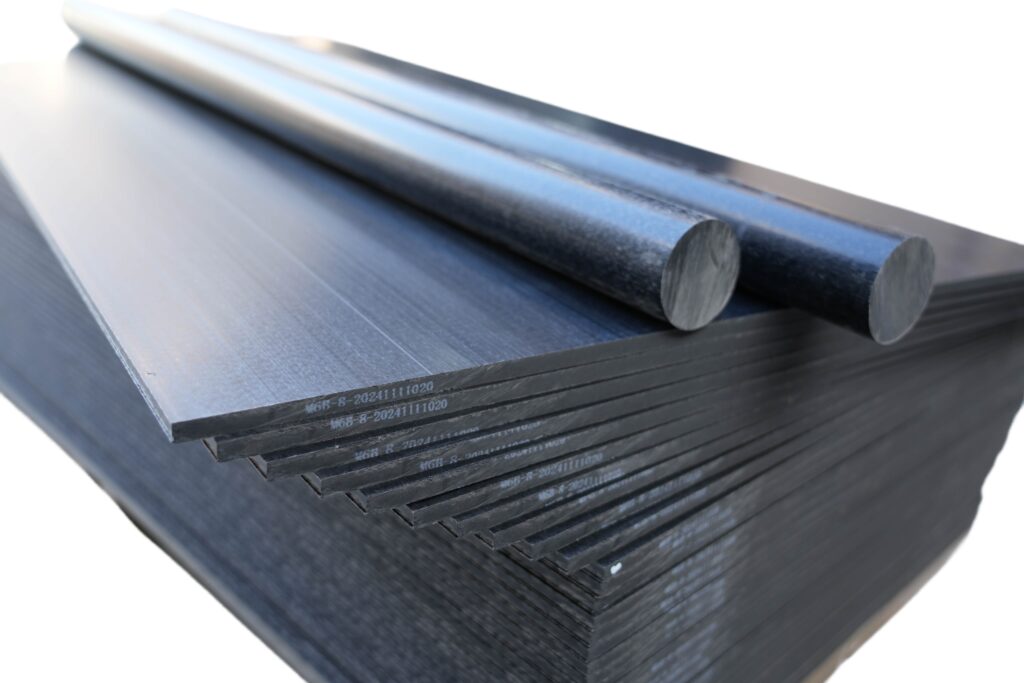
POM is the backbone of packaging line motion. Chain guides, sliding rails, star wheels, feed screws, cam followers, and indexer blocks are predominantly POM. This is because of its low friction coefficient (0.20 to 0.25 against steel) and excellent fatigue resistance under cyclic load. Furthermore, POM does not absorb water like nylon. Therefore, bearing clearances set during machining remain stable through washdown cycles.
POM-C (NAGOMER M6B) is the standard grade for most conveyor components. Moreover, it is the most cost-effective option for high-volume wear parts. POM-H (NAGOMER M12N) is specified when higher mechanical strength or crystallinity is needed. For example, thin-walled feed screws require thread integrity under torsional load. For electronics packaging lines handling ESD-sensitive components, ESD POM (NAGOMER NFP zero-powder) provides surface resistivity of 10^6 to 10^9 ohms. This prevents carbon particles from contaminating optical inspection stations.
Overall, POM‘s reliability in packaging line motion systems makes it the most widely specified engineering plastic in the packaging industry today.
PEEK in Heat Sealing and Cutting Stations
Heat-seal bars, knife holders, and film slitting components operate continuously at 150 to 220C. At these temperatures, PEEK (NAGOMER K12N/B, continuous use 260C) is the reliable choice. It maintains mechanical properties without creep or thermal expansion that would compromise seal precision. Furthermore, PEEK seal bar holders prevent heat transfer from the 200C seal bar to the machine frame. This protects proximity sensors and pneumatic cylinders from thermal drift.
In film slitting and pouch cutting, PEEK cutting blade holders maintain blade position accuracy over long production runs. The coefficient of linear thermal expansion of PEEK (47 x 10^-6 per K) is roughly one-third that of aluminum. Consequently, the cut position does not shift as the station heats up. Glass-filled PEEK (NAGOMER KG12B) is used for structural seal bar supports where higher stiffness prevents deflection under the 2 to 5 kN closing force of a typical sealing press.
Additionally, PEEK‘s chemical inertness allows it to survive washdown cycles without degradation. Therefore, PEEK is suitable for food and pharmaceutical packaging lines that require frequent cleaning.
PC and ABS in Safety Guards and Housings
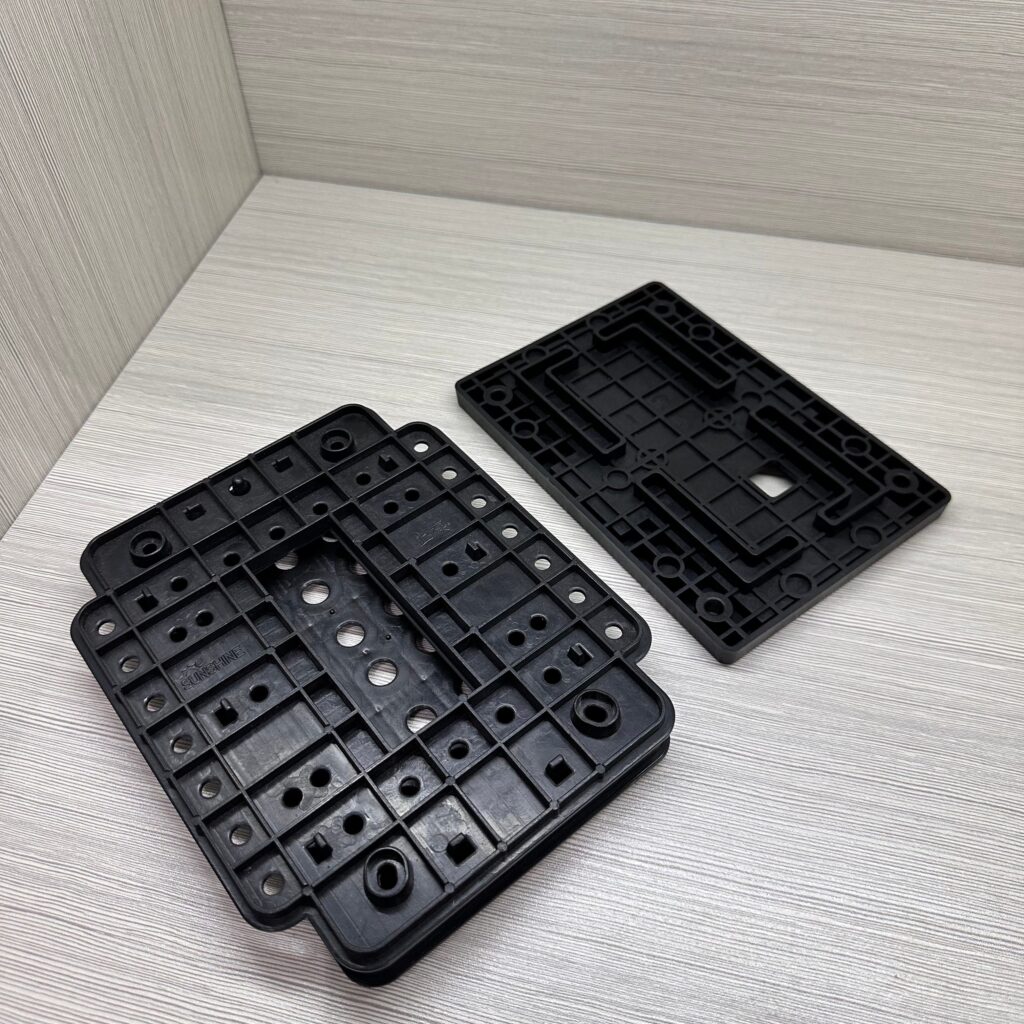
Transparent PC safety guards let operators visually monitor the filling, capping, and sealing process. At the same time, they meet the impact requirements of ISO 16090 and ANSI B11. A 3mm PC guard absorbs enough impact energy to contain a broken bottle or ejected cap without shattering. PC sight windows on filling stations resist chemical splashes from acidic beverages and alkaline cleaning agents. However, designers should verify compatibility with the specific CIP chemistry, as PC is susceptible to stress cracking in certain solvents.
ABS is the standard for control panel housings, sensor enclosures, and non-contact structural covers where cost matters more than transparency. Its paintability and UV-stabilized grades make it suitable for brand-colored machine enclosures. For pharmaceutical packaging lines, PC and ABS components can be specified to USP Class VI biocompatibility standards for equipment that contacts primary packaging materials.
Overall, the combination of PC transparency and ABS economy provides packaging machine builders with a complete solution for safety and housing requirements.
Wear, Changeover, and Total Cost of Ownership
Beyond per-station material selection, packaging line designers should consider three system-level factors. First, wear life: POM chain guides typically last 8,000 to 15,000 operating hours before replacement. By comparison, unlubricated steel guides last only 2,000 to 4,000 hours. The longer service interval reduces unplanned downtime, which at 600 units per minute costs roughly one finished product per second of stoppage.
Changeover efficiency: Modern packaging lines run multiple product formats. Quick-change tooling uses POM and PA6 components that are 40 to 60% lighter than metal equivalents. This reduces operator fatigue during format changes and eliminates the need for lifting equipment. Furthermore, color-coded material enables visual format verification that prevents costly mis-setups.
Noise reduction: POM and PA6 components reduce machine noise by 8 to 12 dB compared to metal-to-metal equivalents. Consequently, packaging hall noise levels drop below the 85 dB OSHA action level without additional soundproofing. This is not merely a comfort benefit. Rather, it is a compliance requirement that determines whether operators need hearing protection throughout the shift.
In summary, packaging machinery plastics deliver measurable improvements in uptime, changeover speed, and workplace safety. Therefore, they are essential to modern high-speed packaging operations.
NAGOMER supplies POM, PEEK, PC, ABS, and PA6 stock shapes for packaging machinery applications, with ESD and food-grade options. Contact info@nagomer.com for station-specific material recommendations and quick-change tooling design support.