
News Centre
News Type
Send your inquiry
Polycarbonate PC: Electrical, Optical, and Safety Guide
What Makes Polycarbonate PC Unique
Polycarbonate PC occupies a niche no other engineering thermoplastic can fill. It pairs optical transparency at 87 to 89% light transmittance with notched Izod impact values of 600 to 850 J/m. Add dielectric strength of 15 to 30 kV/mm. The result is a material that lets engineers see through it, protect what lies behind it, and maintain electrical isolation all at once.
The amorphous molecular structure delivers both clarity and dimensional stability. Mold shrinkage stays below 0.7%, and moisture absorption reaches only 0.15 to 0.20% at equilibrium. Machined parts hold tight tolerances and do not swell in humid environments the way nylon does. The trade-off is a glass transition temperature of 147C. This caps continuous use at roughly 115 to 120C for standard grades. Heat-resistant blends extend that to 130 to 140C.
Switchgear and Low-Voltage Electrical Equipment
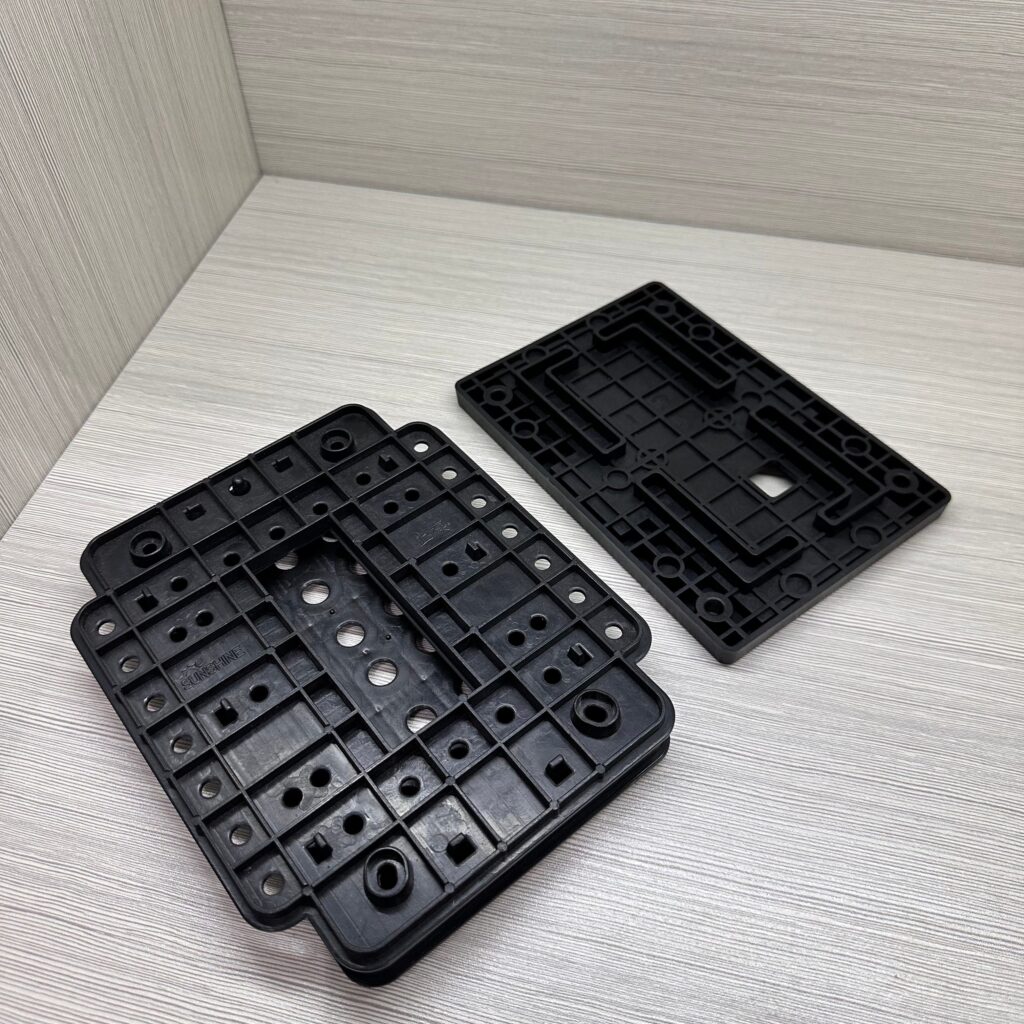
PC is widely specified in low-voltage electrical equipment. Typical applications include circuit breaker housings, contactor covers, terminal blocks, busbar supports, and switch enclosures. Its dielectric strength and arc resistance make it suitable for components rated to 600V. Certain glass-filled grades handle even higher ratings.
The comparative tracking index of standard polycarbonate PC sits around 250V, adequate for most indoor applications. Demanding environments with humidity or contamination call for flame-retardant grades with CTI values above 400V. NAGOMER’s flame-retardant grade (PCFR) achieves UL94 V-0 at 1.5mm thickness. This meets IEC 60669, IEC 60947, and UL 746C requirements. Glass-filled grades add flexural modulus up to 7,500 MPa. This lets structural housings carry both electrical and mechanical loads without warping. The material also machines cleanly, supporting in-house fabrication of custom enclosure shapes.
Safety Glazing and Optical Applications
In machine guarding and safety glazing, PC replaces tempered glass wherever impact resistance is critical. A 3mm sheet absorbs over 20 joules of impact energy without cracking. Acrylic of the same thickness shatters at roughly 4 joules. This is why PC is the standard material for CNC machine windows, injection mold safety doors, and laboratory fume hood panels.
Surface scratch sensitivity is the main weakness in optical use. Untreated material has a pencil hardness of only B to HB, meaning fingernails or coarse wiping can mark it. Hard-coated variants apply a polysiloxane layer that raises hardness to 3H to 6H. This coating maintains 85 to 88% light transmittance. UV-stabilized grades prevent yellowing over 5 to 10 year service periods in outdoor or fluorescent-lit environments. LED lighting lenses benefit from this combination, delivering both optical clarity and long-term durability under sustained illumination. Street lighting fixtures and automotive headlight covers also rely on hard-coated PC for its combination of impact resistance and optical performance. The material tolerates LED junction temperatures up to 120C without deformation, making it suitable for secondary lenses in high-output LED arrays.
EV Charging and New Energy Applications
The rapid expansion of EV charging infrastructure has opened a specific niche for PC and PC/ABS blends. Charging connector housings need UL94 V-0 flame retardancy and CTI above 400V. They also need a relative thermal index above 90C for outdoor exposure, plus high impact resistance to survive drops and vehicle contact.
PC/ABS blends combine PC heat resistance and impact strength with ABS melt flow for thin-wall injection molding. These blends produce connector housings that meet IEC 62196 and GB/T 20234 standards for AC and DC charging interfaces. Inside battery packs, PC is used for cell holders and separation plates. Its electrical insulation and dimensional stability prevent cell-to-cell shorting. PC insulator sheets in battery management system boards provide dielectric isolation between high-voltage busbars and low-voltage control electronics. The material’s inherent flame retardancy adds a safety margin in thermal runaway scenarios.
ESD Grades and Design Considerations
For electronics manufacturing and semiconductor handling, ESD polycarbonate PC (NAGOMER PCB) provides surface resistivity of 10^6 to 10^9 ohms per square. This protects sensitive components without the carbon shedding common in carbon-black-loaded materials. That makes it critical for cleanroom environments where particulate contamination would degrade semiconductor yields. Typical applications include wafer transport boxes, IC handling trays, test fixture plates, and static-safe workstation surfaces.
Designers should note that the material is susceptible to stress corrosion cracking. Aromatic hydrocarbons like toluene and xylene, along with ketones like acetone and MEK, can attack it. Cleaning protocols must verify solvent compatibility before exposure. For routine cleaning, mild detergent solutions and isopropyl alcohol are generally safe. NAGOMER supplies PC in natural clear, black, FR, glass-filled, and ESD grades. Sheets range from 3 to 100mm and rods from 6 to 200mm diameter. Custom colors and UV-stabilized formulations are available for outdoor applications. For applications that demand transparency, impact resistance, and electrical insulation at once, few alternatives come close.
NAGOMER supplies polycarbonate PC, flame-retardant PC, glass-filled PC, and ESD PC in sheets and rods for electrical, optical, and safety applications. Contact info@nagomer.com for UL compliance documentation and grade recommendations.