
News Centre
News Type
Send your inquiry
FDA Compliant Plastics for Food Processing: Material Selection Guide
The Challenge of Food Processing Environments
FDA compliant plastics face a wider range of conditions than most industrial materials. During production, they contact acidic juices, alkaline dairy products, oils, and hot-fill liquids. Between runs, equipment endures clean-in-place (CIP) chemicals and sometimes steam-in-place (SIP) sterilization. Therefore, a material that performs well in the food contact zone can still fail during cleaning. Material selection must account for the worst-case combination of chemistry, temperature, and regulatory requirement.
Moreover, the regulatory landscape adds another layer of complexity. Food contact materials in the US must comply with FDA 21 CFR regulations. In Europe, EU 10/2011 governs food contact plastics. In China, GB 9685 sets migration limits. Therefore, a single material may need multiple regulatory approvals to serve global food processing customers. In practice, most engineering plastic suppliers provide compliance documentation for all three regulatory frameworks.
FDA Compliant Plastics by Material Type
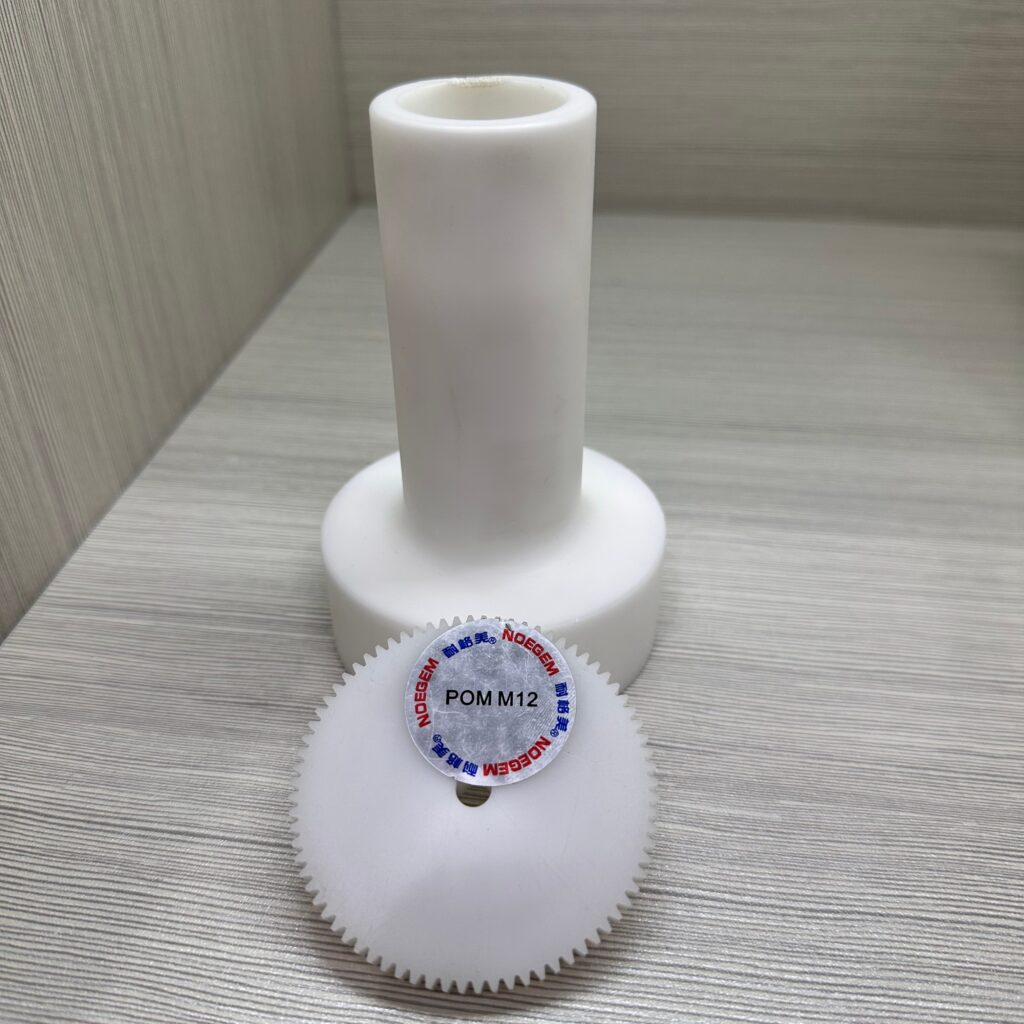
POM (acetal) is regulated under FDA 21 CFR 177.2480 for contact with all food types. Its low friction, fatigue resistance, and dimensional stability make it the default choice for conveyor star wheels, link belts, valve stems, and guide rails. NAGOMER POM-C grade M12N (natural) carries this compliance with supporting documentation.
PEEK, regulated under FDA 21 CFR 177.2410, handles continuous use at 260C and survives steam sterilization. Engineers specify it for hot-fill valve seats, aseptic processing components, and pump parts where POM would soften. Meanwhile, PPS carries FDA 21 CFR 177.2490 compliance and offers the broadest chemical resistance of any engineering thermoplastic. This makes PPS ideal for CIP pump housings and chemical dosing valves. PC provides optical clarity for sight glasses (FDA 21 CFR 177.1580). HDPE remains the standard for cutting boards and storage containers (FDA 21 CFR 177.1520).
Importantly, each material’s FDA compliance comes with conditions. Specifically, temperature limits, food type restrictions, and repeated-use constraints may apply. For example, POM is approved for all food types, but only at temperatures below its heat deflection limit. Similarly, PEEK‘s compliance assumes no contact with highly alcoholic beverages above certain concentrations. Therefore, designers must verify the specific conditions of use against the regulatory approval, not just the material name.
CIP and SIP: The Cleaning Cycle Decides Survival
A typical CIP cycle includes caustic soda wash at 1 to 2% and 70 to 80C. Next comes a nitric or phosphoric acid rinse, then peracetic acid sanitization, and finally hot water rinse. SIP adds saturated steam at 121C or higher. PPS and PEEK survive all of these protocols without measurable degradation. However, POM handles most CIP chemistry but should not exceed sustained temperatures above 105C. Above that threshold, thermal decomposition can release formaldehyde, which is a food contaminant and workplace hazard.
PC requires careful evaluation because certain caustic cleaning solutions cause stress corrosion cracking. Therefore, sight glasses and inspection windows should be checked against the specific cleaning protocol. Alternatively, they can be shielded from direct chemical exposure where possible.
Overall, the cleaning cycle is the most common cause of premature material failure in food processing equipment. Indeed, many components that perform flawlessly in production degrade rapidly during CIP cycles. For this reason, material selection should always start with the cleaning protocol, not the food product.
Zone-Based Material Selection
Rather than selecting one material for an entire machine, food equipment designers divide equipment into zones. In the food contact zone, POM is the baseline for components operating below 80C. PEEK is used for hot-fill, aseptic, and steam-sterilized parts. PPS is chosen for pump and valve components exposed to both product and aggressive cleaning chemicals.
In the cleaning zone, which contacts only CIP and SIP media, PPS dominates. Its chemical resistance eliminates compatibility concerns entirely. In the non-contact structural zone, glass-filled PA6, PC, or ABS are selected on mechanical need and cost. These zones do not require food contact compliance.
Furthermore, the non-contact zone often gets overlooked in material selection. However, it still requires washdown-compatible materials. For instance, a motor housing that rusts during washdown creates contamination risk even though it never touches food. Therefore, glass-filled PA6 or ABS with appropriate surface treatment is recommended for all machine surfaces exposed to cleaning.
Documentation and Audit Readiness
Food safety audits require traceable evidence that every food-contact material meets applicable regulations. The documentation package should include the FDA 21 CFR section, EU 10/2011 declaration, or GB 9685 compliance statement. In addition, the specific grade, lot number, and supplier compliance letter must accompany each shipment. NAGOMER provides all food-grade materials with the required documentation for HACCP, BRC, FSSC 22000, and FDA inspections.
Ultimately, investing in properly documented materials upfront saves significant cost during audits. In fact, a single failed audit can halt production for days. Moreover, insurance carriers increasingly require material compliance records as part of food safety coverage. NAGOMER‘s documentation package satisfies all major audit frameworks, reducing customer risk and streamlining the certification process.
NAGOMER supplies FDA-compliant POM, PEEK, PPS, PC, and HDPE stock shapes for food processing equipment, each with full compliance documentation. Contact info@nagomer.com for material certificates and zone-based material selection guidance.