News Centre
News Type
Send your inquiry
PA6 and PA66 Nylon: Bearing, Wear, and Structural Applications in Industrial Machinery
Why Nylon Dominates Industrial Bearings
PA6 and PA66 remain the default choice for unlubricated bearings, gears, and wear components across industrial machinery. Their low friction coefficient against steel (0.20 to 0.30), combined with high fatigue resistance and impact toughness, explains why they are still specified in applications where external lubrication is either impractical or contaminates the product.
The practical difference between PA6 and PA66 is modest but real. PA66 has a more regular molecular chain, giving it a higher melting point (260°C versus 220°C), slightly better mechanical properties, and lower moisture absorption. PA6 offers better impact resistance, easier processing, and lower cost. For most bearing and gear applications either grade works; PA66 is preferred where temperature or dimensional stability is more demanding.
Bearing Design: PV Limits and Wear Behavior
The pressure-velocity (PV) limit is the key design parameter for any plastic bearing. For unfilled PA6 and PA66 running dry against steel, the practical PV limit is approximately 0.1 MPa-m/s. With lubrication, this rises to about 0.5 MPa-m/s because frictional heat is removed from the contact zone. Applications above these limits require either PEEK or PPS, or a PTFE-filled nylon grade to reduce friction and extend the dry-running envelope.
Wear in nylon bearings follows a predictable pattern: an initial break-in period during which surface asperities wear and a transfer film forms on the steel counterface, followed by a steady-state wear regime. Under moderate PV conditions, PA66 wears at roughly 10 to 20 micrometers per 1,000 hours against polished steel. Designing with adequate wall thickness and conservative clearance gives bearings a multi-year service life.
Gears and Drive Components
Nylon gears run 8 to 12 dB quieter than equivalent steel-on-steel pairs and do not require lubrication. This makes them attractive in packaging machinery, textile equipment, and material handling systems where noise, weight, and corrosion resistance matter. The standard pairing is a nylon gear against a steel pinion: the steel provides a hard, heat-conducting counterface, while the nylon damps vibration and absorbs impact.
For higher loads or speeds, 30% glass-filled PA6 (NAGOMER AG12B) raises flexural modulus from approximately 2,500 MPa to 9,000 MPa, bringing gear tooth stiffness close to die-cast aluminum. The trade-off is increased wear on the mating pinion and some loss of noise advantage, so glass-filled nylon gears are normally paired with hardened steel pinions.
Structural Components and Creep
Glass-filled nylon grades transform PA6 into a structural material competitive with die-cast aluminum and zinc. With tensile strength of 170 to 180 MPa and flexural modulus around 9,000 MPa, 30% glass-filled PA6 is suitable for motor housings, brackets, clamps, and mounting plates where weight reduction or electrical isolation is required.
Creep is the limiting factor for sustained structural loads. At 23°C and 20 MPa, PA6 creeps approximately 1% over 1,000 hours; at 80°C the same stress produces roughly three times that strain. Design practice is to limit sustained stress to 25 to 30% of ultimate tensile strength, or to specify glass-filled grades whose creep resistance is significantly better than unfilled nylon.
Moisture Absorption and Temperature Limits
PA6 absorbs 2.5 to 3.0% water at equilibrium under standard ambient conditions; PA66 is slightly lower at 2.0 to 2.5%. Moisture plasticizes the matrix and increases toughness, but it also causes dimensional change. A 50 mm bore in dry PA6 can close in by up to 0.75 mm after conditioning to 50% relative humidity, so running clearances must be calculated using conditioned dimensions, not dry-as-molded values.
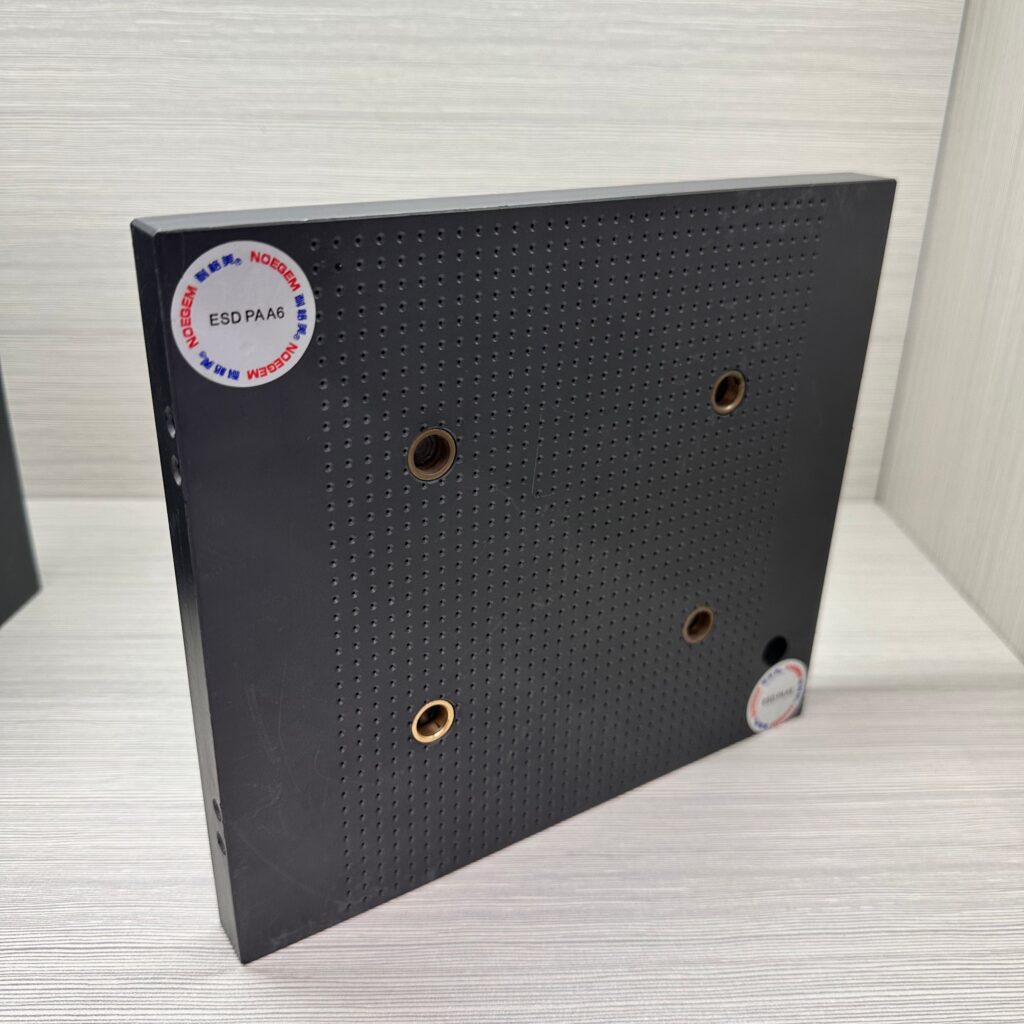
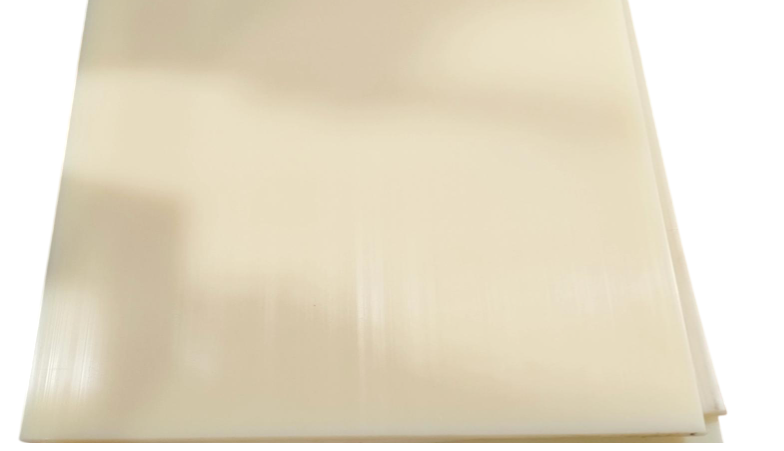
Temperature sets the upper application boundary. Nylon loses roughly half its room-temperature stiffness at 80°C and becomes structurally marginal above 100°C. Glass-filled grades extend useful properties to 120 to 150°C, but continuous operation above that requires PPS or PEEK. NAGOMER supplies PA6 (A12N/B), PA66 (A6612N), glass-filled PA6 (AG12B), ESD PA6 (A6B), and conductive PA6 (A2B) in sheets and rods from 5 to 100 mm.
NAGOMER supplies PA6, PA66, and glass-reinforced nylon grades for bearing, gear, and structural applications. Contact info@nagomer.com for conditioned property data and application-specific material recommendations.