
News Centre
News Type
Send your inquiry
ESD PEI for Semiconductor Test Sockets: Precision, Stability, and Static Control
The Hidden Challenge in Semiconductor Testing
Every semiconductor chip that reaches a customer has been tested — often hundreds or thousands of times — before it ships. At each test step, the device sits in a test socket that makes electrical contact between the chip and the test system. The socket must hold the device with micron-level precision, survive millions of insertion cycles, dissipate static charge, and maintain all of this across temperature fluctuations from ambient to 150°C or higher.
Test socket failure is one of the most expensive events in semiconductor manufacturing. A single socket can test devices worth millions of dollars over its lifetime. If the socket material degrades, warps, or generates particles, the result is false test failures, false test passes, or socket damage requiring production line downtime.
ESD PEI (polyetherimide) has become the material of choice for semiconductor test sockets, offering a combination of properties that precisely matches these demands.
Why ESD PEI for Test Sockets
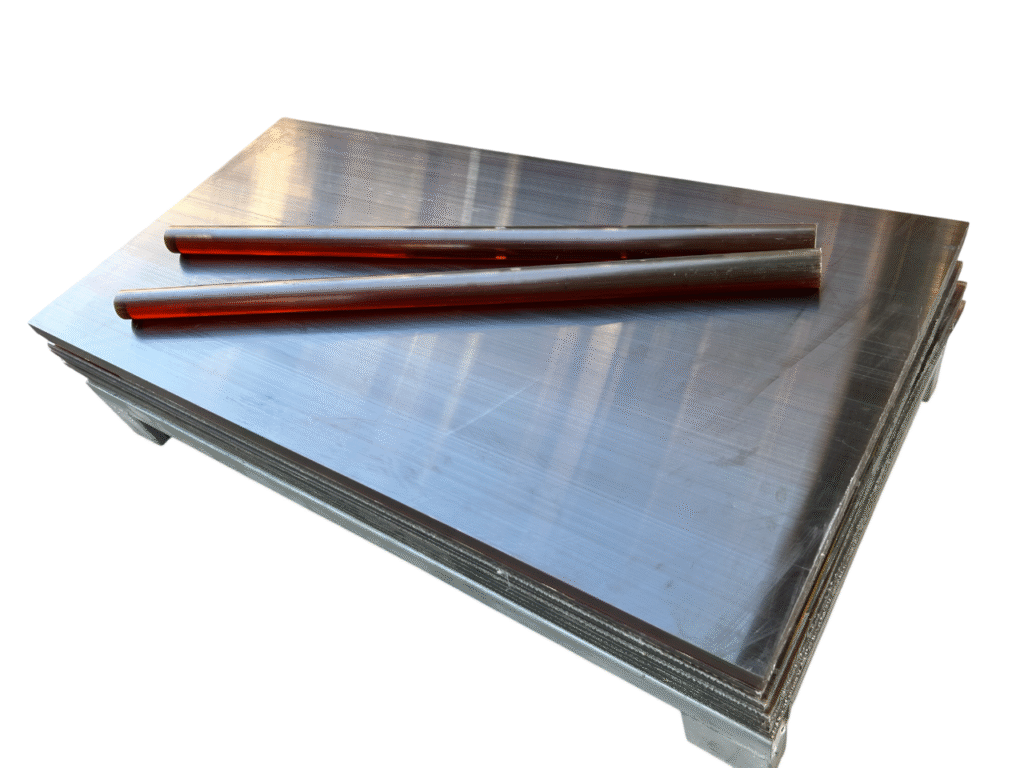
Dimensional stability: PEI‘s amorphous structure and low CTE (47-56 µm/m°C) provide exceptional dimensional stability across temperature cycles. Features machined to ±10 µm tolerances maintain dimensions through thousands of thermal cycles to 150°C.
High Tg: With a Tg of 217°C, PEI maintains mechanical properties well above burn-in test temperatures (125-150°C). The material does not soften, creep, or lose stiffness during extended high-temperature testing.
Controlled static dissipation: NAGOMER‘s ESD PEI (I6B grade) provides surface resistivity of 10⁶-10⁸ ohms/square, delivering consistent static dissipation that protects sensitive devices without rapid discharge risk.
Excellent machinability: PEI‘s amorphous structure makes it one of the most machinable high-performance plastics. Complex socket geometries with thin walls, tight tolerances, and fine features can be CNC machined with exceptional precision.
Semiconductor Test Socket Applications
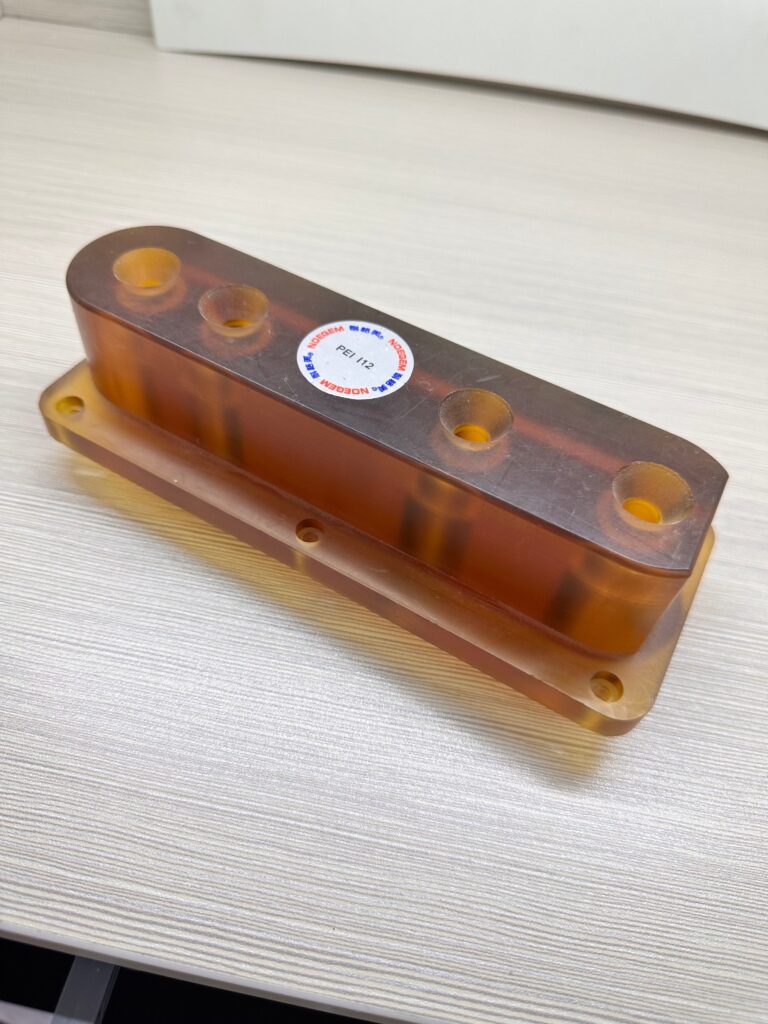
Final test sockets: The socket body that holds the packaged device during final electrical testing must maintain precise contact geometry, dissipate static, and survive millions of insertions. ESD PEI is ideal for socket bodies, contact supports, and alignment features.
Burn-in sockets: Burn-in testing subjects devices to elevated temperature (125-150°C) and voltage stress for extended periods. ESD PEI maintains mechanical properties and dimensional stability throughout, ensuring consistent contact force.
Handler components: Automated test handlers use ESD PEI for contactor covers, test interface boards, staging plates, and component guides requiring static dissipation and dimensional precision.
Load board insulators: PEI‘s availability in both standard (insulating) and ESD grades allows designers to use a single material family for multiple load board functions.
ESD PEI vs Alternative Materials
ESD PEI (NAGOMER I6B): Best overall balance for test sockets. Excellent dimensional stability, machinability, and high-temperature performance at moderate cost. Recommended for most test socket applications.
ESD PEEK (NAGOMER K6B): Superior mechanical properties and wear resistance for the most demanding high-cycle applications. Higher cost (2-3x PEI). Best choice where maximum durability is required.
ESD PPS (NAGOMER S6B): Best chemical resistance for sockets exposed to aggressive cleaning chemicals. Lower cost but more difficult to machine to tight tolerances.
ESD POM (NAGOMER M6B/NFP): Most economical option. Good machinability and wear resistance. Limited to 100°C continuous. Suitable for lower-temperature test applications.
Quality and Certification
Resistivity verification: Every production lot of NAGOMER ESD PEI is tested per ANSI/ESD S4.1 to verify surface resistivity compliance. Full documentation accompanies each shipment.
Dimensional certification: NAGOMER‘s extrusion process ensures sheet flatness and thickness consistency with ±0.2mm tolerance on standard sheets, supporting efficient CNC machining of socket components.
Material traceability: Full lot traceability from raw material through finished product, with certificate of analysis provided for each shipment. Semiconductor customers receive advance notification of any material changes.
NAGOMER‘s ESD PEI (I6B grade) is engineered for semiconductor test applications. Visit nagomer.com for technical datasheets, resistivity certification data, and sample requests.