
News Centre
News Type
Send your inquiry
PPS in Automotive Under-Hood Applications: Lightweight, Heat-Resistant Solutions for 2026
The Under-Hood Environment: Extreme Demands on Materials
The modern automotive under-hood environment presents some of the most demanding conditions for any material. Temperatures routinely exceed 150C near the engine block and turbocharger. Exposure to engine oil, transmission fluid, coolant, brake fluid, and road salt creates a chemically aggressive environment. Vibration and mechanical stress are constant.
For decades, metals were the default choice for under-hood components. However, the automotive industry’s relentless focus on weight reduction, cost optimization, and design flexibility has driven a steady transition toward high-performance engineering plastics.
PPS (polyphenylene sulfide) has emerged as one of the most important materials in this transition. Its exceptional combination of heat resistance, chemical inertness, dimensional stability, and inherent flame retardancy makes it uniquely suited for the most demanding under-hood applications.
Key PPS Properties for Automotive Applications
PPS offers a compelling set of properties for automotive engineers:
Heat Deflection Temperature: 260C at 1.82 MPa, making it suitable for continuous use at 200-220C. This exceeds the requirements for almost all under-hood applications except direct exhaust contact.
Chemical Resistance: PPS is virtually unaffected by all automotive fluids including engine oil, transmission fluid, brake fluid, power steering fluid, and coolants. It outperforms nylon and even many metals in chemical resistance.
Dimensional Stability: With a CTE as low as 2.0 x 10^-5/K (glass-reinforced grades), PPS maintains tight tolerances across the full operating temperature range.
Flame Retardancy: PPS is inherently flame retardant (UL94 V-0) without requiring additive flame retardants, an increasingly important consideration for EV applications.
Cooling System Components
PPS has become the material of choice for numerous cooling system components:
Water pump impellers: PPS replaced cast iron and stamped steel impellers, offering weight reduction of 60% and improved cavitation resistance. The material’s dimensional stability ensures consistent clearance between impeller and housing.
Thermostat housings: PPS maintains dimensional accuracy across freeze-thaw cycles and hot-cool transitions, preventing leaks that could lead to engine damage.
Coolant control valves: The precision moldability of PPS enables complex internal geometries that optimize coolant flow distribution, improving engine thermal management efficiency.
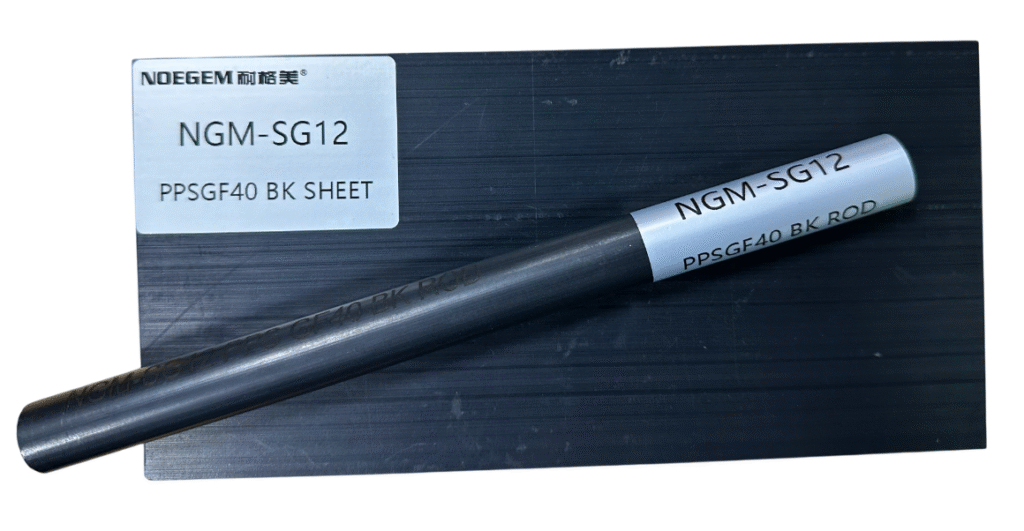
NAGOMER‘s PPS SG12B (30% glass fiber reinforced) grade is specifically formulated for these demanding fluid-handling applications.
Turbocharger and Air Management
The turbocharger environment pushes materials to their limits:
Turbocharger air ducts and resonators: Post-intercooler temperatures can reach 200C. PPS maintains its mechanical properties and dimensional stability at these temperatures, unlike nylon which can soften and deform.
EGR (Exhaust Gas Recirculation) components: The combination of high temperature, acidic condensate, and carbon particulate makes EGR one of the most chemically aggressive environments in a vehicle. PPS is one of the few polymers that can withstand these conditions.
Throttle body components: PPS provides the precision and stability needed for throttle position sensors and actuator mechanisms.
EV-Specific Applications
The transition to electric vehicles is creating new opportunities for PPS:
Battery pack cooling plates and manifolds: PPS provides chemical resistance to glycol-based coolants, electrical insulation, and flame retardancy in a single material.
High-voltage busbar insulators: 800V architectures require robust electrical insulation. PPS offers CTI values suitable for these high-voltage applications.
Motor and inverter housing components: The thermal conductivity of PPS can be enhanced with fillers for heat dissipation applications in power electronics.
NAGOMER supports automotive customers with IATF 16949-compatible material certification and application engineering support.
Discover NAGOMER‘s PPS portfolio for automotive applications. Visit nagomer.com for datasheets and samples.