
News Centre
News Type
Send your inquiry
ESD Plastics in EV Battery Manufacturing: Anti-Static Material Solutions for Cell Assembly
How ESD-safe engineering plastics protect EV battery manufacturing. Covers cell assembly, module production, ESD PEEK/POM/PA materials, and ANSI/ESD compliance for battery factories.
Introduction
EV battery manufacturing involves thousands of sensitive electronic components: BMS (battery management system) boards, cell voltage monitors, temperature sensors, and power electronics. ESD damage to any of these components can cause battery failure or safety hazards.
ESD Risks in EV Battery Manufacturing
ESD risks in battery manufacturing: (1) Cell voltage imbalance from damaged monitoring circuits; (2) BMS board failure from static discharge during assembly; (3) Reduced battery pack lifespan from micro-damage to power electronics; (4) Safety risks from failed cell balancing.
ESD PEEK: Wafer and Cell Handling Components
ESD PEEK is used for: (1) Wafer-handling-style cell carriers for pilot lines; (2) High-temperature resistant test fixtures for cell formation; (3) Insulating components in module assembly that require both ESD protection and 200°C+ service temperature.
ESD POM: Trays, Jigs, and Assembly Fixtures
ESD POM (including NAGOMER NFP non-powdering grade) is the workhorse material for: (1) Cell tray and transfer carriers; (2) Assembly jigs and fixtures; (3) Conveyor components in cell production lines; (4) Test fixtures for cell voltage verification.
ESD PA6: Module Housing and Structural Components
ESD PA6 (nylon 6) with 10^6-10^8 ohm surface resistance is used for: (1) Module housing components; (2) BMS enclosure parts; (3) Structural brackets in battery pack assembly. Glass-reinforced ESD PA6 offers excellent strength-to-weight ratio.
Building a Compliant ESD Protected Area for Battery Lines
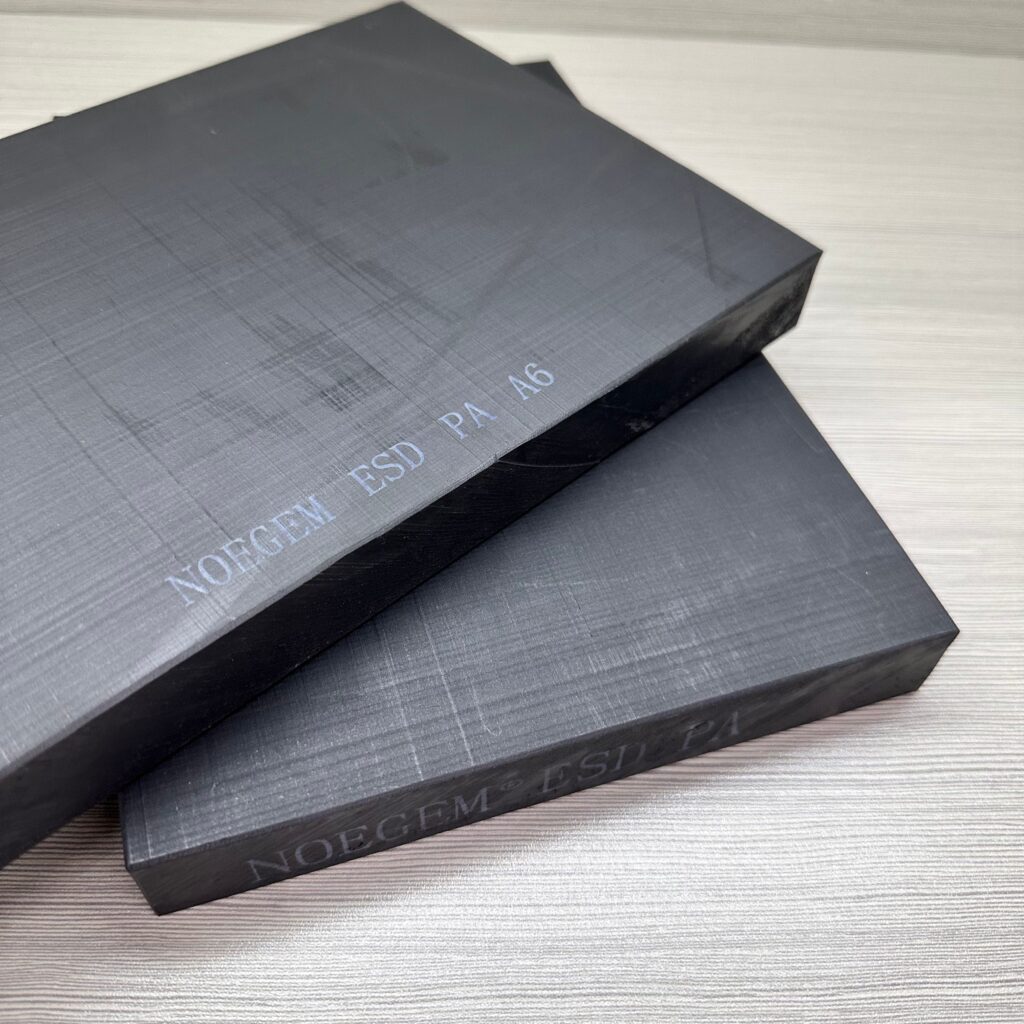
A compliant ESD Protected Area (EPA) for battery manufacturing requires: (1) ESD flooring (10^6-10^9 ohms); (2) ESD worksurfaces (NAGOMER ESD sheets as workbench tops); (3) Personnel grounding (wrist straps, ESD footwear); (4) ESD packaging for all sensitive subassemblies; (5) Periodic verification per ANSI/ESD S20.20.
Conclusion
As EV production scales to 18+ million units in 2026, battery manufacturing capacity is expanding globally. ESD material selection is a critical but often overlooked aspect of battery quality and safety. NAGOMER‘s full ESD product line helps battery manufacturers build reliable, compliant production lines.
Contact NAGOMER today for a free sample and technical datasheet.