
News Centre
News Type
Send your inquiry
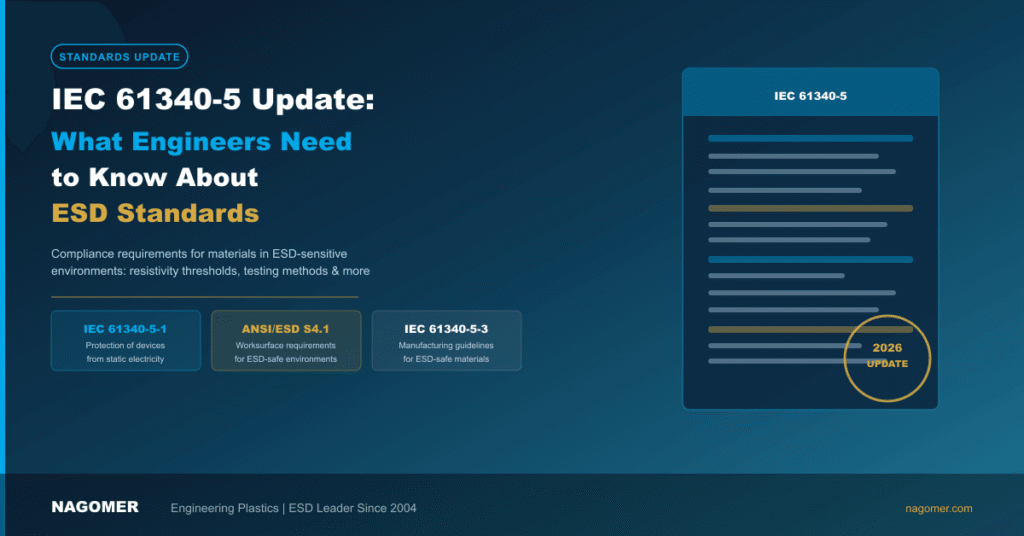
IEC 61340-5 Update: What Engineers Need to Know About ESD Standards
Electrostatic discharge (ESD) standards define the minimum material and process requirements for protecting electronic components from static damage. For engineers and procurement teams specifying plastics for ESD-sensitive manufacturing environments, understanding the current IEC 61340-5 standard — and its recent updates — is not optional. It is a compliance requirement.
This article breaks down the IEC 61340-5 standard family, the key material requirements it imposes, how to interpret material test reports, and what the 2026 update means for your specification process.
The IEC 61340-5 Standard Family: An Overview
IEC 61340-5 is the primary international standard governing ESD protection in electronic manufacturing. It is divided into multiple parts, each addressing a different aspect of ESD protection:
Standard | Title | Scope |
IEC 61340-5-1 | Protection of electronic devices from electrostatic phenomena | Requirements for ESD protected areas (EPAs) and ESDS handling |
IEC 61340-5-2 | User guide | Practical guidance for implementing IEC 61340-5-1 |
IEC 61340-5-3 | Properties of shielding bags for ESD sensitive items | Packaging requirements for ESD-sensitive components |
IEC 61340-4-1 | Worksurface resistance measurements | Test methodology for surfaces in EPAs |
IEC 61340-4-7 | Surface resistance measurement for non-planar items | Testing fixtures, trays, and complex geometries |
| Complementary US Standard ANSI/ESD S4.1-2006 (DIN ICE 60093) is the US equivalent governing worksurface resistance and ESD material classification. NAGOMER’s ESD products meet both IEC and ANSI/ESD testing requirements, with test documentation available on request. |
Key Material Requirements Under IEC 61340-5-1
The standard defines three material categories for ESD environments:
1. ESD-Safe (Dissipative) Materials
Surface resistivity range: 1×10⁶ Ω to 1×10⁹ Ω (some interpretations allow up to 1×10¹¹ Ω for less critical zones)
• These materials dissipate static charge slowly enough to prevent discharge events that could damage ESD-sensitive devices (ESDSs)
• The most common category for fab fixtures, trays, handling tools, and structural components
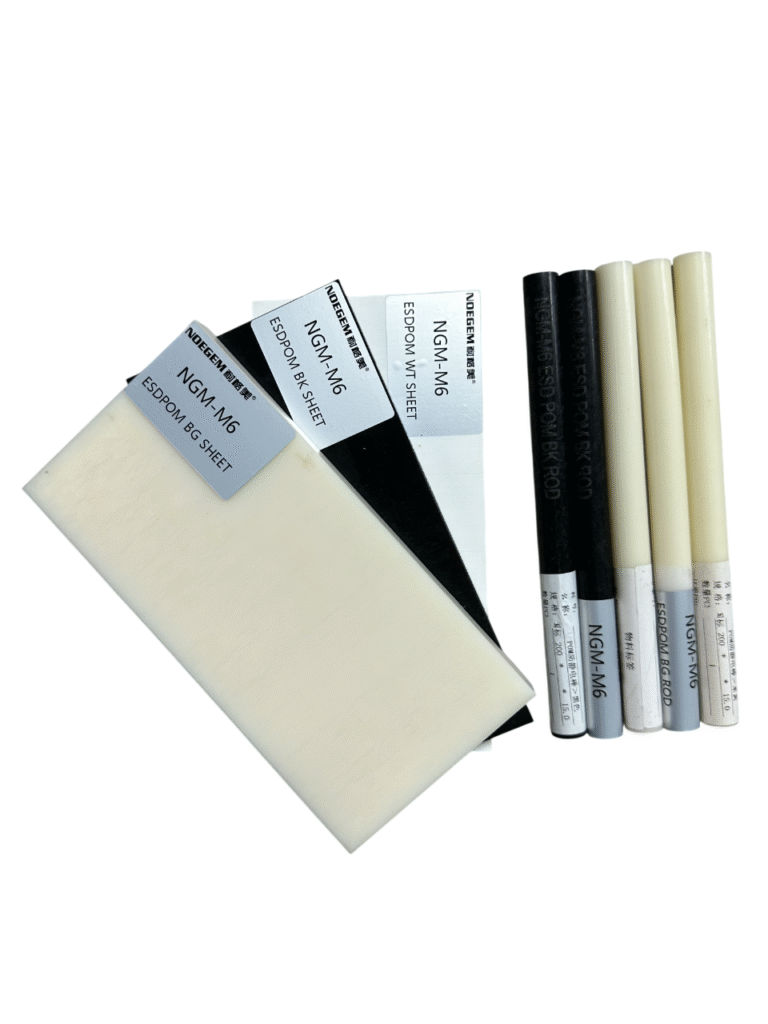
• NAGOMER ESD grades: K6B (ESD PEEK), I6B (ESD PEI), S6B (ESD PPS), M6B (ESD POM), A6B (ESD PA6), B6B (ESD ABS)
2. Conductive Materials
Surface resistivity range: <1×10⁵ Ω (typically 10² to 10⁵ Ω)
• Used for grounding paths, continuous charge bleed-off, and applications requiring immediate static neutralization
• NAGOMER CON grades: K2B (CON PEEK), M2B (CON POM), A2B (CON PA6)
• Note: Conductive materials should not contact ESDSs directly in most applications — they can cause ESD events themselves if improperly used
3. Insulative Materials (NOT Suitable for EPAs)
Surface resistivity: >1×10¹² Ω
• Standard (unfilled) plastics: ABS, PC, PP, PE, standard PEEK, standard PA — ALL are insulative and create static hazards
• Never use standard (non-ESD) plastics in direct contact with ESD-sensitive devices or in ESD-protected work areas
How to Read an ESD Material Test Report
When qualifying ESD plastics from any supplier, you should receive a material test report containing the following elements. Here’s what to look for:
• Test standard cited: Should reference IEC 61340-4-1, ANSI/ESD S4.1-2006, DIN IEC 60093, or equivalent
• Test voltage: Typically 10V or 100V. Note that results can vary significantly by voltage — ensure the voltage matches your specification
• Measurement points: At minimum 5 measurement points across the sample surface, reported individually and as an average
• Sample conditioning: Temperature and humidity must be stated (typically 23°C, 12% or 50% RH per IEC standard)
• Resistance values: Look for both point-to-point AND point-to-groundable point measurements for complete characterization
• Pass/fail determination: Results should be explicitly compared against the applicable standard thresholds
| Quality Checkpoint Be wary of ESD plastic suppliers who only provide a single resistance value without stating test conditions, test standard, sample size, or conditioning. A compliant test report is non-negotiable for semiconductor and electronics manufacturing qualification. |

2026 Update: What Has Changed?
The most recent update to the IEC 61340-5 standard family brings several clarifications and tightened requirements that materials suppliers and end-users should be aware of:
• Expanded guidance on automated manufacturing environments: The 2026 revision provides updated requirements for robotic material handling systems where contact resistance and charge dissipation time are critical parameters
• Clarification on temperature performance: ESD classification must now be verified at operating temperature for high-temperature applications (>85°C continuous) — not just at room temperature
• New test protocol for non-planar geometries: IEC 61340-4-7 revisions improve measurement reproducibility for complex shapes like rods, tubes, and machined fixtures
• Tighter humidity sensitivity requirements: Materials whose ESD performance degrades significantly at <30% RH must now be disclosed in product documentation
• Supply chain traceability provisions: Updated guidance on documenting material grade, lot number, and test certification chain for ESD plastic components used in critical applications
Practical Specification Checklist for ESD Plastics
When specifying ESD plastics for your application, ensure your supplier can confirm all of the following:
• Material classification: ESD (dissipative, 10⁶–10⁹ Ω) or CON (conductive, 10²–10⁵ Ω) — and which is appropriate for your application
• Test standard compliance: Certified per IEC 61340-4-1 and/or ANSI/ESD S4.1-2006
• Test conditions documented: Test voltage, temperature, RH, and sample conditioning
• Batch-level test reports: Not just a generic product spec sheet — actual test data from the production lot
• Temperature performance: If your application exceeds 60°C, confirm ESD performance is maintained at operating temperature
• Powder/particle release assessment: Critical for cleanroom and semiconductor applications — ask specifically whether the material is subject to particle shedding
• Manufacturer quality system: ISO 9001:2015 certification with documented quality control procedures
|
|
NAGOMER ESD Compliance All NAGOMER ESD and CON grade plastics are tested per ANSI/ESD S4.1-2006 (DIN IEC 60093). Full test documentation is available including lot-level resistivity reports, temperature performance data, and ISO 9001 quality certification. Our NFP ESD POM series additionally provides particle contamination test data. Request full compliance package at www.nagomer.com |
Conclusion
IEC 61340-5 is the foundation of ESD protection in electronics manufacturing, and the 2026 updates raise the bar for material characterization and supply chain traceability. For engineers and procurement teams, the standards provide a clear framework: qualify your ESD plastics rigorously, demand complete test documentation, and ensure your suppliers understand the difference between dissipative and conductive grades.
As semiconductor fabs and electronics manufacturers tighten their supplier qualification processes in 2026, the ability to provide IEC 61340-5-compliant documentation will increasingly be a differentiator between suppliers who can access top-tier customers and those who cannot.
Conclusion
IEC 61340-5 is the foundation of ESD protection in electronics manufacturing, and the 2026 updates raise the bar for material characterization and supply chain traceability. For engineers and procurement teams, the standards provide a clear framework: qualify your ESD plastics rigorously, demand complete test documentation, and ensure your suppliers understand the difference between dissipative and conductive grades.
As semiconductor fabs and electronics manufacturers tighten their supplier qualification processes in 2026, the ability to provide IEC 61340-5-compliant documentation will increasingly be a differentiator between suppliers who can access top-tier customers and those who cannot.